Retirement Age 67: The 1960 Cohort Reaches It in 2027


Retirement age 67 is the full Social Security retirement age for people born in 1960 or later, not the earliest age they can claim. Someone born in 1960 turns 66 in 2026 and generally reaches 67 in 2027. Claiming at 62 pays 70% of the worker's full retirement benefit, while waiting from 67 to 70 can raise that starting amount to 124%, according to the Social Security Administration's birth-year table and its delayed-credit schedule.
That age rule is newly relevant because Social Security announced a 3.6% cost-of-living adjustment for 2027 on October 14. The agency says the average retired worker's monthly benefit would rise by $75, from an estimated $2,095 before the adjustment to $2,170 afterward. Those are averages across existing recipients, not a promised check for a new claimant. The choice of claiming age changes the worker's own benefit calculation; the annual inflation adjustment is a different calculation.
Related reading: Two of Three CPI-W Months Are Locked. October 14 Sets Your 2027 COLA.
Put the numbers in a household budget. For an illustrative worker whose full monthly retirement benefit is $2,000, 70% means $1,400 a month at 62, and 124% means $2,480 at 70, before later changes to the underlying benefit or deductions. That is a $1,080 monthly spread in starting amounts, but the person claiming at 62 receives payments for eight more years before the 70-year-old starts. The comparison is about cash-flow timing and longevity, not a forecast of which age will produce the most lifetime income.
How the full retirement age reached 67
Social Security's full retirement age was 65 for many years. Congress raised it gradually under a law passed in 1983, according to the agency's retirement age explanation. The change did not move every worker to 67 at once. People born from 1943 through 1954 have a full retirement age of 66. For births in 1955 the age is 66 years and two months, with another two months added for each subsequent birth year through 1959. People born in 1960 or later have a full retirement age of 67.
Related reading: Social Security 2027 COLA Projected at 3.6%, the Biggest Since 2023.
The age is attached to a birth year, not to the year an agency issues a COLA. A worker born in July 1959, for instance, has a full retirement age of 66 years and 10 months and generally reaches it in 2026. A worker born in July 1960 reaches 67 in July 2027. The 1960 group turned 62 in 2022 and turns 66 during 2026. Saying the group reaches full retirement age in 2026 confuses turning 66 with turning 67. The SSA actuarial birth-year schedule makes the distinction plain; people born January 1 should check the previous birth year's rule.
Neither 67 nor 65 is a mandatory stop-work date. A person may retire from a job without filing for Social Security, and an eligible person can file for retirement benefits while still working. Age 62 is generally the earliest claiming age for a worker's own retirement benefit. Age 67 is the point at which the worker's age-based reduction disappears for the 1960-and-later cohort. Age 70 is the last age at which waiting earns delayed retirement credits. Medicare has a separate age-65 decision even when Social Security benefits are delayed.
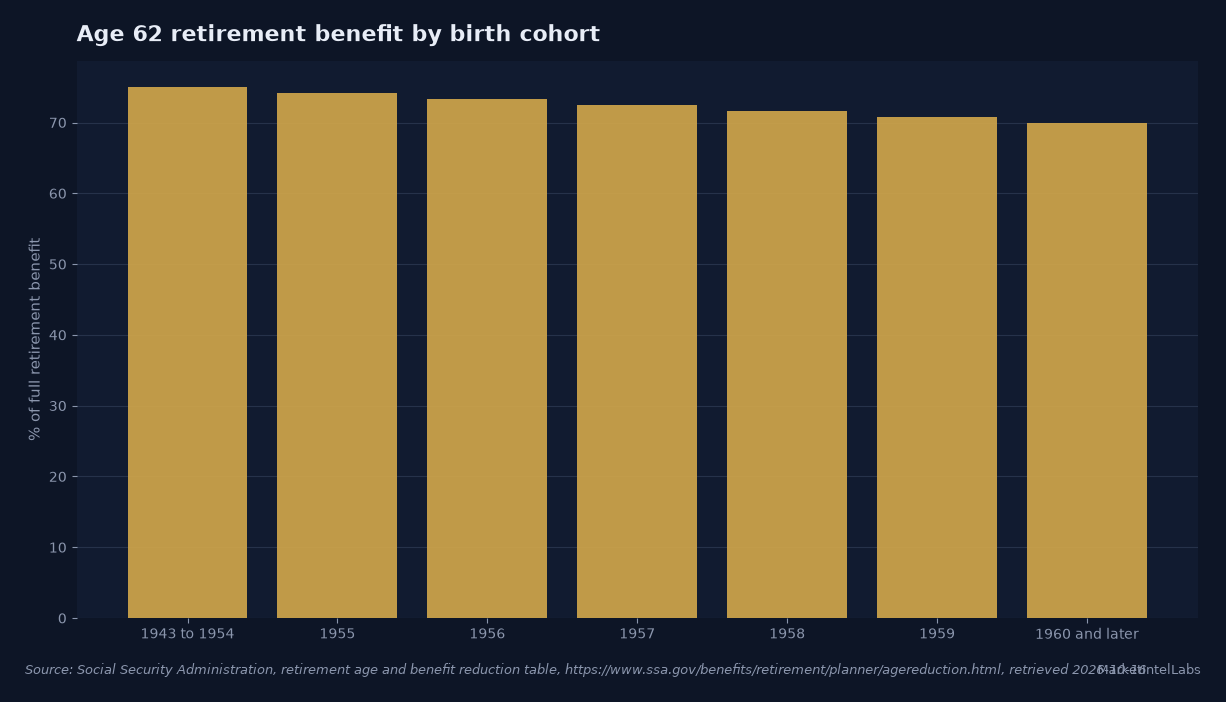
This is why the usual headline about the government having raised the retirement age is incomplete. The law changes the monthly price of an early claim rather than eliminating early claims. A worker born from 1943 through 1954 could claim at 62 for 75% of the full amount under the SSA reduction table. A worker born in 1960 or later can claim at 62 for 70%. That five-percentage-point difference reflects a longer interval between 62 and full retirement age, not a lower flat payment imposed on everyone.
The longer interval can also make timing differences inside one birth year matter. SSA's 1960-and-later monthly table shows a worker's share rising from 70% at exactly 62 to 75% at 63, 80% at 64, about 86.7% at 65 and about 93.3% at 66. At 67 it reaches 100%. A birthday or filing month can affect the estimate, so an annual age label alone is too crude for an individual decision.
What changes the monthly check
SSA first calculates a worker's primary insurance amount, or PIA, using a history of covered earnings. Its benefit calculation guide says the agency generally selects up to 35 years of indexed earnings to calculate average indexed monthly earnings and then applies the statutory formula. Claiming age modifies the resulting retirement benefit. A person with a different earnings record will not receive the illustrative $2,000 amount simply because a chart uses that figure.
For the worker born in 1960 or later, filing exactly five years before full retirement age means 60 months of early retirement. The published SSA schedule gives 70% of the full benefit at 62. At exactly 65, the table gives about 86.7%, and at 67 the age-based factor is 100%. Waiting three years beyond 67 accrues credits at 8% a year for people born in 1943 or later, giving a 124% age factor at 70 if all credits have applied. The SSA delayed-credit page says increases stop at 70 and notes that the timing of credit application can affect an initial check.
Consider the same $2,000 full-benefit illustration in monthly spending terms. At 62, $1,400 covers $600 less of rent, food and utilities than the $2,000 age-67 starting check. At 70, $2,480 is $480 above that full-benefit baseline. These are comparisons at a common hypothetical base, not quotes in 2026 dollars from actual recipients. Annual cost-of-living changes, additional work and benefit rounding can alter checks over the intervening years, so multiplying the age factors does not predict a person's eventual statement.
The tradeoff is not symmetrical. Early filing supplies checks during the years when a delayed filer gets none. Later filing provides a larger monthly amount when payments begin. Health, household income and an eligible spouse's circumstances can change the value of either path. SSA's retirement planning guidance says there is no best age for everyone and directs workers to personalized benefit estimates. A household comparing 62 with 70 needs to measure both the missing early checks and the larger later checks, rather than treating 124% as a return on an investment.
Spousal benefits have their own reduction schedule. SSA's 1960-and-later comparison shows an eligible spouse claiming at 62 receives 32.5% of the worker's full benefit, versus up to 50% at the spouse's full retirement age, subject to the applicable rules. That is not the same as applying the worker's 70% factor to a spouse's check. Survivor benefits are different again. The SSA actuarial guidance explicitly warns that its early and late retirement calculator should not be used for survivor benefits.
Continuing to work brings a second mechanism. The earnings test can temporarily withhold payments when a recipient is below full retirement age and earns more than the annual limit. The 2027 SSA fact sheet sets that limit at $25,560 for someone under full retirement age throughout the year, up from $24,480 in 2026. SSA withholds $1 in benefits for every $2 of work earnings above the applicable limit. For the year a person reaches full retirement age in 2027, the higher $67,920 limit applies only before that birthday month and withholding is $1 for each $3 over the limit. From the month full retirement age starts, the earnings limit ends.
Withholding is not the same as permanently losing the original age-adjusted benefit. SSA's working-while-claiming rules say it recalculates benefits at full retirement age to account for months in which benefits were withheld. New high-earning years can also replace lower years in the earnings record and increase a benefit. But someone planning monthly bills still needs to budget for the near-term withholding, even if a later recomputation helps. Earnings from a job and net self-employment count in this test; SSA says investment income and pensions do not.
The first year of retirement has a further wrinkle for someone who earned heavily before leaving work. SSA's special monthly earnings rule can pay a full check for a whole month the agency considers the person retired, despite annual earnings above the normal limit. In 2026 the monthly test for someone under full retirement age all year is $2,040, together with a substantial-services test for self-employment. That provision matters to a person retiring in July after earning a salary from January through June: treating the prior wages as proof that every later check is unavailable would misstate the agency's rule.
The age factors, earnings test and inflation adjustment often appear beside each other on a statement. They answer different questions. The first changes the size of the worker's retirement benefit based on when it begins; the second affects payments during work before full retirement age; the third updates applicable benefit amounts for inflation. Our earlier look at the 2027 COLA and CPI-W explains the inflation measure. The early-versus-late claim should be judged on the worker's own estimate, not on the national average that appears in a press release.
The age-62 percentages by cohort show the effect of the 1983 phase-in. The chart uses the agency's published table, with the old 1943-to-1954 cohort at 75% and the 1960-and-later cohort at 70%. These are shares of each worker's own full retirement benefit, not average checks or a chart of the 2027 COLA.
What the agency's documents actually say
The new 2027 COLA does not alter the statutory full retirement age. In its October 14 release, SSA says the 3.6% adjustment starts with Social Security benefits payable in January 2027. SSI recipients see increased payments beginning December 31, 2026. The press release estimates about 72 million Social Security beneficiaries and about 7.3 million SSI recipients affected, with overlap between groups. The agency frames the adjustment as a change in benefit dollars, not a new age threshold.
SSA's fact sheet says the increase comes from CPI-W growth between the third quarter of 2025 and the third quarter of 2026. An average retired-worker benefit of $2,095 before COLA and $2,170 after it is an estimated $75 gain. For a couple both receiving benefits the corresponding estimated average rises from $3,238 to $3,355, a $117 monthly increase. Neither figure says what an individual will collect after Medicare premiums or any other deductions.
The relevant price index and the age schedule have separate histories. SSA's COLA page records a 2.8% adjustment payable in January 2026 and the newly announced 3.6% for January 2027. Its benefits planner instead places full retirement age at 67 for births in 1960 and later, without tying that age to the CPI print. One can change each year while the other stays fixed. In a household already drawing checks, a COLA changes the dollar amount; in a household deciding when to claim, the birth-year rule shapes the starting percentage.
There is a genuine household counterpoint to the appeal of the bigger check at 70: waiting requires a source of spending money in the intervening years. A worker who left a job at 62 could face years of withdrawals or wages before any Social Security retirement payment begins. Claiming earlier cuts the monthly benefit but supplies income sooner. The SSA guide emphasizes both sides. It does not endorse one universal age, and neither does this analysis.
Medical coverage is another separate calendar. SSA's delayed-benefit guidance warns people who delay retirement benefits to consider enrolling in Medicare at 65. Missing a relevant enrollment period can lead to delayed coverage or higher costs in some circumstances. The government has not moved the standard Medicare milestone to 67 just because this cohort's Social Security full retirement age is 67. Checking those two dates separately is more useful than calling both of them retirement age.
The inflation announcement also lands against a wider consumer-price picture. Our September CPI household-cost analysis examines why gasoline can make the headline price index feel unlike a particular family's bills. Social Security's COLA is based specifically on CPI-W, not the national average retiree's spending mix. A 3.6% increase in the check is a nominal benefit adjustment, not evidence that every household's rent, medical costs and grocery basket increased by exactly 3.6%.
What to watch next
In late November 2026, beneficiaries with personal mySocial Security accounts should be able to view their individual COLA notices online, according to SSA's October release. The agency says recipients not enrolled for paperless notices will get their notice by mail in December. That notice, rather than a national average, gives the actual new gross benefit and any listed deductions. Increased SSI payments begin December 31, while the Social Security COLA appears in January 2027 payments.
For someone born in 1960, the next age event is the month of the 67th birthday in 2027, subject to SSA's birthday-on-the-first rules. From that month, the retirement earnings test no longer applies and an early claimant's benefit can be recalculated for previously withheld months. The full retirement age does not change because the October 2026 COLA was 3.6%; those two figures simply share the same news cycle.
A worker close to filing should compare the agency's personalized amounts for multiple claiming months, the expected wages before 67 and the dates for health coverage. A higher or lower future COLA will change nominal checks, and an extra high-earning work year may change the benefit base. Neither changes the birth-year full retirement age set out in the current SSA table. The practical test for a household is whether its bills can be covered before the chosen claim date and what monthly income it would need afterward.
Frequently Asked Questions
What is the full retirement age for someone born in 1960?
The Social Security full retirement age for someone born in 1960 is 67, generally reached in 2027. SSA's normal retirement age table gives 67 for births in 1960 or later. Its special rule for a January 1 birthday can assign the previous birth year's schedule, so check an individual birthday with the agency.
Can I claim Social Security at 62 if my retirement age is 67?
Yes. SSA allows an eligible worker born in 1960 or later to start retirement benefits as early as 62, but its claiming-age schedule shows an age-62 starting benefit equal to 70% of that worker's full retirement benefit. The percentage increases with later claiming months. Eligibility, earnings history and other benefit categories require individual review.
Does working after 62 reduce my Social Security benefit?
If you collect retirement benefits before full retirement age, work earnings above the applicable limit may cause SSA to withhold some current payments. For 2027 the earnings-test limit is $25,560 for a worker under full retirement age all year, with $1 withheld for every $2 above it. Starting the month you reach full retirement age, there is no earnings limit, and SSA can recalculate benefits for earlier withheld months.
Does the 2027 Social Security COLA change retirement age 67?
No. The 3.6% COLA announced October 14, 2026 adjusts benefits for 2027, while full retirement age follows the year-of-birth schedule in the Social Security retirement planner. The 1960 birth cohort generally reaches full retirement age in 2027 even though the COLA was announced in 2026.
Is waiting until age 70 always better than claiming at 67?
No one age is best for every household. For people born in 1960 or later, delaying from 67 to 70 can bring the starting retirement benefit to 124% of the full amount under the SSA credit schedule, but waiting means foregoing three years of payments. Health, wages, other income and family benefit rules can change the comparison. Use a personalized SSA estimate rather than the illustrative amounts in this article.
This content is for informational purposes only and does not constitute financial advice. Past performance is not indicative of future results. Consult a qualified financial advisor before making investment decisions.
Get daily intelligence delivered
Create a free account for the Daily Brief every weekday and The Week Ahead every Sunday. No card required.