September Payrolls Beat Strengthens "Higher for Longer" Case

The September jobs report delivered a beat that matters: nonfarm payrolls added 190,000 jobs against a 180,000 consensus, while the unemployment rate held at 3.8% against expectations for a rise to 3.9%. Wage growth matched the 0.3% monthly consensus, but the year-over-year rate accelerated to 4.2% from 4.1%, a detail that matters more than the headline.
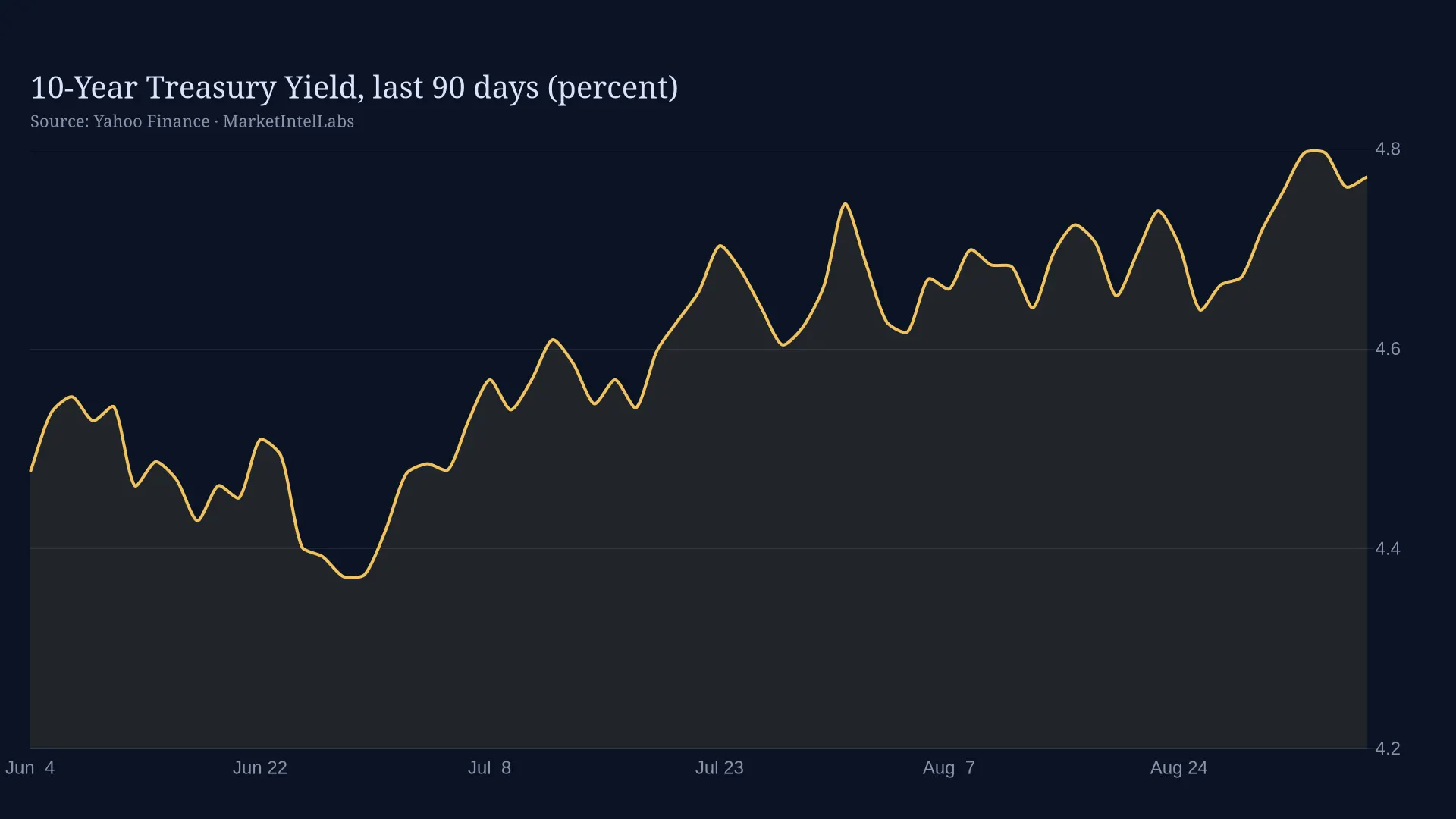
The data supports a Federal Reserve that stays in holding mode longer, and the market's muted reaction suggests investors are not yet pricing what that means. The S&P 500 slipped 0.4%, the 10-year Treasury yield climbed to 4.77%, and gold fell 0.9%. Those are modest moves for a report that could push the first rate cut deeper into 2027.
What the payrolls number tells us is that the labor market is not cooling as quickly as the Fed needs. The three-month average now sits around 177,000, below the 200,000 threshold that signals an overheating economy but still firm enough to sustain wage pressure. The Fed wants to see this trend continue, not collapse, but this report is closer to "resilient" than "softening."
The unemployment rate staying at 3.8% when economists expected it to tick up to 3.9% is the real story here. The unemployment rate has a self-reinforcing quality. When it rises, even by a few tenths of a percentage point, consumer confidence weakens, spending slows, and businesses become more cautious about hiring. That creates a feedback loop that accelerates cooling. The Fed monitors this carefully because they know that once unemployment starts rising, it is hard to stop without aggressive policy action. The fact that it did not rise this month means that feedback loop has not yet engaged.
The wage data requires attention. Average hourly earnings grew 0.3% month-over-month, exactly as expected, but the year-over-year rate accelerated to 4.2% from 4.1%. That is the wrong direction. The Fed would like to see wage growth drift closer to 3% over the next few quarters to allow inflation to settle back toward their 2% target without requiring a dramatic rise in unemployment. Wage growth at 4.2% is still above the level consistent with 2% inflation, and it is accelerating. That suggests labor market tightness is still feeding through to price pressures.
The labor force participation rate edged up to 62.7%, a positive sign for labor supply. More workers entering the labor force reduces wage pressure by increasing the pool of available talent. But the increase was modest, and the participation rate remains below pre-pandemic levels. The Fed will need to see sustained improvement here before they can be confident that wage pressures are easing.
The revisions matter too. July's payrolls were revised up by 10,000 to 175,000. Upward revisions to prior months suggest the underlying labor market trend is stronger than the headline numbers initially indicated. The Bureau of Labor Statistics revises its estimates as more complete data becomes available, and the pattern of upward revisions in 2026 tells you that the labor market has been more resilient than the initial reports suggested.
The market reaction reveals a disconnect. The 10-year Treasury yield climbed to 4.77%, up from 4.76% before the release, but that is a modest move for data that pushes rate-cut expectations further out. Fed funds futures markets had been pricing in roughly a 65% probability of a September rate cut before this report. That probability should decline on a beat like this, but the market's response suggests traders are not adjusting their expectations aggressively.
The equity market's reaction was similarly muted. The S&P 500 slipped 0.4%, while the Nasdaq-100 was essentially flat. The lack of a stronger sell-off suggests investors either do not believe the data will change Fed policy, or they are positioned for a stronger economy and are comfortable with higher rates. Either way, the market is underpricing the risk that the Fed stays in restrictive territory longer.
Gold's 0.9% decline reflects the math of higher real yields. When nominal yields rise and inflation expectations hold steady, real yields increase, which reduces the appeal of non-yielding assets like gold. The metal has been trading as a hedge against both inflation and geopolitical risk, but higher real yields pressure both those narratives. If the Fed maintains higher rates for longer, the opportunity cost of holding gold increases.
What this report confirms about the macro narrative is that the Fed's "higher for longer" stance has data to support it. The labor market is not weakening enough to force the Fed's hand, and wage growth is not easing enough to give them confidence that inflation is sustainably moving toward 2%. The Fed's September policy statement will likely reiterate their data-dependent approach, but the data they are seeing points to a longer hold than the market is currently pricing.
The risk now is that the Fed overtightens. If the labor market remains this resilient while the Fed keeps rates high for another six to nine months, the cumulative effect of restrictive policy could push the economy into a recession that did not need to happen. The Fed is trying to thread the needle between bringing inflation down and avoiding a hard landing, but this report suggests the needle is getting harder to thread.
What to watch next is the October jobs report. The September data could be noise, and the three-month trend is what matters for Fed policy. If October shows another beat around 190,000 or above, the market will have to adjust its rate-cut expectations by 25 bps or more. If October comes in below 150,000, the narrative shifts back toward cooling, and the Fed's path becomes clearer. The Fed meets on November 5-6, and the October jobs report will land on November 7, too late to influence that decision. The Fed is flying blind on labor market data for their next two meetings, which makes the September and October reports unusually important.
The other data point to watch is inflation. The September CPI report arrives on October 11, and that will be the last major inflation reading before the November Fed meeting. If wage growth is accelerating while inflation remains sticky, the Fed's decision becomes more complicated. They may need to communicate that they are prepared to keep rates high for longer, which could spook a market that is not pricing that scenario.
The takeaway from today's jobs report is that the labor market is not doing the Fed's work for them. The Fed wants to see softening that allows them to cut rates without worrying about reigniting inflation. This report shows softening, but not enough. The market is not yet pricing what that means, which creates an opportunity for investors who are paying attention to the data rather than the consensus.
This content is for informational purposes only and does not constitute financial advice. Past performance is not indicative of future results. Consult a qualified financial advisor before making investment decisions.
Get daily intelligence delivered
Create a free account for the Daily Brief every weekday and The Week Ahead every Sunday. No card required.