SAP Job Cuts: Bloomberg Reports 10,000 Roles in AI Restructure


Bloomberg reported on November 26 that SAP is weighing at least 10,000 job cuts as it reorganizes for artificial intelligence, citing people familiar with discussions that are still under way. Reuters separately reported on November 27, citing two people familiar with the matter, that SAP is preparing to cut a sizeable number of jobs. The 10,000 figure is Bloomberg's reported minimum, not a target SAP has announced. The investment question is whether a company already growing cloud revenue can turn internal AI efficiency into lower costs without weakening the engineers and sales teams responsible for that growth. For the first account of the reports, see our SAP job cuts news coverage.
Bloomberg said the possible cuts could affect at least 9% of the workforce and the final number could change after labor negotiations. Reuters reported that one source said the works council had not yet been informed of the plans. CNBC said SAP had not immediately responded to its request for comment; its account cites Bloomberg rather than a separate company announcement. None establishes that 10,000 employees have received notices.
Related reading: Microsoft Cloud Outage: Code Red Declared, Final Report Details Testing Gaps.
As of November 27, SAP's October 21 third-quarter statement and its publicly available investor presentation show a business pursuing AI efficiencies, but neither announces a new 10,000-position program. That gap is material. A contemplated restructuring can change in size, timing, mix of voluntary exits and reassignments, or fail to proceed as described. Bloomberg attributes the figure to unnamed people; Reuters independently describes a sizeable plan but does not independently specify 10,000 in its account.
For the broader AI-driven enterprise software frame, see our AI Markets coverage.
What SAP has disclosed and what remains reported
SAP's September 30 quarterly statement puts group headcount at 113,076 full-time equivalents, up from 110,730 one year earlier. Bloomberg's at least 10,000 estimate would amount to about 8.8% of that September base if every position translated into a net reduction, an assumption the company has not endorsed. A full-time equivalent is a staffing measure, not the count of people whose contracts might end. The reporting gives no final geographic allocation, timetable, severance cost or forecast net headcount.
Related reading: Dell Q3 earnings preview: $95 billion AI backlog faces the conversion test.
CNBC, citing Bloomberg, says product, engineering and sales are in focus as departments identify possible cuts. Reuters' November 27 report supplies a check on process: one of its sources said the works council had not yet been informed. A proposed list of roles and a finalized negotiation are different things. Without a SAP announcement, readers cannot tell whether the company would substitute retraining or redeployment for some separations.
SAP's January 2024 announcement said roughly 8,000 positions would be affected, with the majority expected to be addressed by voluntary leave programs and internal reskilling. SAP expected to end that year with headcount similar to its starting level after reinvesting in growth areas. That original announced scope is not the same as the roughly 10,000 number sometimes attached to later descriptions of the old program; the former is the verifiable initial company figure.
Related reading: AMD Q3 earnings: data center revenue nearly doubles to a record $8.5 billion.
SAP's 2025 Integrated Report social data show why the distinction matters. Year-end group full-time equivalents rose from 107,602 in 2023 to 109,121 in 2024 and 110,650 in 2025. The series does not reveal how many people left under the 2024 program, who joined afterward or whether roles changed. It does establish that the company did not finish those two subsequent years with a shrinking net employee base. Anyone projecting a future 10,000-person net decline from a reported plan is going beyond the evidence.
SAP's third-quarter 2026 employee table shows 113,076 full-time equivalents at September 30, rather than a reduction from 2025's year-end level. The dates differ: the first three observations in the chart are December snapshots, while the fourth is September. The rise between them should not be called an annual growth rate. It is useful for a narrower point: the workforce expanded in the public records available before the new reports.
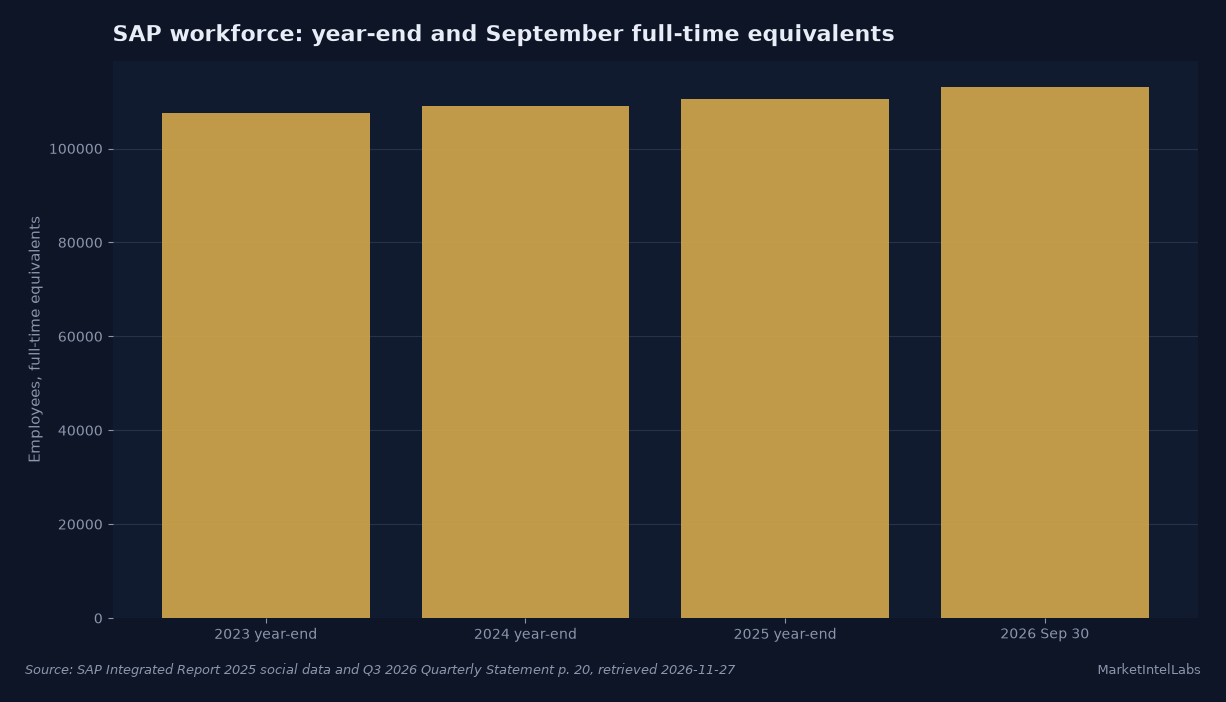
The chart cannot say who would be affected. Nor can the 2024 experience guarantee that a new plan would use voluntary departures. Labor negotiations and SAP's eventual disclosure will decide what can be counted.
The AI productivity claim has a financial test
SAP's October 21 third-quarter investor presentation says the company has more than 110,000 Joule Work Desktop users, more than 20% productivity gains across central functions and an efficiency run rate above €2 billion by the end of 2028. It also cites an approximately 70% increase in code pull requests merged per developer so far this year. These are company-reported operational measures, not independently established causal estimates of how many roles AI replaces. Code throughput is not identical to useful shipped software, and time saved in one function may be redeployed rather than removed from payroll.
Its July second-quarter investor presentation had already put the expected efficiency run rate above €2 billion by the end of 2028, while citing up to 30% developer productivity uplift with AI tools. The October document updated the examples, but the recurring 2028 efficiency goal was on the record before the November job-cut stories. Neither presentation provides a reconciliation from productivity percentages to a named number of positions. That missing bridge is where a reported restructuring would have to become a costed financial plan.
Dominik Asam's wording is less dramatic than the job-cut headlines. In SAP's October third-quarter results release, the CFO credited a disciplined approach to cost management alongside cloud momentum for the ability to grow revenue and profit together. That is a statement about operating discipline, not confirmation of Bloomberg's reported headcount target. Reports that he expects AI to slow headcount growth are context for the strategic direction; the company's own investor documents establish efficiency aims, but do not authorize treating the reported cuts as a board-approved decision.
One operational route is clear. If developers use AI assistance to resolve routine code work, SAP could try to deliver more features without adding staff in proportion to customer demand. If internal finance and human-resources work becomes faster, it could avoid replacing some departures. Conversely, a substantial net cut would require savings after severance, retraining, new AI spending and the cost of serving a growing cloud business. The presentations report goals and selected productivity measures, not that full reconciliation.
The second route is reallocation. SAP's January 2024 company announcement explicitly paired AI-driven efficiency with investment in Business AI and expected the year-end workforce to remain broadly similar. A new plan could again cut some roles and hire in different ones. That is why gross affected positions, actual departures and net group staffing need separate numbers. A savings target can coexist with more headcount if the company removes expensive legacy processes and expands its AI and cloud teams.
There is an important measurement trap in the €2 billion figure. SAP calls it an efficiency run rate by end-2028, not the amount of cash already saved in 2026 or the yearly payroll value of 10,000 jobs. Dividing one by the other would assign an invented salary and ignore spending on software, infrastructure and transition. Investors should ask for a reconciliation between gross savings, reinvestment and the effect on reported operating expenses rather than treating a management target as realized profit.
Cloud growth makes simple cost cutting risky
SAP's third-quarter 2026 statement reports cloud revenue of €6.67 billion, up 26% from €5.29 billion a year earlier at reported currency rates. Current cloud backlog reached €24.14 billion, 28% higher than the €18.84 billion comparison figure. Cloud ERP Suite revenue grew 29% to €5.92 billion. These are not the numbers of a vendor trying to cut its way out of a collapsing cloud business. The timing looks more like an attempt to improve how many employees it needs to support growth already in its order book.
But backlog is not earnings. SAP's quarterly statement defines its performance and cautions through the financial tables: cloud gross margin on a non-IFRS basis fell to 74.3% from 75.1% a year earlier even as cloud revenue rose. Non-IFRS operating profit grew 18% to €3.03 billion and non-IFRS operating margin improved to 29.5% from 28.3%. The juxtaposition is the market test. Can wider operating margin persist if the firm loses people who build, sell and implement the products generating its backlog?
SAP's same statement lists 38,735 research and development full-time equivalents, 27,524 in sales and marketing and 18,849 in services at September 30. The company also lists 14,964 in cloud and software, 7,471 in general and administration, and 5,533 in infrastructure. These are accounting categories with distinct work, not an official map of positions at risk. Bloomberg's reporting about product, engineering and sales makes revenue execution a live concern precisely because a cut in any one category might have a different effect on product delivery and new bookings.
Revenue mix matters as much as the raw headcount. SAP's third-quarter statement puts software licenses and support revenue at €2.58 billion, down 5% year over year, while cloud revenue advanced 26%. A smaller workforce in legacy support could reflect customers moving to the cloud; a smaller workforce in implementation could strain that migration. The same headcount reduction can be constructive in one business and costly in another. Without SAP's allocation of positions and expected savings, treating the report as an automatic margin gain is an unsupported shortcut.
The cost record offers another guardrail. SAP's October presentation estimated full-year 2026 restructuring charges of €0 to €20 million, a forecast set before the November report. It is not an estimate for an unannounced future program. The Q3 statement also says the quarter's profit comparison benefited from a prior-year negative workforce-transformation impact of around €0.1 billion. Those disclosures show why investors must separate underlying earnings improvement from timing of restructuring charges and comparison effects.
In 2024 SAP's January program carried a preliminary restructuring-expense projection of around €2 billion, mostly expected in the first half of that year. The company said benefits would be partly reinvested and cost savings in 2024 would be minor excluding restructuring expenses. That is a historical example of cash and earnings timing, not a pricing guide for a new program. The economics of a later plan would depend on location, contract, whether departures were voluntary and which roles SAP refilled.
What the reported plan says about the layoff cycle
The October 2026 Challenger, Gray & Christmas report puts announced US technology job cuts at 171,501 through October, up 21% from the comparable 2025 period, while total US employer announcements across sectors fell 44% to 617,189. The technology industry therefore looks weak against a softer aggregate layoff picture. But Challenger counts announcements by US-based employers, while SAP's group workforce is global and the November proposal remains unannounced. Adding Bloomberg's figure to that US total would be a category error.
Challenger's report also says October technology announcements were 5,576, the industry's lowest month of 2026. An accumulated annual rise and one quieter month can both be true. The figures say a great deal about where employers have cut in this cycle; they do not prove that AI caused each position to disappear. SAP's own disclosures identify AI efficiency as a management objective, while the link between that objective and a particular future net employment change still awaits a company plan.
For the AI productivity trade, the near-term bullish interpretation is a better operating-cost ratio as cloud revenue rises. SAP's third-quarter numbers give that interpretation a plausible starting point: cloud revenue grew 26% and non-IFRS operating margin widened by 1.2 percentage points. If a future restructuring trims duplicated functions and does not delay implementations, the margin gain could survive. The alternative is that cuts create a backlog of unfinished customer work or force expensive rehiring just when SAP needs to convert cloud backlog into billed revenue.
The latter risk matters for a business selling software to other large enterprises. A customer moving core finance or supply-chain systems needs implementation staff, support and credible product maintenance. Making engineers faster on code tasks does not necessarily remove work from integration, security review and customer migration. Even if the reported plan proceeds, a higher net margin would have to arrive without a weakening in backlog conversion or customer retention. SAP has not disclosed enough to decide that outcome now.
More broadly, the story forces a distinction between three investment narratives. AI may improve a vendor's own unit labor productivity. It may make the vendor's software more useful to customers. It may also change what customers are willing to pay for software seats. The October SAP presentation supports the first as a management claim and its strong cloud backlog supports current demand; neither proves the third. A market that prices only the staff cuts while overlooking revenue durability is pricing one side of the mechanism.
A useful check is the calendar of disclosures. SAP's October third-quarter materials are the latest dated financial documents used here, and the November reporting concerns plans still in discussion. A final company announcement, if one comes, should disclose the affected positions and how many are expected to become actual departures; a later quarterly filing can show expenses and staffing. The timetable, regional allocation and whether SAP will disclose net savings are not yet public. A report about the talks should not be turned into a schedule for layoffs.
The decisive signal would be a SAP release giving an approved scope and the expected mix of voluntary exits, redeployment and involuntary departures. Reuters' report that a works council had not yet been informed as of November 27 makes the labor process a separate variable. If consultation substantially changes the plan, Bloomberg's at least 10,000 estimate would cease to be a reliable guide to implementation. If SAP announces a net staffing decline, readers can compare it with the September 113,076 base rather than assume the Bloomberg figure was already reflected in company guidance.
Financially, watch future non-IFRS expense guidance alongside IFRS restructuring charges, not one in isolation. A later explanation that pairs gross efficiencies with reinvestment would be more informative than a headline cut count. A weakening in cloud growth or backlog conversion while employee totals fell would argue against the clean productivity story.
For now the strongest defensible conclusion is modest: SAP has put AI-driven efficiency into investor materials, while Bloomberg and Reuters report that a major workforce proposal is under discussion. The public accounts do not establish a final number, an agreed process or a realized earnings benefit. Keep those separate until the company puts an actual plan and cost reconciliation in the record.
Frequently Asked Questions
Is SAP cutting 10,000 jobs?
Bloomberg reported on November 26, citing people familiar with discussions, that SAP was weighing at least 10,000 position cuts. Reuters separately reported on November 27 that SAP was preparing a sizeable reduction, citing two people, but did not independently assign the 10,000 figure. SAP's public third-quarter documents do not announce that number as a finalized decision.
How many people work at SAP?
SAP's third-quarter 2026 statement reports 113,076 group full-time equivalent employees on September 30, compared with 110,730 on September 30, 2025. Its 2025 Integrated Report lists 110,650 full-time equivalents at year-end 2025. These are dated workforce snapshots, not an estimate of how many would leave under a proposal.
Why is SAP considering job cuts if cloud revenue is growing?
Bloomberg attributed the reported proposal to an AI restructuring. Separately, SAP's October investor presentation cites greater than 20% productivity gains across central functions and an end-2028 efficiency run-rate aim above €2 billion, while its third-quarter statement shows cloud revenue up 26%. A company may seek lower cost per unit of cloud growth, but SAP has not publicly connected those metrics to a 10,000-position decision.
Did SAP already lay off 10,000 people in 2024?
No such net workforce decline follows from SAP's original 2024 announcement. The company initially said about 8,000 positions would be affected, mostly through expected voluntary exits and reskilling, with reinvestment intended to leave year-end headcount similar to the starting level. Its 2025 Integrated Report records 109,121 full-time equivalents at year-end 2024, up from 107,602 at year-end 2023.
What should readers watch next in the SAP restructuring story?
Look for SAP's own announcement of a final headcount target, the labor consultation process, the number of actual exits, restructuring charges and savings net of reinvestment. Compare subsequent staffing disclosures with the September 2026 base and test cost savings against cloud revenue, backlog conversion and operating margin. Until then, the reported 10,000 is a scenario in negotiations, not an executed program.
This content is for informational purposes only and does not constitute financial advice. Past performance is not indicative of future results. Consult a qualified financial advisor before making investment decisions.
What we don't know yet
- SAP has not announced a final reduction target or timetable for a new program.
- The regional allocation, share of voluntary departures and net annual savings have not been disclosed.
Get daily intelligence delivered
Create a free account for the Daily Brief every weekday and The Week Ahead every Sunday. No card required.