AMD Q3 earnings: data center revenue nearly doubles to a record $8.5 billion

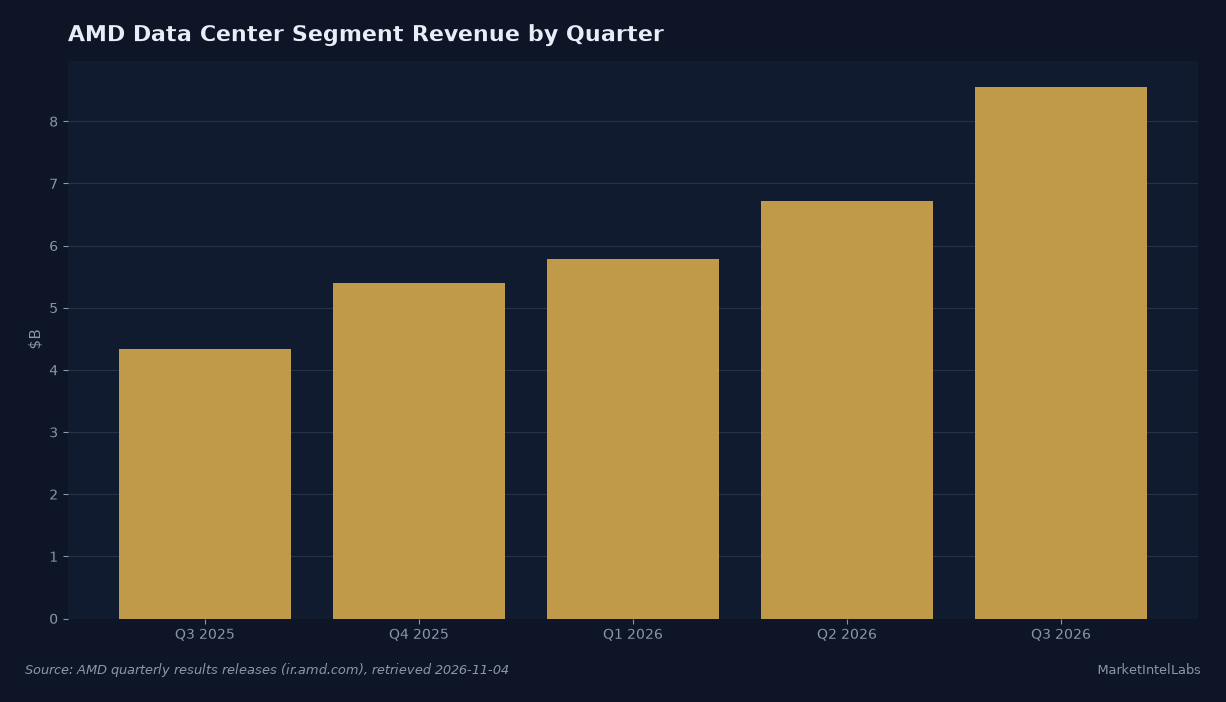
AMD reported third-quarter 2026 results on Tuesday evening, November 3, and the headline number for the AI trade is the record run in its data center business. The segment that sells the Instinct GPUs and EPYC server chips powering the hyperscaler buildout brought in $8.5 billion of revenue, up 97% from a year earlier. Total revenue rose 45% to $13.4 billion, also a record, and both revenue and earnings beat analyst expectations, sending shares up about 8% in extended trading, according to CNBC.
The numbers mark the third straight quarter in which AMD has accelerated as the AI cycle deepens. Data center now accounts for roughly 64% of company revenue, up from about 47% a year earlier, a shift that has remade the profit mix as high-margin server silicon displaces a shrinking gaming business. On a non-GAAP basis AMD earned $2.09 a share, up 74% year over year, on a gross margin of 56%.
Related reading: AMD Q3 earnings due Tuesday: data center is 58% of revenue.
The data center machine is doing the work
The growth is flowing almost entirely through data center. AMD guided investors to a quarter where Instinct accelerator sales and EPYC server volumes both expanded at record levels, and the print confirmed it. Management credited "record sales of AMD Instinct GPUs and AMD EPYC CPUs" for the 97% segment rise. The company's MI450 series accelerators and sixth-generation EPYC processors are now shipping into systems from Anthropic, Meta, Microsoft, OpenAI and Oracle Cloud Infrastructure, which AMD said are running models on its Helios rack-scale platform.
That breadth matters for the AI markets thesis. A single cloud customer dominating a chip vendor's numbers is a concentration risk; AMD is naming five hyperscale and AI-lab buyers across its recent product cycles. Oracle added sixth-generation EPYC to its compute instances in the quarter, a sign the CPU side of the AI buildout is feeding the accelerator growth rather than cannibalizing it.
Related reading: Supermicro Q1 earnings: record $19.9B on AI servers as margins compress.
Guidance points to re-acceleration
The forward read is where the report gets interesting. AMD guided fourth-quarter revenue to approximately $17 billion, plus or minus 3%. The midpoint implies about 66% year-over-year growth and 27% sequential growth, a clear step up from the 45% the company just printed. Non-GAAP gross margin is expected to hold near 55%.
Chief Executive Lisa Su framed it as acceleration rather than durability. In the release she said the company expects "growth to accelerate further in the fourth quarter" as it scales Helios and next-generation "Venice" production, citing strengthening demand for Instinct and EPYC products. The sequential guide is the cleanest signal that management sees the current order book as firm, not fading.
Related reading: Microsoft Q1 earnings: capex doubles to $39.4B as Azure grows 48%.
The other half of the story is shrinking. For balance, the client and gaming segments are in retreat. Combined revenue there was $3.7 billion, down 8% year over year. Gaming fell 40% to $773 million on lower semi-custom and graphics revenue, while the broader client business rose 7% to $2.9 billion on Ryzen laptop demand. Embedded revenue climbed 29% to $1.1 billion, helped by aerospace, defense, automotive and industrial customers.
The composition says something about AMD's new constant. The segments that used to cushion a data center dip are no longer big enough to materially move the total, which cuts both ways. In a strong AI cycle the leverage is enormous, as the operating income swing illustrates, but it also concentrates the entire earnings story on one engine and one demand cycle.
Related reading: WEC Energy capital plan jumps to $47.5 billion on Microsoft and Oracle data center demand.
Cash flow is the quiet risk. The other number worth watching is what the buildout is costing now in exchange for that growth. AMD's free cash flow fell to $554 million in the quarter from $1.53 billion a year earlier, and its free cash flow margin dropped to 4% from 17%, as capital spending on capacity and tooling accelerated. Depreciation and the cost of standing up new capacity are rising alongside revenue, a dynamic every AI-capex beneficiary shares.
That is the crux of the bull-bear debate. The bullish read is that AMD is buying durable share in an accelerant-driven cycle and the Q4 guide confirms demand is still rising. The bearish read is that the entire valuation now rests on a one-engine, cash-intensive ramp whose margin contribution arrives later than the capex bill. Both are supported by the same print.
What is dated next
The AI chip demand chain has two near-term reads. Taiwan's TSMC reports October monthly sales on November 10, a high-frequency check on foundry utilization that tends to move chip names. Then Nvidia, AMD's dominant rival and the biggest weight in the AI trade, announces fiscal third-quarter results on November 17, per its own calendar. If Nvidia's data center picture echoes AMD's 97% print, the segment narrative hardens; if it shows a different pace, investors will replay the concentration question they are already asking of AMD.
For now the data point AMD delivered is unambiguous on direction: record data center revenue, record total revenue, and guidance that points to a faster fourth quarter. The debate after this report is not whether the AI cycle is real, but how much of the reward is being spent today on the equipment to earn it. The next two scheduled prints will test whether that re-acceleration persists, and how much of the reward AMD ultimately keeps as the capex-heavy buildout matures.
This content is for informational purposes only and does not constitute financial advice. Past performance is not indicative of future results. Consult a qualified financial advisor before making investment decisions.
Get daily intelligence delivered
Create a free account for the Daily Brief every weekday and The Week Ahead every Sunday. No card required.