Real Average Hourly Earnings Fell 0.5% in September as Wages Lost to Inflation


Real average hourly earnings fell 0.5 percent from August to September, and the year-over-year decline widened to 0.7 percent, marking the third consecutive month of negative annual real wage growth. The Bureau of Labor Statistics reported Wednesday that real average hourly earnings for all private employees landed at $11.24 in constant 1982-1984 dollars, down from $11.30 in August and $11.32 a year earlier.
The arithmetic is straightforward and it is the story. Nominal average hourly earnings rose 0.1 percent on the month, to $37.81, and 3.0 percent over the year. The Consumer Price Index for All Urban Consumers climbed 0.6 percent in September and 3.7 percent over the year. When the deflator runs ahead of the wage, purchasing power shrinks. Against the BLS's inflation yardstick, the wage earner is losing ground.
Related reading: Real Wages Fall Behind 3.4% Inflation as August CPI Outpaces Pay Growth.
Real Earnings September 2026
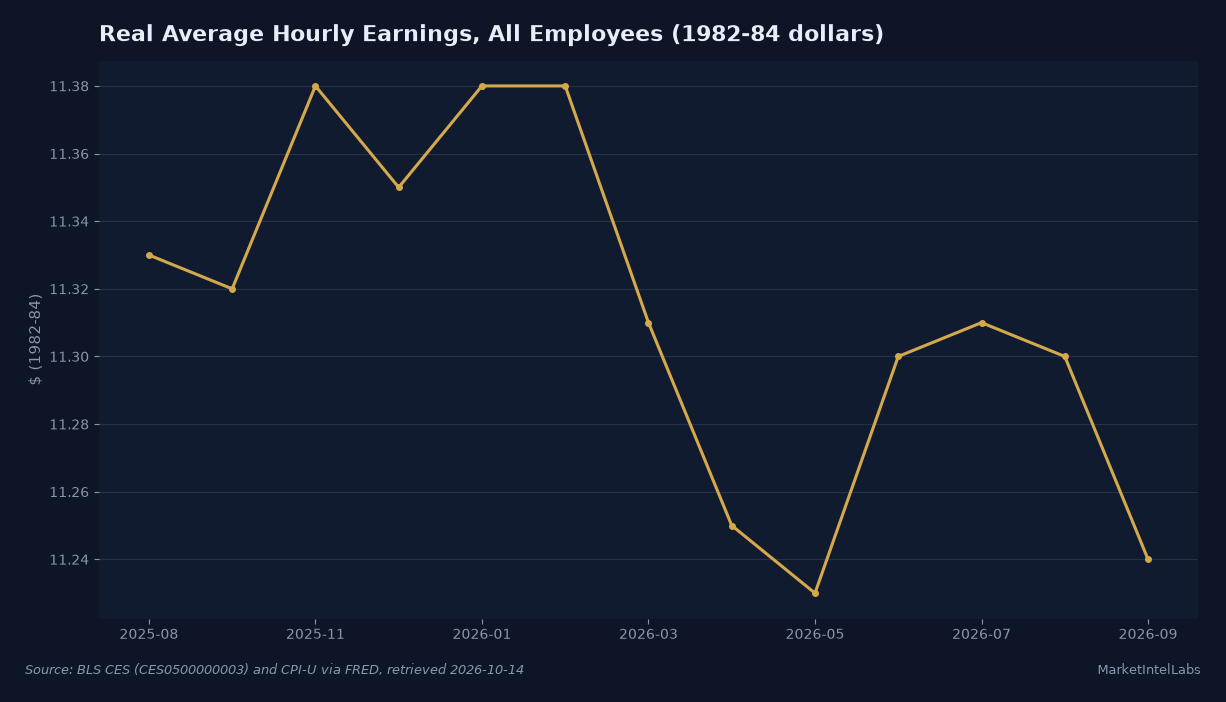
The trend line tells the same tale as the monthly print. Real hourly earnings peaked at $11.38 in February and drifted through a choppy spring, then lost their footing when CPI accelerated mid-summer. The year-ago comparison has been negative for three months running: minus 0.1 percent in July, minus 0.3 percent in August, and minus 0.7 percent in September. One soft month is noise. A three-month streak of negative annual real wage growth is a measurable squeeze on the take-home pay that funds consumer spending.
The move over the month was almost entirely a price story. Nominal hourly earnings added just 0.1 percent, roughly their pace of the past several months, while the CPI-U accelerated to 0.6 percent for the month, the fastest monthly gain of the year and up from 0.4 percent in August. Prices at the gas pump and in the services basket are doing the damage, not a pay shock. For production and nonsupervisory workers, the group that most directly reflects hourly floors, real hourly earnings fell 0.6 percent in September and 0.6 percent over the year, with the separate CPI-W index for urban wage earners rising 0.7 percent on the month.
For the broader framework, see our Fed policy coverage.
Related reading: Hourly Pay Is Slipping Below Inflation Again, and Friday's Jobs Report Tests the Wage Line.
The weekly numbers carry a partial offset. Real average weekly earnings fell 0.5 percent on the month, to $386.76, but over the year they were down only 0.1 percent, because the average workweek lengthened 0.6 percent. Americans are working slightly more to defend their weekly earnings against inflation, a tradeoff that shows up as flat real weekly pay instead of a deeper cut. Average weekly hours held at 34.4 in September.
The three-month average of real hourly earnings measures the same erosion from a different angle. Averaged over July, August and September, real hourly pay is running below the year-ago average, which is the signal the BLS itself prints in its tables and the one labor economists watch for a lasting change in the wage picture. September's step down simply confirmed the direction the third quarter was already heading.
Related reading: September Jobs Report Lands Friday With Real Wages Already Shrinking.
What it means for the Fed
This release lands at an awkward moment for the policy outlook. The same CPI that eroded real pay is the one the Federal Reserve reads when it weighs the October meeting, and the September print re-armed the case for restraint. The labor side of the ledger has already cooled, with the employment report showing modest payroll gains and a downward revision to prior months. A worker who sees their real paycheck shrink while the Fed keeps its foot on the brakes is the uncomfortable intersection of soft hiring and sticky inflation.
The wage-inflation mix matters more than either number alone. Nominal earnings growth of 3.0 percent is not excessive on its own; it is roughly consistent with a 2 percent inflation target and trend productivity. The problem is that inflation is running at 3.7 percent, above that pace. Until the two converge, real earnings stay negative and the squeeze on households persists, which in turn is one reason the Fed's policy stance is doing some of the work on demand.
Related reading: 197,000 Claims Meet a 51K Payroll Pace.
What is dated next
The BLS publishes the Real Earnings release for October on Tuesday, November 10, 2026, at 8:30 a.m. ET. Before that, the weekly initial and continuing claims data arrive Thursday, and the October employment situation follows on the first Friday of November. Those prints will show whether the real wage squeeze is broadening into softer hiring, or whether employers keep paying people enough in nominal terms to give real earnings room to recover once inflation cools. For now, the lede is the arithmetic: pay is still rising, but not fast enough to stay ahead of prices.
This content is for informational purposes only and does not constitute financial advice. Past performance is not indicative of future results.
Get daily intelligence delivered
Create a free account for the Daily Brief every weekday and The Week Ahead every Sunday. No card required.