Oil Rebounds Past $94 After Trump Rejects Hormuz Offer

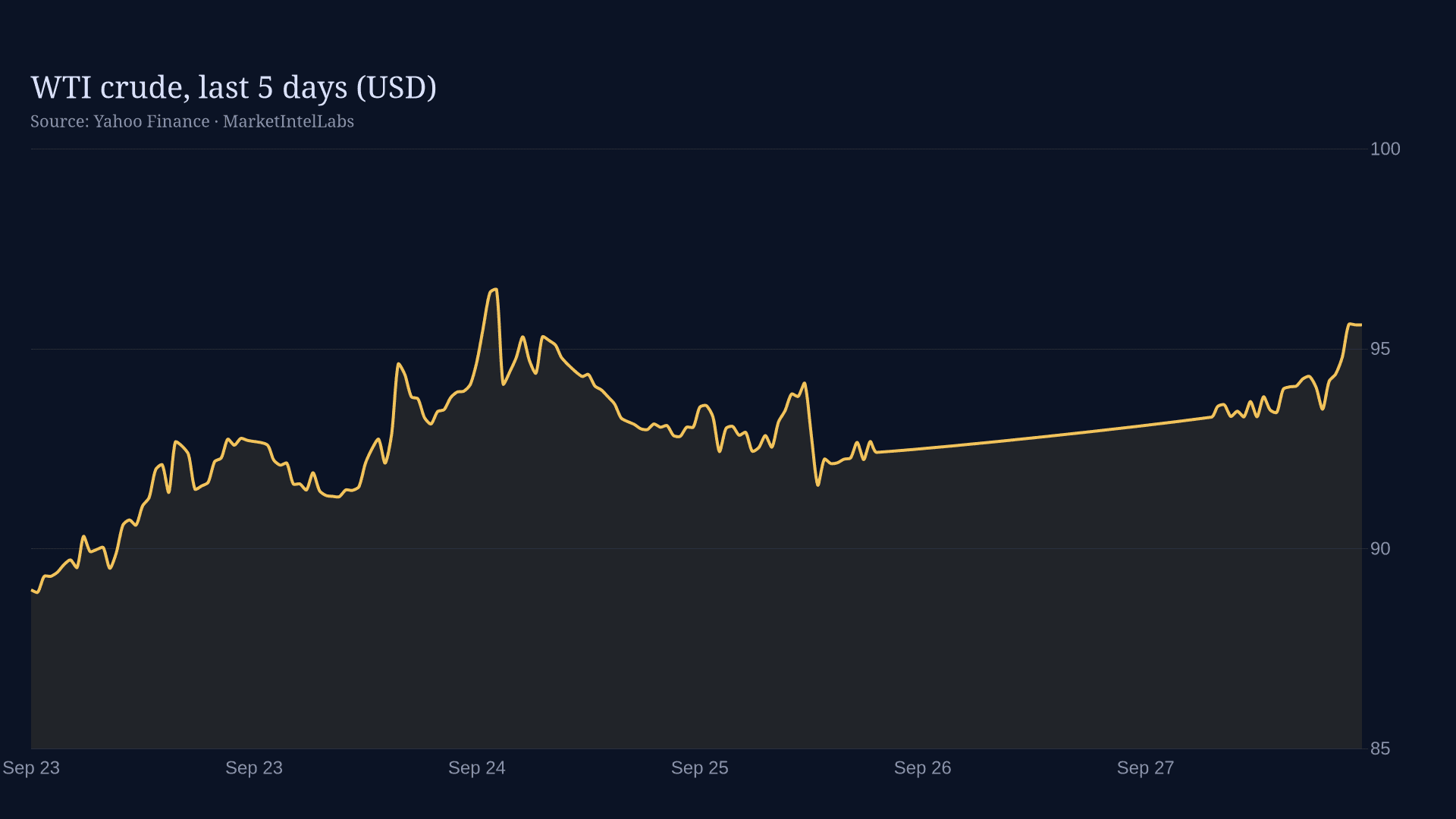
Crude shook off Friday's slide and turned back up as the White House rejected Iran's proposal to reopen the Strait of Hormuz. November WTI traded at $94.10, up 1.69%, and Brent cleared $106.96, up 2.65%, on the session, per CNBC, with the market pricing a return to strikes on Iranian oil infrastructure after the November midterms rather than an early deal that would free the roughly 262 vessels holding at the chokepoint.
The rejection removes the relief valve the market had been pricing since Iran floated a short reopening window. Friday's numbers told the story of a trade reaching for a diplomatic exit; Monday's session opens into the one where Hormuz stays effectively closed, with roughly one transit a day against an 85-per-day baseline and about 262 vessels holding at the water, per IMF PortWatch data tracked through the Straits Daily Brief. Support for WTI sits near $93 and resistance at the $95 round number, while Brent holds support around $105 with resistance near $110 and its 52-week high at $126.10.
The crude bid is only half the supply story, and it may not be the half that moves diesel. Ukraine's Defense Forces struck the Ilsky refinery in Krasnodar Krai on the night of Sept 26, according to claims carried by RBC-Ukraine, with drone maker Fire Point saying FP-1 drones hit three primary refining units and a storage tank farm and forced the facility to halt. Russian EMERCOM published photos of firefighting at the plant in response, though no refinery-specific official acknowledgment beyond the fire response was located. Reuters lists Ilsky with nameplate capacity above 6 million tonnes a year, and RBC-Ukraine puts the halt at roughly 100 to 132 kb/d of capacity offline, per the tracked dated range.
That range is why the confirmed offline tally keeps climbing. The strike tracker now records 18 confirmed strikes across 15 distinct targets, with cumulative confirmed capacity of 2,277 to 4,617 kb/d taken out of the system, per the standing tracker updated Sept 28. Treat the capacity number as a range, not a point estimate, because refinement runs and repair timelines move independently of a plant being down. What matters for the price is that every incremental confirmed outage bites a product market already running tight, not a crude market still digesting the loss of a fraction of Russian seaborne diesel and gasoil loadings, which ran near 150 kb/d, down roughly 81% versus the five-year average per Vortexa.
| Date | Target | Type | Ukraine says | Russia says | Confirmed by | Est. capacity effect |
|---|---|---|---|---|---|---|
| 2026-09-26 | Ilsky oil refinery (Krasnodar Krai) | refinery | Ukraine's Defense Forces struck the Ilsky refinery on the night of 26 Sep: Fire Point said FP-1 drones hit three primary refining units and a storage tank farm, forcing the facility to halt; General Staff confirmed and noted the plant also meets Russian military needs. (Fire Point statement; General Staff of Ukraine (via RBC-Ukraine, UNN)) | Russian EMERCOM (mchs.official) published photos of firefighting at the refinery after the strike; no named refinery-specific official acknowledgment beyond fire response was located. (mchs.official (Russian EMERCOM) photos via RBC-Ukraine) | Reuters capacity listing + General Staff confirmation of damage | 100 to 132 kb/d (RBC-Ukraine ~6.6 Mt/yr (~132 kb/d nameplate); 3 of 6 primary units hit, production halted, 2026-09-26) |
| 2026-09-22 | Rosneft Kuibyshev Oil Refinery, Samara Oblast | refinery | Ukraine's General Staff said Defense Forces struck the Kuibyshev refinery in Samara on the night of 21-22 September; Ukrainian drone maker Fire Point said FP-1 drones hit the AVT-4 and AVT-5 primary crude-distillation units, starting a large fire. (General Staff of Ukraine / Fire Point (via RBC-Ukraine, Euromaidan Press)) | Samara Oblast Governor Vyacheslav Fedorishchev confirmed a large drone attack on the region on 22 Sep, saying drones 'targeted industrial enterprises' and that one person was killed and four injured from falling debris; he did not name the Kuibyshev refinery. (Vyacheslav Fedorishchev (via Euromaidan Press, United24)) | Euromaidan Press + Russian outlet ASTRA confirmed fire on refinery grounds | 130 to 150 kb/d (Euromaidan Press (7 Mt/yr nameplate, each AVT unit ~73 kb/d), 2026-09-22) |
| 2026-09-20 | Gazprom Neft Moscow Oil Refinery, Kapotnya (Moscow) | refinery | President Zelensky said Kyiv hit "one of Russia's key oil industry facilities and the aggressor's logistics facility"; Ukrainian sources cited primary (AVT-6-type) and isomerization units hit and a large fire. (Zelensky / Ukrainian reports (via Srpske Novine, Energy News Beat)) | Moscow Mayor Sobyanin confirmed damage in the capital's orbit and a large drone wave (450 drones toward the capital per Sobyanin; Russia claimed it downed 660 craft); Moscow Region Gov. Vorobyov confirmed two dead in the region; Gazprom Neft did not comment. (Sergei Sobyanin / Andrei Vorobyov (via BBC/Srpske, Energy News Beat)) | Srpske Novine / BBC report + Reuters June confirmation of plant outage | 220 to 245 kb/d (Energy News Beat (plant nameplate ~220,000-245,000 b/d), 2026-09-20) |
| 2026-09-15 | Syzran refinery (Rosneft, Samara region) | refinery | Ukraine's General Staff listed the Syzran refinery among targets struck between 14 and 20 September in its post-campaign report; it said more than 45% of Russia's refining capacity is offline as of 21 September and cited a Euro-5 fuel shortage. (General Staff of Ukraine (via Caliber.Az, 2026-09-21)) | No official Russian statement located; Reuters (via Moscow Times), citing three industry sources, said the plant paused processing on 15 September and that the main CDU-6 crude-distillation unit, accounting for 71% of capacity, was damaged and could take at least a month to repair. (Reuters via The Moscow Times, 2026-09-16) | Reuters (via The Moscow Times), 2026-09-16 | n/a |
| 2026-08-30 | Kirishi refinery | refinery | SOF/SBU/Unmanned Systems struck Kirishi, halting crude processing (>half of capacity out). (Ukraine Joint Deep Strike (via drone-warfare)) | Crude processing halted at the plant, ~7% of Russian refining. (industry sources (drone-warfare)) | drone-warfare (crude processing halted, >half capacity) | 300 to 420 kb/d (drone-warfare (20 Mt/y, ~7% of refining), 2026-08-30) |
| 2026-08-25 | Lukoil NORSI refinery (Kstovo) | refinery | SOF/Unmanned Systems struck NORSI overnight 25-26 Aug; General Staff confirmed strike and fire; plant ~17 Mt/y, ~11% of Russian petrol. (Ukraine General Staff (via Ukrainska Pravda)) | Fire at the refinery confirmed; adjacent logistics facility also hit. (Nizhny Novgorod governor / officials) | Ukrainska Pravda (GS confirmation + fire) | 160 to 350 kb/d (Ukrainska Pravda (17 Mt/y, ~11% of petrol), 2026-08-25) |
| 2026-07-14 | Salavat refinery (Bashkortostan) | refinery | SOF struck the AVT-6 primary distillation unit (~1,500 km range). (Ukraine SOF (via drone-warfare)) | No Russian capacity statement located; refinery in Bashkortostan. (no Russian capacity statement located) | satellite imagery (AVT-4 + Rosneft-Opt depot hit) per drone-warfare | 100 to 300 kb/d (drone-warfare, 2026-07-14) |
| 2026-07-06 | Omsk refinery (Gazprom Neft, largest in Russia) | refinery | Struck Omsk, Russia's largest refinery (22 Mt/y), hitting the ELOU-AVT-11 crude unit. (Ukraine (FP-1 drones, via drone-warfare)) | Omsk stopped selling gasoline/diesel on the exchange on 7 July; status not fully disclosed by officials. (SPIMEX listing / industry (drone-warfare)) | drone-warfare (exchange delisting + unit hit) | 200 to 450 kb/d (drone-warfare (22 Mt/y, AVT-11), 2026-07-06) |
| 2026-05-20 | Lukoil NORSI refinery (Kstovo) | refinery | General Staff confirmed strike on Lukoil NORSI, damaging AVT-6 (CDU-6) crude distillation unit. (Ukraine General Staff (via Euromaidan Press)) | Governor Gleb Nikitin confirmed a fire at the industrial site; Lukoil did not respond. (Nizhny Novgorod governor (Reuters)) | Reuters (CDU-6/AVT-6 damaged, primary processing shut) | 160 to 330 kb/d (Reuters (CDU-6 ~53% of NORSI capacity), 2026-05-20) |
| 2026-05-05 | Kirishi refinery (Leningrad) | refinery | Struck Kirishi, Russia's 2nd-largest refinery (20 Mt/y), shutting crude processing. (Ukraine (via drone-warfare)) | Facility shut down production; output diverted to domestic market. (Russian Energy Ministry / industry) | drone-warfare (20 Mt/y rated) | 300 to 420 kb/d (drone-warfare (20 Mt/y), 2026-05-05) |
| 2025-11-18 | Ryazan refinery (Rosneft) | refinery | Struck, suspending crude processing. (Ukraine (via Reuters)) | Rosneft plant suspended crude processing after the strike, sources said. (industry sources (Reuters)) | Reuters (sources: crude processing suspended) | 100 to 400 kb/d (Reuters / drone-warfare, 2025-11-18) |
| 2025-11-06 | Volgograd refinery (Lukoil) | refinery | Struck the refinery; General Staff confirmed explosions and fire. (Ukraine General Staff (via RBC-Ukraine)) | Governor Bocharov confirmed a fire in Volgograd's Krasnoarmeysk district (refinery site); CDU-5 (66.7 kb/d) and hydrocracker damaged per sources. (Volgograd governor + sources (Reuters)) | Reuters (CDU-5 + hydrocracker, plant halted) | 67 to 280 kb/d (Reuters (CDU-5 66.7 kb/d; 13.7 Mt/y plant), 2025-11-06) |
| 2025-08-28 | Kuibyshev refinery (Rosneft, Samara) | refinery | Struck, damaging both primary refining units and secondary units days after restart. (Ukraine (via Wikipedia)) | Rosneft plant hit; damage to both primary units acknowledged by industry sources. (industry sources (Wikipedia)) | Wikipedia (primary + secondary unit damage) | 100 to 200 kb/d (drone-warfare, 2025-08-28) |
| 2025-08-07 | Afipsky refinery (Krasnodar) | refinery | Overnight drone strike set a fire at the gas-condensate processing unit. (Ukraine (via Wikipedia)) | Regional crisis center said drone debris ignited a gas condensate unit; fire out by 08:21 local. (Krasnodar crisis center) | Wikipedia citing regional officials | 40 to 130 kb/d (drone-warfare, 2025-08-07) |
| 2024-04-28 | Tuapse refinery (Rosneft, Black Sea) | refinery | Drone attack caused a major fire, halting operations. (Ukraine military (via RFE/RL)) | Attack on the Black Sea oil terminal reported; fire extinguished. (Russian emergency services) | RFE/RL (Russian officials) | 100 to 240 kb/d (drone-warfare/Reuters, 2024-04-28) |
| 2024-03-13 | Ryazan refinery (Rosneft) | refinery | Struck Ryazan refinery, setting it ablaze and damaging units equal to ~70% of intake capacity. (Ukraine (via drone-warfare)) | Governor confirmed a drone strike caused a fire; no capacity figures given. (Ryazan governor) | Reuters via drone-warfare | 200 to 400 kb/d (drone-warfare/Reuters, 2024-03-13) |
| 2024-03-12 | Lukoil NORSI refinery (Kstovo) | refinery | Struck NORSI, damaging the main CDU-1 crude distillation unit and halting at least half its processing. (Ukraine General Staff / drone-warfare) | Aerial attack reported over the region; refinery operational status disputed. (Russian MoD / Lukoil) | drone-warfare (Reuters tally) | 0 to 170 kb/d (drone-warfare/Reuters, 2024-03-12) |
| 2024-01-21 | NOVATEK Ust-Luga condensate terminal | export terminal | Struck Ust-Luga gas condensate terminal; SBU-linked source said a major fire. (Ukraine security service (via Wikipedia)) | Two storage facilities and a pumping station damaged; fire at the terminal. (Russian authorities / Leningrad Oblast) | Wikipedia (attributed to Russian officials) | n/a |
The product side is where the tightness shows up first. The ULSD crack versus Brent stayed bid around $92.44 per barrel on Sept 25, per the franchise factsheet, with heating oil futures (HO=F) at $4.59 a gallon, up 2.97%, on the session and the NYMEX 3-2-1 crack near $72 a barrel. Crude spikes are often the loudest part of a geopolitical day, but refiners are what translate barriers to shipping into the refined products consumers and factories actually burn, which is why the diesel crack has held its premium even as crude slipped on Friday.
None of this is one-sided. Iran has offered to reopen the strait, and President Trump rejected that offer, per CNBC, expecting strikes to resume after the midterms rather than continue an indefinite shipping blockade with its energy-price and inflation consequences. A Hormuz reopening would compress the crude premium quickly and relieve the product-crack inflation that is feeding into the same rate-hike debate that pressured gold this session. The market is paying for the gap between a negotiated opening and a prolonged closure, and that gap is what traders should keep priced into the curve until a verifiable reopening shows up in the transit count.
Watch the daily transit number and the vessel-hold count as the cheapest leading indicator, then the confirmed capacity tally as Russian refineries keep taking hits, a series we track in our crude oil coverage. Crude has support near $93 and $105 for WTI and Brent respectively, and the next leg up needs either a fresh supply disruption or confirmation that product inventories are draining, not just a headline about negotiations. On the downside, a credible reopening signal takes the fear premium out fast, so stops and targets should respect the wide $105 to $126 Brent range rather than a tight intraday band.
Related Reading: WTI gave back 7.9% while the $89.60 distillate crack held: the tightness is in products, not crude, Hormuz at a Crawl: What Monday's Oil Open Is Pricing and Two more Russian refinery strikes extend the outage: the tracker now counts 26.
This content is for informational purposes only and does not constitute financial advice. Past performance is not indicative of future results. Consult a qualified financial advisor before making investment decisions.
Get daily intelligence delivered
Create a free account for the Daily Brief every weekday and The Week Ahead every Sunday. No card required.