Nvidia spy scandal explained: China chip controls after Huang

The Nvidia spy scandal puts a concrete licensing question before Washington: which AI chips may reach China, and who must verify the buyer. Senior U.S. officials told CNBC on November 13 that President Donald Trump does not expect to raise the allegations involving former Nvidia chief Jensen Huang at his upcoming meeting with China's Xi Jinping. That reported plan does not settle the separate question facing Commerce: whether a customer, intermediary or data center can receive controlled hardware. Our earlier report on Chinese AI projects and restricted Nvidia chips explains the diversion concern behind the present debate.
The distinction matters. The account of the forthcoming summit is a report about a planned conversation, not a White House finding on espionage or an amendment to the Export Administration Regulations. The company's board has opened a review; it has not announced a conclusion that Huang knowingly disclosed information. The agency that administers export licenses has its own decisions to make regardless of whether the president discusses the allegation with Xi.
Related reading: Nvidia CEO Investigation: Board Probes Spy Targeting, Stock Slips 3.4%.
What is established and what remains an allegation
Nvidia's November 8 board statement said its founder and then CEO had been the target of what recent reporting described as a foreign intelligence effort. The board said it had no reason to believe either national security or company secrets were compromised and assigned the inquiry to independent directors and outside counsel. On November 10 the independent directors said they had retained former acting U.S. Attorney Joon H. Kim and Wachtell, Lipton, Rosen & Katz to conduct the inquiry. Those are company disclosures about a review, not a government determination that a crime occurred.
Nvidia then announced on November 12 that Huang had resigned as president, chief executive and director, effective immediately. Chief Financial Officer Colette Kress is serving as interim CEO while retaining her finance role, and Harvey C. Jones became board chair. The announcement did not say that the board had completed its inquiry or establish a causal finding about espionage. The sequence is striking, but sequence alone is not proof of what the board found, much less proof that an export license was misused.
Related reading: Nvidia Q3 earnings preview: what the Nov 17 print must show after the CEO shake-up.
News organizations have reported a relationship between Huang and Alice Huang, an executive associated with Singapore-based cloud company Megaspeed, and allegations that she was linked to Chinese intelligence. Those assertions are contested and are not findings in Nvidia's board statements. CNBC reported that China called the allegations against Alice Huang baseless. CNBC also reported that Megaspeed has denied illegally transferring chips to China and said reviews had found no evidence of violations. We have not seen the underlying classified intelligence or a public adjudication establishing that either person committed espionage.
That evidentiary boundary should shape the questions about chip policy. A personal relationship, if confirmed, cannot by itself identify which exporter filed a license, which purchaser was the end user or where physical processors were installed. Conversely, the absence of a public finding about a person does not answer whether a controlled shipment was diverted. One inquiry asks about information access and corporate governance; another asks about a particular hardware flow, customer identity and compliance with export rules. Conflating them produces a dramatic headline but a poor account of the regulatory mechanism.
For the narrower history of the board's review, see our earlier investigation explainer. This feature follows the newer policy dispute: what happens when a reported intelligence warning, a company leadership change and a China summit collide with the ordinary export-licensing process.
The summit report is not a licensing decision
CNBC's November 13 account attributed the expected summit agenda to senior U.S. officials speaking to reporters. One official said export controls were not negotiated with China in those talks and that the Nvidia situation should not affect the trip. Another said the president was not expected to raise the Alice Huang matter. Those are reported official expectations ahead of the meeting, not a transcript of the meeting and not evidence that every U.S. agency agrees about the risk.
The White House's published September 2026 fact sheet from Xi's U.S. state visit describes an economic relationship organized around trade and investment boards, supply chains and a bilateral dialogue about super intelligence. It does not resolve the current allegations or announce a license for any particular Nvidia chip buyer. The distance between an agenda-setting document and a shipment approval is the point. Diplomacy can set priorities; it cannot substitute for an end-user assessment attached to a specific application.
Reported friction among Commerce Secretary Howard Lutnick and officials elsewhere in the administration should be read at the same level of precision. CNBC reported on November 13 that Treasury Secretary Scott Bessent said Treasury, Defense, State and the trade representative had favored putting Megaspeed on the Entity List for months, while pointing to Commerce as the department responsible for that list. CNBC also cited Axios reporting that Lutnick resisted pressure to act. Neither statement is an Entity List notice or proof that an internal recommendation became a signed enforcement action. Lutnick's rationale for individual decisions has not been established in a public agency record we could verify.
The dispute is consequential even without assuming misconduct by an official. An Entity List designation can change a company's licensing exposure; it is not the same thing as a criminal conviction. Leaving a party unlisted does not itself certify that all its transactions are lawful. The pace of decisions, the scope of screening and any eventual published listing matter more to suppliers than the political shorthand about who won a cabinet argument.
Where Commerce actually has leverage
The Bureau of Industry and Security, inside the Commerce Department, administers the U.S. export-control regime for the covered hardware. Its published revision to semiconductor licensing policy says applications for the Nvidia H200, AMD MI325X and similar products for China are reviewed case by case if security requirements are satisfied. Applicants must demonstrate that the shipment will not reduce global semiconductor production capacity available to U.S. customers, that a Chinese purchaser has adopted compliance procedures including customer screening, and that the product has undergone independent U.S. testing to verify performance. A case-by-case process is neither a blanket ban nor a standing permission to ship.
That is the first pressure point for Nvidia's new management. It needs to know which product a customer is requesting, which legal entity signs for it and whether the proposed destination matches where the machines will actually run. The published H200 policy describes conditions for a defined class of China-bound applications. A report about another product, a cloud service outside China or a third-country intermediary cannot simply be squeezed into the same factual box without checking classification, destination and the applicable rule.
BIS has separately announced additional licensing requirements for certain advanced chips headed to Malaysia and Thailand because of diversion concerns and issued guidance on protecting supply chains. Those measures show why a sale to an intermediary outside China can still be examined as a potential route to a restricted end user. They do not establish that any named company in the present controversy violated the law. The evidence needed for that would concern actual shipments, license conditions, custody of hardware and access by end users, none of which a summit agenda supplies.
There is a second lever: identifying parties whose conduct warrants specific restrictions. Placing a firm on the Entity List changes the treatment of exports to that named entity under the published rules. The legal consequences depend on the entry, product and license policy, not on a generalized assumption that a Singapore data center is equivalent to a buyer in mainland China. A public BIS listing or rule text should therefore be the test for a claim that a restriction took effect. At this writing, the report of arguments about listing Megaspeed is not itself a listing notice.
There is also enforcement after licensing. If an investigation were to find misrepresentations about the end user or movement of controlled goods, the documents that would move the story beyond accusation are a regulator's action, court record or a verified company disclosure. An announced board inquiry may produce relevant information, but independent directors do not write federal export rules. Equally, an agency's decision about a license cannot by itself decide the truth of an intelligence allegation against an individual.
The measurable commercial exposure
Nvidia's own financial disclosures show why a narrow procedural issue can have wide market consequences. The company reported second-quarter fiscal 2027 revenue of $96.221 billion, versus $81.615 billion in the immediately preceding quarter and $46.743 billion a year earlier. Data Center revenue in that latest quarter was about $89.0 billion. These are company-wide reported figures, not a measure of disputed China shipments. But they show the scale of a business whose order flow, delivery schedules and customer certification all depend on policy being legible.
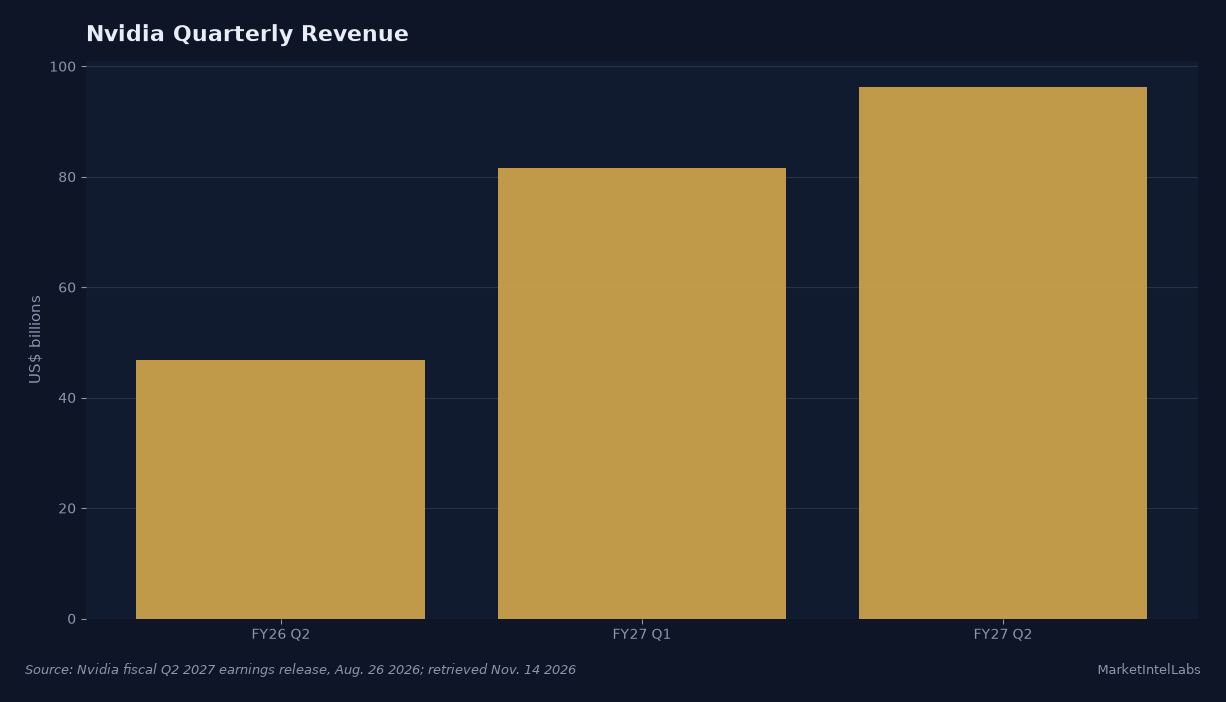
The original chart plots those three GAAP revenue observations from Nvidia's August 26 fiscal second-quarter release. It does not plot the alleged amount of diverted chips, because that is not an audited series in this record. Nor does the rise in global revenue establish that disputed exports occurred. It instead locates the size of the business whose governance and compliance process is under scrutiny. Investors should not infer a China sales figure by subtracting one global quarter from another.
The forward-looking disclosure is more revealing for the policy channel. In the same release Nvidia said its outlook for fiscal third-quarter revenue was $108.0 billion, plus or minus 2%, and that it was not assuming any Data Center compute revenue from China in that outlook. The outlook was issued in August, before this November leadership announcement. It is not a post-scandal revision, and it does not predict a permanent absence of China revenue. It does demonstrate that the company already treated the China compute market as uncertain enough not to build such revenue into that forecast.
The closest test of whether the episode changes reported economics will be Nvidia's scheduled November 17 fiscal third-quarter results and commentary from Kress. The November 12 succession announcement gives that reporting date and the planned call. Revenue, gross margin, inventory and customer commitments can be compared with the earlier guidance, while management can be asked to separate China-specific restrictions from broad AI infrastructure demand. None of those disclosures can be assumed before the company publishes them.
Who bears the cost of uncertainty?
Start with Nvidia. A founder's departure shifts the burden of policy engagement and customer assurance to an interim CEO who is also CFO. That is an operational concentration, not evidence that product development has stopped. The board said it expects operations, customer commitments and the technology roadmap to continue. Its assertion should be weighed against subsequent delivery and financial disclosures rather than taken as a guarantee. A permanent CEO search and the scope of the independent review are distinct milestones.
Then consider the would-be buyers of advanced compute. A cloud provider may have financing, a facility and customers but still face uncertainty about whether a particular processor requires a license and whether access from another jurisdiction alters the risk. Screening a contractual counterparty alone would be inadequate if the party operating the workloads is different. That is why BIS's language about compliance procedures and customer screening matters in commercial terms. Each additional check can delay a shipment, but a clear process can also make permitted sales more durable than informal assurances.
Other chip and system suppliers face related but not identical exposure. BIS's China licensing revision expressly mentions AMD's MI325X alongside Nvidia's H200, so the policy is not a one-company exemption. A design difference or a lower-performance product does not eliminate the need to inspect the actual applicable classification and destination. Data-center builders, networking vendors and firms financing capacity could feel second-order effects if a buyer's purchase order is deferred, though the public source record here does not quantify those effects.
The more constructive scenario is administrative clarity. Commerce could publish a decision about a named party, enforce existing requirements where evidence supports it and preserve a transparent route for compliant sales under the stated case-by-case policy. Nvidia's board could report material findings without asking readers to guess what investigators concluded. Customers would then price known conditions rather than cabinet rumors. The less constructive scenario is a prolonged gap between allegations and verifiable decisions, in which counterparties tighten terms while export-policy assumptions keep changing.
Neither scenario requires assuming that the summit produces a chip deal. CNBC's officials specifically framed export controls as outside the negotiations. An administration can keep talks about trade implementation separate from sensitive investigations and still make decisions at BIS later. It could also alter policy through published regulatory processes. The important investor distinction is between words about what will be discussed, an agency notice with legal force and an issuer disclosure showing a measurable business impact.
Four dates to keep separate
The first date is November 8, when Nvidia's board disclosed its independent inquiry and explicitly said it had no reason to believe secrets or national security were compromised. November 10 brought the appointment of outside counsel. November 12 brought the company's announcement of Huang's immediate resignation and Kress's interim appointment. These are three separate corporate facts, not one completed finding.
November 13 is the date of the officials' reported account to CNBC about the president's forthcoming China trip and of Bessent's public comments as reported by CNBC on other agencies' preference for a listing. The summit is still ahead, and an expectation about what Trump will say can change. The next dated issuer event is the planned November 17 earnings release. Reading these dates in order prevents a rumor about what may happen at a meeting from being mistaken for a concluded investigation or a change in the license regime.
The primary policy dates precede the scandal. BIS's published case-by-case rule for some chips bound for China and its separate anti-diversion measures define the baseline against which a new action should be judged. A new press statement could clarify an agency's intentions; only the operative rule, listing, license disposition or enforcement record would demonstrate the corresponding regulatory change. A responsible account should identify the document and its effective date before saying controls have tightened or loosened.
Frequently Asked Questions
What is the Nvidia spy scandal about?
Reports allege that former Nvidia CEO Jensen Huang had a relationship with a person suspected of links to Chinese intelligence, against a backdrop of questions about restricted AI-chip flows. Nvidia's board said it opened an independent investigation into reporting that Huang was targeted by a foreign intelligence effort. It said it had no reason to believe secrets or national security were compromised. The allegation is not the same as a public finding that espionage occurred.
Did Jensen Huang resign as Nvidia CEO?
Yes. Nvidia said on November 12 that Huang resigned immediately as president, CEO and director. Colette Kress, its CFO, became interim CEO while continuing as CFO; the board began a permanent successor search. The company's release did not announce the results of its independent inquiry.
Is Trump changing Nvidia chip export controls during the China trip?
There is no such change in the summit report. Senior officials told CNBC on November 13 that they did not expect the Nvidia allegation to be raised with Xi and said U.S. export controls were not being negotiated with China. A report of an expected agenda does not override published BIS licensing rules or decide the treatment of a particular company.
Can Nvidia sell H200 chips to China?
BIS's published policy provides for case-by-case review of license applications for H200, AMD MI325X and comparable chips if specified security requirements are met. That is neither an automatic authorization for all shipments nor an assertion that no shipment can qualify. The purchaser, screening procedures, production-capacity condition and independent performance testing all matter under the published framework.
What should readers watch next in Nvidia's China dispute?
Watch for a dated BIS rule, Entity List entry or enforcement action, any substantive update from Nvidia's independent board committee, and the company's November 17 financial disclosure. Each answers a different question. A named listing establishes a legal restriction; a board report addresses company governance; earnings reveal what management says happened to the business. None should be used as a shortcut to infer guilt from allegations.
The most consequential fact may be the one not yet in the public record: whether regulators document a prohibited diversion or explain why the questioned transaction complied with the applicable rules. Until that evidence arrives, the policy thesis is narrower than the scandal. The United States already has a case-by-case licensing route and anti-diversion tools; the test is whether officials use them predictably and whether Nvidia's next management team can demonstrate that its customers can be screened in practice. The summit may make the front page, but the next dated agency action and the company's November 17 disclosures will say more about the commercial outcome.
This content is for informational purposes only and does not constitute financial advice. Past performance is not indicative of future results. Consult a qualified financial advisor before making investment decisions.
Get daily intelligence delivered
Create a free account for the Daily Brief every weekday and The Week Ahead every Sunday. No card required.