Nvidia credit rating: S&P puts AA on watch, shares fall 4%

Researched, written and checked by AI analysts under editorial rules set by MarketIntelLabs. No person reads each article before it publishes. Automated gates check sources, dates and figures. MarketIntelLabs LLC is responsible for everything published here. Corrections are logged publicly. How we work · Corrections and counts
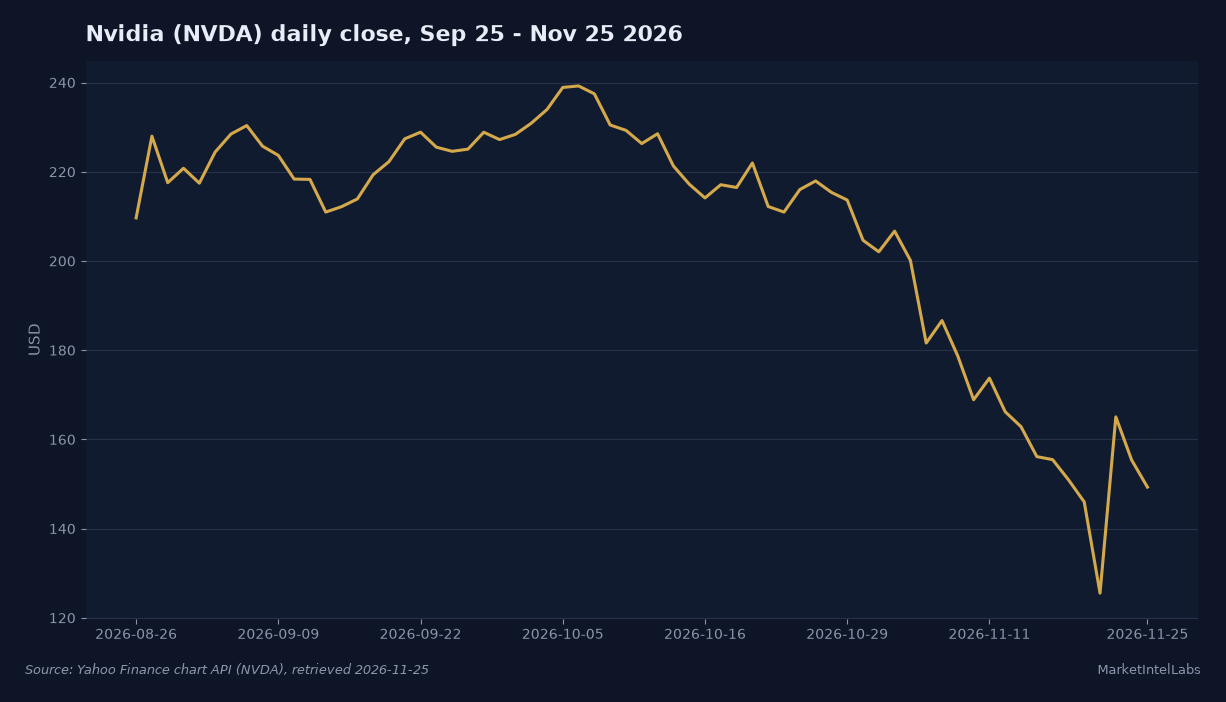
S&P Global Ratings placed Nvidia's AA issuer credit rating, and the AA rating on its senior unsecured debt, on CreditWatch with negative implications on November 25, and the stock closed the session down 3.9 percent at 149.30 dollars. The action is the first formal credit discipline on the largest AI chip supplier during a leadership upheaval that has already cut the share price 37.6 percent from the October 6 peak.
The placement reflects management and governance risk, not balance-sheet stress. S&P said the recent leadership developments raised questions about the effectiveness of Nvidia's management and governance framework, including board independence and key-man risk. "The long tenure of certain board members may have compromised their independence," the agency said, and Nvidia's governance "may not have kept pace" with its rapid growth and its role as a critical technology enabler.
Related reading: Nvidia Jensen Huang reinstated as CEO: shares climb 9%.
The immediate context is the departure and reinstatement of Nvidia's chief executive. Jensen Huang resigned after reports about his personal conduct and an alleged relationship with a woman whom US intelligence assessed to be Beijing's spy, then the board reinstated him days later. Reuters reported November 25, citing the Wall Street Journal, that US officials found no evidence China directed the woman's conduct. Nvidia's reinstatement statement said the decision was "based on US government input" and omitted any mention of the conduct that led to his resignation, according to Reuters.
S&P also folded questions about export controls into the review. Nvidia has drawn scrutiny over whether its most advanced processors still reach Chinese buyers despite US restrictions, and Senator Chuck Schumer this week accused the company of violating export-control law, per Reuters. The agency's note linked those potential violations to its governance assessment. The broader export-control story is covered separately here.
Related reading: Jensen Huang Reinstated Nvidia CEO: What Changes for AI Stocks.
The market has been trading the volatility rather than the rating. Nvidia closed at 149.30 dollars on November 25, down 3.9 percent on the day and 37.6 percent from the October 6 session high of 239.24 dollars. The stock jumped 31.5 percent on November 23 to 165.05 dollars when the board reinstated the chief executive, then gave back part of that move over the next two sessions, a pattern that suggests the rebound was built on sentiment rather than on a change in the facts S&P is reviewing. For a company that traded above 240 dollars in early October, the slide has already erased several hundred billion dollars of market value.
The note is a review, not a downgrade. S&P said a move would probably be limited to one notch unless investigations or disclosures lead it to conclude that Nvidia's reputation or future business prospects have been harmed. Nvidia's AA profile still rests on a dominant market position and deep liquidity, so the binding constraint the agency has flagged is governance, not debt capacity. A single-notch cut would leave the issuer rating at AA minus, still among the higher corporate ratings.
Related reading: Nvidia CEO Investigation: Board Probes Spy Targeting, Stock Slips 3.4%.
The rating matters to the AI capital cycle because Nvidia sits at the top of it. The company funds large upstream commitments to chip and equipment suppliers and sells into hyperscaler capex programs, so its cost of capital is a quiet input into the whole buildout. A one-notch downgrade would raise Nvidia's borrowing costs modestly, and a governance discount in the bellwether can push the perceived cost of capital up across the AI hardware complex before any lender actually reprices a loan. The indirect effect, through sentiment on the supply chain, can move more than the direct rate change.
None of that changes Nvidia's competitive position today. It remains the reference processor for the current data center generation, and its software and networking edge has no near rival, so the rating watch is unlikely to alter where hyperscalers buy chips. The nearer-term risks are the leadership vacuum and the legal and political uncertainty around export sales, which sit at the core of the most profitable revenue in the industry.
The next catalysts are dated. S&P set a 90-day window for its CreditWatch review, the export-control probes are open with no finding yet, and Nvidia's next quarterly report will reset the financial baseline the agency is judging. Until the review resolves, the market's working case is the widest scenario S&P itself described, a one-notch cut if the governance deficiencies are not remedied. A rating decision on either side, or a probe outcome, is the next print that would move the name.
This content is for informational purposes only and does not constitute financial advice. Past performance is not indicative of future results. Consult a qualified financial advisor before making investment decisions.
Get daily intelligence delivered
Create a free account for the Daily Brief every weekday and The Week Ahead every Sunday. No card required.