Jensen Huang Reinstated Nvidia CEO: What Changes for AI Stocks


Jensen Huang was reinstated as Nvidia president, chief executive and a director effective November 22, 2026, according to the company’s Form 8-K signed the next day. The board’s November 23 statement says the vote was unanimous. The decision closes a short, costly leadership vacancy, but it does not close the separate questions about accounting, export controls or the board’s own investigation. For investors in AI infrastructure, this is a governance reset rather than a new sales forecast.
Our Nvidia Q3 earnings explainer described the CEO search while the company reported extraordinary AI demand. Our news report on Huang’s reinstatement covers the announcement and immediate share reaction. This new decision resolves that search in favor of its founder. It also tests whether investors can separate confidence in a familiar architect of the product roadmap from assurance about what the independent directors, regulators and export authorities may find. Those are different propositions.
A widely circulated headline described Nvidia stock as up 35% on the news. The Nasdaq historical-quote page accessible for this review showed November 20 as the last completed session, at $125.53, and a premarket indication of $136.21 at 5:56 a.m. Eastern on November 23. That indication was not a 35% gain against the listed close, and premarket indications can change before the open. We do not present the headline’s 30% to 35% figure as a verified daily move or claim that it persisted into the close. The governance development is documented; a full-session stock reaction needs a dated exchange close.
The eleven-day leadership gap
The chronology matters more than a slogan about a comeback. Nvidia’s November 12 press release said Huang resigned as president, CEO and director effective immediately, that Executive Vice President and CFO Colette Kress agreed to serve as interim CEO while retaining her finance responsibilities, and that the board would consider internal and external candidates. The company’s November 12 Form 8-K dates the underlying board action to November 11. This distinction between the board decision and public release explains why a reader can encounter two dates for the departure without there being two departures.
The same November 12 filing says Harvey C. Jones became board chair, a role the board’s November 23 release says he keeps. Huang’s return restores him to management and the board but does not undo that independent chair structure. Kress, in turn, returns to her executive vice president and CFO role after the interim appointment. These are discrete corporate offices, not a vague assertion that the old leadership arrangement has simply been recreated.
What did Kress do while the search was open? Nvidia’s November 17 fiscal third-quarter results identify her as interim CEO and CFO and quote her on the product roadmap. Her role was real, not merely a name on a succession chart: the company issued results and a fourth-quarter outlook under her interim tenure. The November 12 board statement explicitly said that its experienced leadership team was expected to keep operations, customer commitments and the product roadmap running. That is the company’s assurance, not proof that no project faced friction.
The November 23 board announcement says directors held a series of discussions and meetings with Huang and became satisfied about his candor and capacity to lead. It states that senior levels of the United States government provided input and says the board is confident reinstatement poses no national-security risk. Those words do not identify the government officials, publish their analysis or amount to a public clearance certificate. Reuters has framed the return amid pressure from President Trump and investors; the issuer’s narrower on-record disclosure establishes government input, not a specific presidential directive to the board.
The board’s own November 8 statement is also worth reading against the return announcement. It said an independent committee, aided by independent counsel, would investigate reporting that Huang had been the target of a foreign intelligence effort, and that it had no reason to believe national security or company secrets were compromised. On November 23 the board expressly said that inquiry would proceed to its conclusion and Huang would cooperate. The return is a decision about leadership now, not a published final report on the underlying concerns.
Why the stock can reprice without new earnings
Chief executives do not physically build every server, but at Nvidia the founder is closely associated with product cadence, customer and partner relationships and capital-allocation credibility. A leadership vacancy can raise the risk investors attach to the same expected revenue stream, even without revising that stream. Reinstatement can therefore move a share price by changing the discount applied to anticipated cash flows rather than by adding a single new chip order. This is an interpretation of valuation mechanics, not a claim that the board disclosed a numeric risk-premium estimate.
Nasdaq’s historical quotes provide a useful baseline. The exchange lists closes of $173.73 on November 11, $166.19 on November 12, $162.85 on November 13, $156.14 on November 16, $155.46 on November 17, $150.96 on November 18, $145.98 on November 19 and $125.53 on November 20. That is a series of observed prices, not a controlled experiment proving leadership alone caused each move. Reuters reported that its November 20 story on a possible SEC accounting investigation preceded an extension of share losses that day. The market was processing more than one risk at once.
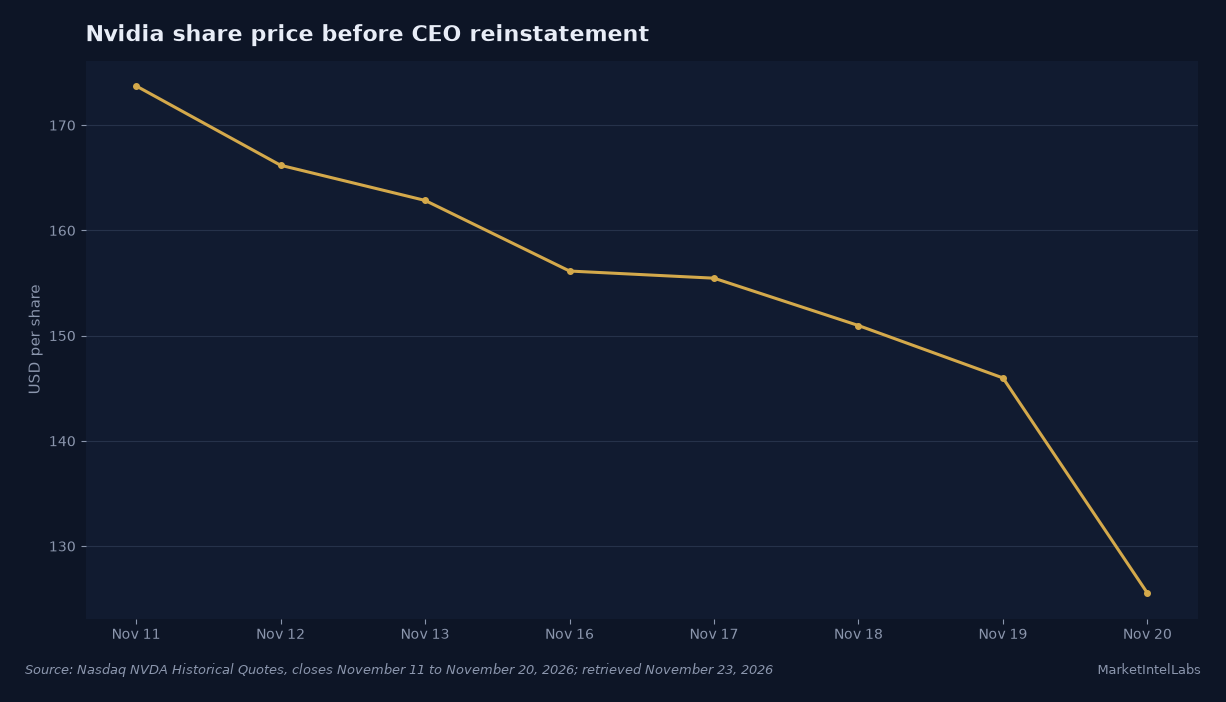
The chart ends before the reinstatement on purpose. It displays eight exchange-listed closes, not an intraday estimate dressed up as a confirmed close. For any claimed comeback percentage, the right question is which reference price and which timestamp the source used: Friday close, an early premarket print, an opening auction or an actual Monday close. A 35% headline without that denominator cannot substitute for a closing return. Neither can an indicated bid tell us how long a rally lasts.
A strong price response would be consistent with relief about the CEO search, but it could also reflect short covering, an oversold starting point, changes in broader AI shares or beliefs about regulatory outcomes. The available primary documents do not isolate those effects. In particular, the reinstatement release contains no revised earnings guidance, no announcement of new China licenses and no SEC conclusion. Treating the shares as a simple referendum on a single board decision would assign precision that the evidence cannot support.
An operating machine bigger than the leadership story
Nvidia’s November 17 earnings release reported $115.8 billion in fiscal third-quarter revenue for the quarter ended October 25, up 103% from a year earlier. It reported $107.6 billion of Data Center revenue, up 110% year over year, and a 74.8% GAAP gross margin. Those numbers describe the operating business while the interim CEO was in place at the release date; they are not a forecast created by Huang’s return. The company’s release also put fourth-quarter revenue guidance at $130.0 billion, plus or minus 3%, for a quarter including an additional week.
The issuer’s fiscal third-quarter CFO commentary, furnished with its November 17 Form 8-K, adds an essential distinction: it reported $60.1 billion from Hyperscale and $47.5 billion from AI Clouds, Industrial, & Enterprise within Data Center. The document said revenue recognized from Hopper shipments to China during the quarter was $2.4 billion, while supply commitments increased from $279 billion in the prior quarter to $390 billion. The first figures describe shipped demand; the commitments describe future procurement exposure. They cannot be netted into a guaranteed revenue number.
According to Nvidia’s earnings release, the fourth-quarter outlook assumed no Data Center compute revenue from China. That omission is particularly important when assessing what a CEO change can accomplish. A founder with renewed board backing can negotiate, prioritize products and communicate with customers, but he cannot turn a case-by-case export license regime into automatic permission. A share-price move that prices in the return of Chinese sales would need evidence beyond the appointment filing.
For customers building AI clusters, the relevant operating test is whether the product schedule, systems integration, supply allocation and software support remain on track. Nvidia’s November 12 announcement said its management team expected continuity; the November 17 release said Vera Rubin NVL72 had begun shipping. These are issuer claims about execution and product timing, not independent verification of every customer deployment. Investors should distinguish a resumed CEO title from actual deliveries, recognized revenue and margin performance in subsequent reports.
The counterargument to a purely bearish governance reading is substantial: a large installed platform and an experienced finance-led management team kept the company reporting sales during the vacancy. Conversely, the argument against treating the return as a cure-all is that the same business faces supplier commitments, customer concentration, export scrutiny and a live inquiry. The third-quarter revenue base raises the financial stakes of both interpretations.
Three inquiries and controls that do not disappear
First, the board’s independent inquiry into the foreign-intelligence reporting remains open by the board’s own November 23 release. The board says it has confidence in Huang’s capacity to lead and, based on government input, sees no national-security risk from his reinstatement. It also states unequivocally that the committee will continue its review. The findings, methodology and any further governance recommendations were not published in that release. The November 8 board statement similarly described the inquiry’s remit without reporting an outcome.
Second, Reuters reported on November 20, citing two people briefed on the matter, that SEC enforcement staff were scrutinizing potential accounting issues at Nvidia. Reuters said it could not determine precisely what issues the SEC was examining or when the inquiry began; it said the SEC declined comment and Nvidia spokespeople did not immediately respond. An inquiry is not a finding of misconduct. Nvidia’s November 23 appointment Form 8-K does not announce an SEC conclusion, and the board’s reference to ongoing government investigations is not a description of their scope. Our earlier SEC report explainer separates those reported concerns from what the company has filed.
Third, the Commerce Department’s Bureau of Industry and Security said in its January 13, 2026 policy release that H200 and similar semiconductor export licenses for China would be reviewed case by case, subject to requirements including compliance screening and independent testing in the United States. That rule describes the gate, not the status of any particular Nvidia shipment. The company’s November 17 decision not to assume China Data Center compute revenue in its outlook makes the commercial uncertainty visible. No passage in the November 23 reinstatement release says those approvals were granted.
The board also announced a separate National Security and Export Control Committee made up only of independent directors and a search for a chief compliance officer reporting to the Nominating and Corporate Governance Committee. These are governance changes with potentially meaningful oversight implications. But forming a committee is not the same as publishing its work, and opening a search is not the same as filling the post. The company says it will continue cooperating with government inquiries; future filings will have to establish what that cooperation produces.
The distinction between these tracks matters because they have different decision makers. Nvidia’s directors can restore an executive and set company oversight. The SEC controls its own enforcement process. The Commerce Department reviews export applications under its rules. Customers decide what capacity to buy and when to deploy it. A single dramatic market session cannot resolve all four.
What to watch after the appointment
The first public check is the next updated management disclosure: does Nvidia continue to describe Huang as CEO and director, Jones as chair and Kress as CFO in its formal filings? The November 23 Form 8-K already establishes the appointments as of the effective date. Subsequent disclosures would show whether the new National Security and Export Control Committee and compliance officer role acquire defined membership, reporting lines and resources. Those details would matter more for oversight than a celebratory board quote.
The second check is disclosure from the independent committee. The board committed on November 23 to completing its investigation; it did not give a completion date. Until it reports, neither an assumption that all concerns are cleared nor an assumption of wrongdoing follows from the public record. The same restraint applies to Reuters’ reported SEC inquiry: investors need an official development or attributable new reporting, not inference from a share-price change.
The third check is execution against the dated financial baseline. Nvidia’s November 17 release put fourth-quarter revenue guidance at $130.0 billion, plus or minus 3%, and gross margins between 71.0% and 72.0% on both GAAP and non-GAAP bases. Because the quarter includes an extra week, simple quarter-on-quarter comparisons can exaggerate underlying momentum. Future reports can test shipments, margins and whether China revenue remains excluded from management assumptions. A governance vote does not itself revise those figures.
For the wider AI market, the strongest transmission channel is confidence in Nvidia’s roadmap and the spending plans of its infrastructure customers. Suppliers and cloud builders can respond to expectations of continuity, but their economic exposure is not identical to Nvidia’s. The reinstatement can lift sentiment while leaving buyers’ budgets, power availability, chip-delivery schedules and licensing constraints unchanged. The bullish case is reduced succession uncertainty around a company reporting very large AI sales. The bearish case is that the price of relief outpaces evidence that regulatory and operating risks have diminished.
Frequently Asked Questions
When was Jensen Huang reinstated as Nvidia CEO?
Nvidia’s Form 8-K says the board reinstated him as president, CEO and director on November 22, 2026, effective immediately. The issuer announced the decision publicly on November 23. The filing and announcement describe the same action, not separate appointments.
Who was Nvidia’s CEO while Huang was away?
Colette Kress, Nvidia’s executive vice president and CFO since 2013, served as interim CEO after the November 11 resignation. Nvidia’s November 23 announcement says she continues as CFO following Huang’s reinstatement. Harvey C. Jones remains board chair.
Did Nvidia stock really rise 35% after Huang returned?
Headlines claimed a 35% surge, but Nasdaq historical quotes accessible at this review showed November 20 as the latest completed session at $125.53 and displayed a November 23 premarket indication, not a closing return. The 35% claim should not be treated as a verified full-session change without a dated exchange close and an explicit comparison price.
Did the reinstatement end the SEC probe and export restrictions?
No such outcome is announced in Nvidia’s November 23 Form 8-K or press release. Reuters reported an SEC accounting inquiry based on unnamed sources; neither its scope nor outcome was established by the appointment filing. The Commerce Department’s H200 export policy remains case-by-case, and Nvidia’s fourth-quarter outlook assumed no China Data Center compute revenue.
What does Huang’s return change for AI investors?
It ends the publicly announced CEO search and restores the founder to management and the board. It does not itself change recognized sales, supply commitments, the board’s ongoing investigation, regulatory processes or customer spending. Whether the governance relief translates into sustained operating value depends on subsequent company disclosures and results.
This content is for informational purposes only and does not constitute financial advice. Past performance is not indicative of future results. Consult a qualified financial advisor before making investment decisions.
Get daily intelligence delivered
Create a free account for the Daily Brief every weekday and The Week Ahead every Sunday. No card required.