Nvidia SEC Investigation: Reuters Report Explained


Reuters reported on November 20 that two people briefed on the matter said Securities and Exchange Commission enforcement staff were examining potential accounting issues at Nvidia. That is a consequential claim about the supplier at the center of the AI buildout, but it is not a public finding of accounting misconduct. Reuters said it could not determine the precise issues or when the reported inquiry began; the SEC declined to comment and Nvidia spokespeople did not immediately respond to its requests. For the verified state subpoena and leadership transition, see our earlier news report. The useful investor question now is not which accounting line is supposedly wrong. It is what evidence, if any, could alter confidence in the company's reported revenue and its customers' capacity to pay.
The New York Times also reported on November 20, citing people briefed on the matter, that the SEC was investigating Nvidia's accounting practices and that the inquiry was at an early stage; its report said civil charges might never follow. The Wall Street Journal had earlier reported an SEC inquiry without identifying its focus, according to Reuters. These reports can describe what their sources say without establishing the identity of any accounting question. A reported investigation is not a restatement, a Wells notice, a charge or a judgment. Treating one as the other would turn an uncertainty premium into a fictional loss.
Related reading: Nvidia Investigation Explained: Board Review and Chip Risk.
The public record offers a deliberately narrower set of facts. Nvidia disclosed a chief executive change in a Form 8-K signed November 12 and provided results for its quarter ended October 25 in a Form 8-K dated November 17. California's attorney general publicly announced a state investigative subpoena on November 19. Neither of the two cited Nvidia 8-Ks identifies an SEC accounting inquiry or names an accounting practice under federal review, and we found no public SEC finding establishing one as of November 22. A confidential federal inquiry need not appear in those filings; absence of an announcement is not proof that Reuters's reporting is false. Equally, a state press release does not confirm the subject or scope of any federal investigation.
What happened, and what is still reported
Start with the sequence rather than the theories. Nvidia's November 12 Form 8-K says its board accepted Jen-Hsun Huang's resignation as president, chief executive and director effective November 11. The board named Colette Kress, then executive vice president and chief financial officer, interim chief executive while it searches for a successor. Kress kept the finance role. Harvey Jones became chair of the board. That means an unusually large combination of operational and financial reporting responsibilities now sits with the interim chief executive at precisely the moment investors are asking harder disclosure questions. The filing does not attribute the departure to an SEC action, and a temporal coincidence cannot supply that missing causal link.
Related reading: Nvidia Q3 earnings explained: who pays for AI growth?.
On November 17 the company issued quarterly results and furnished the release, CFO commentary and supplementary accounts with an earnings 8-K. The commentary says the company plans to file its Form 10-Q in the coming weeks. Until that periodic report arrives, the unaudited supplementary statements and the earlier annual report are the published accounting detail available for this latest quarter. None of this determines what federal staff might be examining, if Reuters's reported inquiry is under way.
California Attorney General Rob Bonta's November 19 release supplies the on-record government action. His office said it had served an investigative subpoena to ask whether Nvidia's advanced chips or confidential information may have gone to China and whether the company misled investors and the public. Bonta said the information would help his department evaluate whether conduct violated California law. Those are questions in a state investigation, not state findings. The California Department of Justice release concerns a separate track from the federal SEC inquiry described by Reuters. Neither regulator has publicly linked the two on the record in the sources reviewed here.
Related reading: China AI projects built on restricted Nvidia chips: $3.2B exposed.
The accounting lines that matter, without guessing the allegation
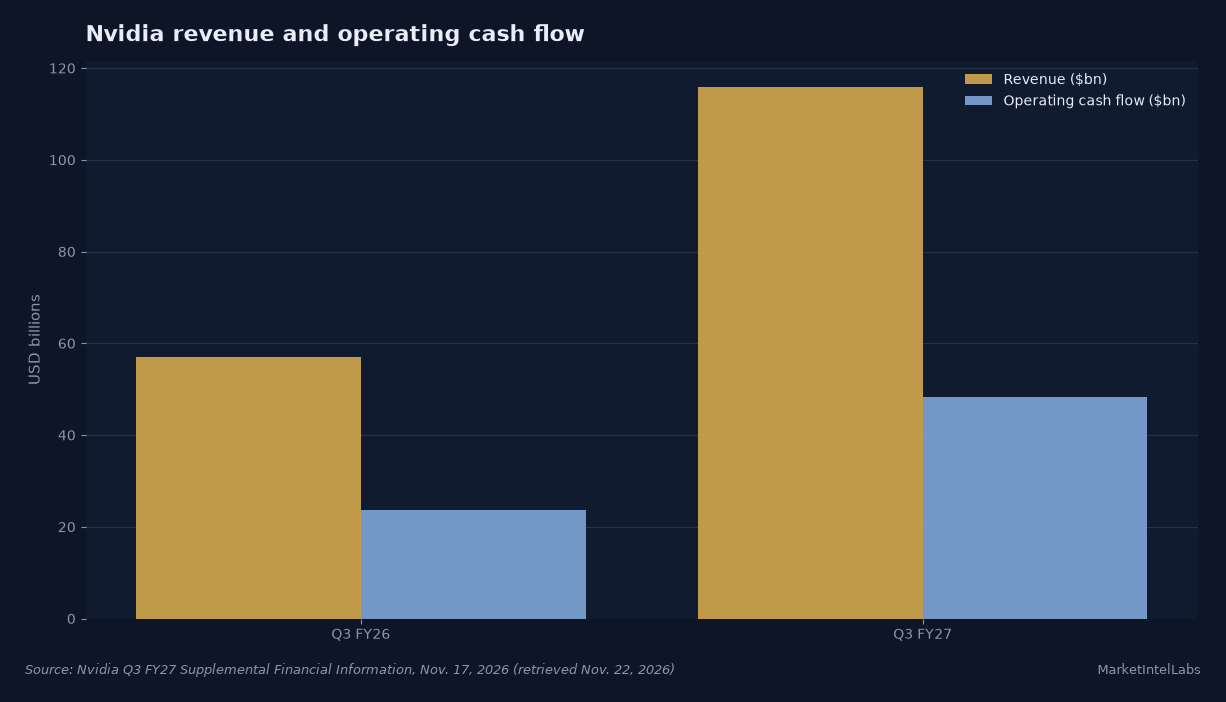
There is a temptation to label every unusual number a suspected violation. That would be bad accounting analysis. Nvidia's November 17 CFO commentary puts third-quarter fiscal 2027 revenue at $115.8 billion, up 103% from a year earlier, with data-center sales of $107.6 billion. It reports GAAP gross margin of 74.8% and operating cash flow of $48.3 billion. These are company-reported, unaudited quarterly measures. Reuters did not identify any one of them as a subject of its reported SEC inquiry. We examine them because the relationship among sales, cash collection and commitments determines how investors should assess the durability of the AI revenue stream, not because any figure proves impropriety.
Start with collection. Nvidia's supplemental financial information shows accounts receivable of $81.033 billion at October 25, up from $38.466 billion at the fiscal year start on January 25. The CFO commentary says receivables were about $81.0 billion and days sales outstanding reached 64 days, versus 60 days sequentially. The company attributes the change to timing of Rubin shipments and extended payment terms on large, multiquarter agreements with certain investment-grade customers. Payment terms may be an ordinary commercial accommodation in a rapid equipment rollout. The test over successive filings is whether cash collected from those customers keeps pace with reported sales under the contractual terms. A rising receivable balance by itself cannot distinguish a genuine shipment backlog from a collection problem.
The same supplemental statement reports $48.253 billion in cash from operating activities for the quarter, versus $23.750 billion one year before. It also records an $18.052 billion increase in receivables as a use of operating cash during the quarter, compared with $5.583 billion a year earlier. Inventory accounted for another $8.148 billion use of operating cash, versus $4.823 billion a year before. That is why a cash-flow statement can tell a different story from an income statement in a high-growth hardware business: revenue can be recognized before invoices are paid and inventory must often be funded before systems ship. On the disclosed figures, operating cash still grew sharply. The open question is how smoothly the timing differences reverse as new product launches mature.
Nvidia's November 17 supplement says inventory stood at $39.724 billion at October 25, compared with $21.403 billion at January 25. Its CFO commentary points to the Rubin ramp and puts the immediate prior-quarter inventory balance at $31.6 billion. A more expensive product transition can lift raw materials and work in process without implying obsolete stock. Equally, a sudden change in orders, export restrictions or customer financing could leave a larger asset base exposed to write-down risk. The supplement separates inventory into raw materials, work in process and finished goods, a better guide to production bottlenecks than a single headline total. The next periodic filing can show whether the mix and provisions change as installations proceed.
Customer concentration narrows the margin for error. Nvidia's supplementary statement says three direct customers each contributed 14%, 11% and 11% of third-quarter revenue. It says two direct customers accounted for 18% and 17% of the receivable balance at October 25. Direct customers can be distributors and systems integrators rather than the ultimate cloud user, a distinction the company makes explicitly. That concentration means the reported sales curve can be healthy while the payment behavior of a small set of purchasers matters disproportionately. It is also why one cannot simply match a cloud provider's capital expenditure to Nvidia's direct-customer invoices.
A separate disclosure concerns the way revenue is assigned geographically. Reuters noted that Nvidia had changed its geographic reporting from billing location to customer headquarters; the company's November 17 supplemental statement explicitly says its regional revenue is designated by the location of direct customers' headquarters and that the end customer or shipping location may differ. The statement assigns $11.050 billion of third-quarter revenue to customers headquartered in China, including Hong Kong. That is not a count of chips shipped to China. The CFO commentary separately says shipments of Data Center Hopper products to China were $2.4 billion for the quarter and says the fourth-quarter outlook assumes no China data-center compute revenue. Mixing those figures would compare different definitions. California's questions about transfers cannot be answered by the headquarters table alone.
Finally, the November 17 CFO commentary describes a web of capital commitments around the sales channel. Nvidia lists $390 billion of future supply and capacity commitments, $28 billion of cloud service agreements and $74 billion of data-center leases not yet commenced. It separately lists $32 billion of contingent neocloud commitments and $118 billion of maximum gross exposure under specified guarantees, while saying no payments have yet been made related to the guarantees. Those categories have different triggers, durations and accounting treatment; adding them into a single current debt figure would be misleading. They matter because customer financing, infrastructure delivery and equipment purchases now sit close together in the AI supply chain. A future disclosure identifying who bears a shortfall in a failed project could change how investors judge both growth and risk.
The chart compares Nvidia's reported quarterly revenue and operating cash flow a year apart. Both are flows; their gap cannot diagnose an accounting violation.
Who decides what happens next?
The SEC's Office of Investor Education says its enforcement staff typically investigates confidentially. Staff may seek voluntary documents and testimony; with formal authority it can issue subpoenas. Staff can close a matter without recommending action, or it can consider a Wells notice to give a potential respondent a chance to answer proposed allegations. Any eventual civil enforcement action requires authorization by the Commission. This is a general description of the process, not a statement that Nvidia has received a federal subpoena, a Wells notice or charges. Reuters's sources have not supplied that level of detail publicly.
The SEC bulletin also makes the civil and criminal distinction plain. Federal securities enforcement can seek monetary or conduct remedies; the SEC cannot send someone to jail. The California attorney general's office, by contrast, says its subpoena is gathering facts to evaluate potential violations of state law. Bonta's release does not announce an indictment or determine that a crime occurred. Investors should resist converting the phrase possible criminal exposure in a news summary into a declared criminal case. What California requests, what it receives and whether it brings an action are decisions for that office and, if litigation follows, the courts.
Nvidia's board has a different set of decisions. Its November 12 filing says it will search for a permanent CEO; it also put its sitting finance chief in temporary charge of the company. The company can explain payment terms, geographic definitions and customer exposures through later filings. Its next 10-Q is the nearest stated accounting document. A new CEO appointment would not resolve the reported inquiry.
The stock and the AI spending chain
The stock case turns on what buyers thought the dollars represented. Nvidia's $107.6 billion of data-center revenue in its November 17 release accounts for most of the $115.8 billion total. The upside case is straightforward: customers are spending heavily on compute and Nvidia is converting those orders into revenue and operating cash, even through a difficult leadership change. The CFO commentary's $48.3 billion of quarterly operating cash flow offers a concrete counterweight to the notion that growth exists only on paper. None of those published numbers is a clean bill of health on the unnamed accounting question in Reuters's report; nor does the reported inquiry erase the cash received.
The downside case does not require assuming fraud. Longer payment terms can shift risk from customers' balance sheets to the supplier's receivables. A larger inventory stack increases exposure to canceled deployments or product transitions. Guarantees tied to data-center buildouts bring Nvidia closer to the financing of the same demand it supplies. A market that previously capitalized every dollar of AI infrastructure revenue as equally durable may apply a lower multiple until it can distinguish independently funded demand from demand supported by vendor commitments. That is a valuation mechanism, not a forecast of a particular share price.
Contagion across the AI trade would follow cash obligations rather than a headline. Chip foundries and memory suppliers may still fill signed supply orders; data-center operators and neoclouds may still need equipment. But if any major buyer delayed accepting systems or struggled to finance sites, Nvidia could experience slower collections or altered commitments, and counterparties would confront timing risk. Conversely, if customers pay on schedule, project financing closes and the next 10-Q reconciles the growth and receivable details, a reported inquiry could remain an event with limited operational transmission. We do not know which path will prevail, and the anonymous federal reporting does not establish an accounting defect at a named customer.
For a dollar investor, the geographic distinction is another transmission channel. Nvidia's headquarters-based sales table cannot identify the destination of every system, and restrictions on exports can affect where products ultimately go. California's subpoena asks whether chips or information may have reached China and whether public statements were misleading. A substantiated change in export exposure could alter forecasts for Nvidia, its channel partners and the AI hardware cycle; a press release asking a question cannot be booked as an established loss. This is precisely where legal fact-finding and financial modeling need to stay separate.
Frequently Asked Questions
Has the SEC confirmed an accounting investigation of Nvidia?
No public SEC confirmation was identified as of November 22. Reuters reported on November 20, citing two people briefed on the matter, that SEC enforcement staff were scrutinizing potential accounting issues; the New York Times separately described an early inquiry citing unnamed people. Reuters said the SEC declined comment and Nvidia spokespeople did not immediately respond. The SEC's investor bulletin explains that enforcement investigations are generally nonpublic, so the agency's silence neither confirms nor refutes the outlets' reporting.
What specific accounting issue is under investigation?
Reuters said it could not determine the precise issues under scrutiny. Its account does not designate revenue recognition, receivables, geography or guarantees as a subject of the reported federal inquiry. The New York Times said the relationship to separate revelations was unclear. The figures examined above come from Nvidia's own earnings materials because they bear on financial risk; they should not be mistaken for a list of SEC allegations.
Did Jensen Huang resign because of the reported SEC inquiry?
Nvidia's Form 8-K says the board accepted Huang's resignation effective November 11 and appointed Kress interim CEO; it does not say an SEC accounting inquiry caused the resignation. Reuters's later report concerns a federal inquiry whose start date it could not determine. Without a dated, attributable link in the public record, the sequence cannot establish a reason for Huang's departure.
Does the California subpoena mean Nvidia has been charged?
No. California Attorney General Bonta said on November 19 that his office had served an investigative subpoena and was asking whether chips or confidential information might have gone to China and whether investors had been misled. The stated purpose was to evaluate possible violations of California law. A request for information is not a conclusion, and the state action is not proof of Reuters's reported SEC accounting focus.
Which document could change the financial analysis first?
Nvidia's November 17 CFO commentary says a third-quarter Form 10-Q is planned in the coming weeks. That would provide a formal periodic filing to compare with the unaudited supplement, including collections, commitments and geographic reporting. A public enforcement filing would answer a different question about regulators' conclusions if one ever appears. Until either arrives, the defensible position is to distinguish the company's documented numbers, California's documented subpoena and Reuters's attributed but unconfirmed federal report.
This content is for informational purposes only and does not constitute financial advice. Past performance is not indicative of future results. Consult a qualified financial advisor before making investment decisions.
Get daily intelligence delivered
Create a free account for the Daily Brief every weekday and The Week Ahead every Sunday. No card required.