Nvidia backlog tops $2.5 trillion as AI chip supply lags

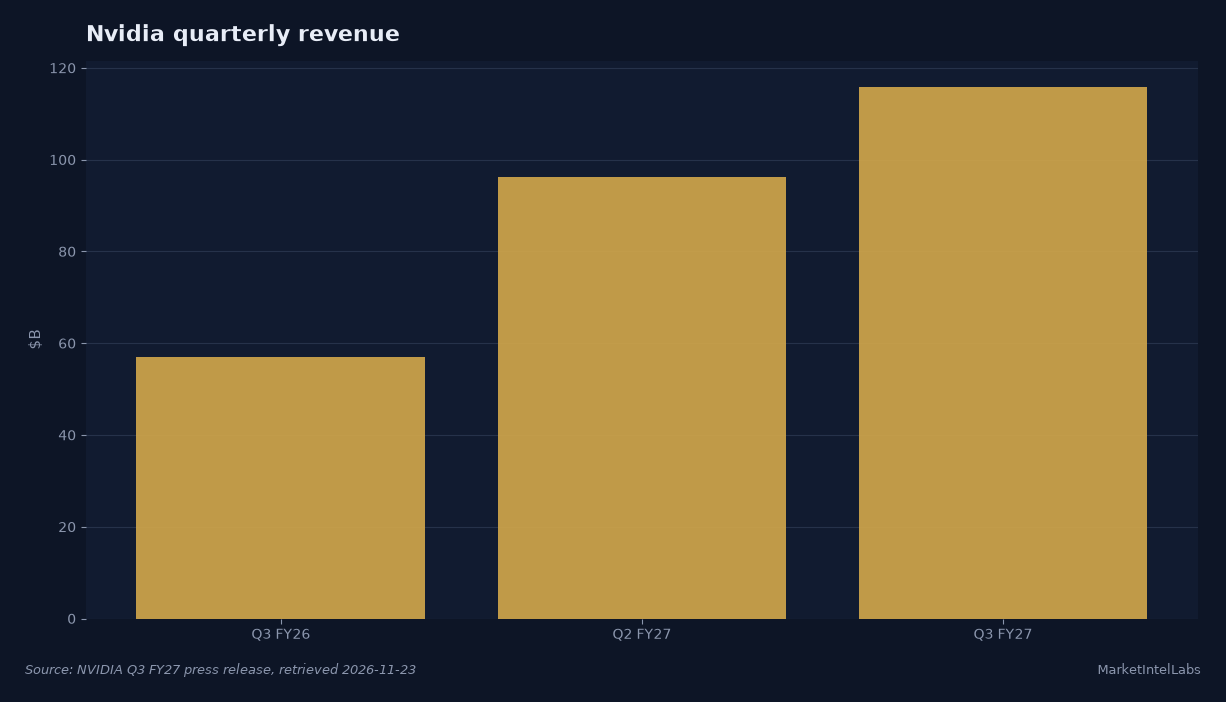
Nvidia's third-quarter report, posted Tuesday, is the week's defining number for the AI buildout. Revenue of $115.8 billion was up 103 percent from a year earlier and 20 percent from the prior quarter, and a cloud-industry backlog the company now puts at $2.5 trillion, up from $2 trillion three months ago, is the clearest measure yet of how much AI compute buyers have committed to pay.
The demand signal is the backlog
The backlog is the number to sit with. It is orders and committed future purchases for cloud computing, not revenue yet booked, and it grew half a trillion dollars in a single quarter even as Nvidia's data center unit, the engine of the quarter, shipped record revenue of $107.6 billion. Interim CEO Colette Kress, who steps in after co-founder Jensen Huang's resignation, told the call that momentum is real and that the company's multi-year roadmap is on track.
Related reading: Nvidia Q4 guidance: zero China revenue, margin guide 71-72%.
Guidance carries the same message. Nvidia told investors to expect roughly $130 billion of revenue in the quarter ending late January, up about 90 percent from a year earlier and above the $125.1 billion average analyst estimate, according to LSEG. Management also raised its fiscal 2028 growth outlook to about 75 percent from the 70 percent it flagged last quarter. For a company that reported $57 billion in the same quarter a year earlier and $96.2 billion in the quarter just before this one, the trajectory is a straight-line escalator.
Where the constraint shows up
The beat was not just to the upside in revenue. Adjusted earnings of $2.68 a share topped the $2.48 analysts expected, and revenue cleared the $109.1 billion consensus by a wide margin, according to LSEG. The stock rose more than 3 percent in extended trading after the release, a muted move for a number that big, which itself is a signal: the demand side of the AI trade is now so well understood that the multiple, not the growth, is where the debate runs. A $115.8 billion quarter is priced for the backlog to keep compounding.
Related reading: Nvidia Data Center Revenue Hits Record $107.6B as Vera Rubin Ships.
The binding constraint sits on the supply side; demand is increasingly the easy part of the forecast. A $2.5 trillion backlog means the ask is larger than near-term manufacturing can answer. The binding inputs are well known: advanced packaging and memory capacity led by TSMC and the HBM suppliers, plus the power and data center buildout that turns a chip order into a running workload. Demand signals are already straining upstream prices. GPU rental rates are climbing, and memory and packaging lead times remain the industry's slow valve.
The counter-case is that supply is catching up, not falling further behind. Nvidia raised its outlook even as it models zero data center revenue from China in the forecast, a deliberately conservative posture in a year when export controls repeatedly tightened. Margins also bear watching: non-GAAP gross margin was 74.9 percent in the quarter, roughly flat for two quarters, and the company spent $28.1 billion on buybacks and dividends with $227.3 billion still authorized for repurchases. The gap between what buyers commit and what the industry can physically deliver is where this cycle's biggest surprises, up or down, tend to come from.
Related reading: AI chip stocks diverge after TSMC record October revenue.
The week's other thread tied demand to how it gets paid for. With hyperscaler capital spending running at records and free cash flow under pressure, a growing share of the buildout is financed with borrowed money rather than operating cash flow, a pattern this week's corporate bond issuance in the AI chip complex kept on display. Debt does not change the backlog, but it makes the durability of demand more sensitive to financing conditions. If the cost of that capital rises, repricing comes slowly, because committed orders and signed power contracts do not bend quickly. That lag, more than any single earnings number, is what an investor betting on the buildout has to hold against the cycle's ability to overshoot in both directions.
What to watch next
The next hard prints are TSMC's monthly revenue reports, which lead the packaging and memory picture, and Nvidia's fiscal-fourth-quarter results when the year closes in late January. Data center power decisions and fresh hyperscaler capex numbers land in between. As long as the backlog keeps growing faster than the industry can fill it, the supply constraint, not the demand number, is the more telling series for AI chip economics.
Related reading: Nvidia supply chain expansion: SPIL, Amkor packaging deals.
This content is for informational purposes only and does not constitute financial advice.
Get daily intelligence delivered
Create a free account for the Daily Brief every weekday and The Week Ahead every Sunday. No card required.