Musk SpaceX Shares for American Children: $18 Billion Pledge Explained


Reuters reported on November 26 that Elon Musk plans to give two SpaceX shares to every child in the United States, one newly issued share from SpaceX and one from his own holdings. At SpaceX's November 25 closing price of $127.44, Reuters puts the headline value near $18 billion. But the company's November 25 announcement describes a narrower first step: one new Class A share for every currently active Trump Account, matched personally by Musk. The difference between every child and every active account is the part of the pledge that matters most to its delivery, cost and ownership math.
This is an ownership question before it is a philanthropy number. New shares from a public company change its outstanding share count; existing shares transferred by a founder change the shareholder register without creating more stock. For our news report on the giveaway, the announcement is the event. Here the issue is who must deliver which shares, through what account, and what a child would actually own.
SpaceX is a listed company, not a private startup awaiting a general secondary-market valuation. Its September 2026 quarterly report filed with the Securities and Exchange Commission identifies Class A stock trading as SPCX on Nasdaq. That makes the proposed gift easier to price than an unlisted-company promise, but it does not make a pledged share identical to a deposited share. Account eligibility, transfer processing, the founder's lockup and the treatment of future children still have to be resolved.
What SpaceX committed to, and what Musk added
SpaceX's November 25 investor release says it will contribute one newly issued Class A common share to every currently active Trump Account. It says Musk will personally match the number of shares donated by SpaceX. This is the primary company record of an announced commitment; its forward-looking statement cautions that future contributions depend on contingencies, including third-party and government approvals. It does not provide a completed distribution register, record date, trustee agreement or final recipient count.
Reuters reported that Musk then described the gift as two shares for every child in America, adding that he would donate another share to all U.S. children in each future year. Reuters reported his proposed calendar: the company-issued share would be transferred in December 2026, while the share from his personal stake would move when his lockup expires in June 2027. Those are reported intentions, not dates established as completed transfers. Reuters said SpaceX did not respond to its question about whether Musk's personal gifts would also go through Trump Accounts.
Why the distinction? SpaceX's release attaches the corporate share to an existing, active account. Reuters' description of Musk's statements uses every child. The White House said on October 7 that nearly 70 million Trump Accounts had been created, more than 60 million through automatic enrollment, for children under 18 with Social Security numbers. It also said parents or guardians still need to claim the account in its app to manage it and unlock contributions. An automatically created account, an active account, a claimed account and all children in the country are not interchangeable denominators. SpaceX has not published which definition it will use on a distribution record date.
Reuters estimated roughly 72 million children under 18 for the broad promise. That count is useful for estimating an upper-scope headline, not proof that 72 million eligible accounts will receive stock. A child without the relevant account or identification could be outside the company-share mechanism as currently announced. Musk's stated personal promise might cover a larger group, but Reuters reported no answer from SpaceX on its delivery channel. The valuation depends on the recipient assumption, not just the share price.
What $18 billion measures
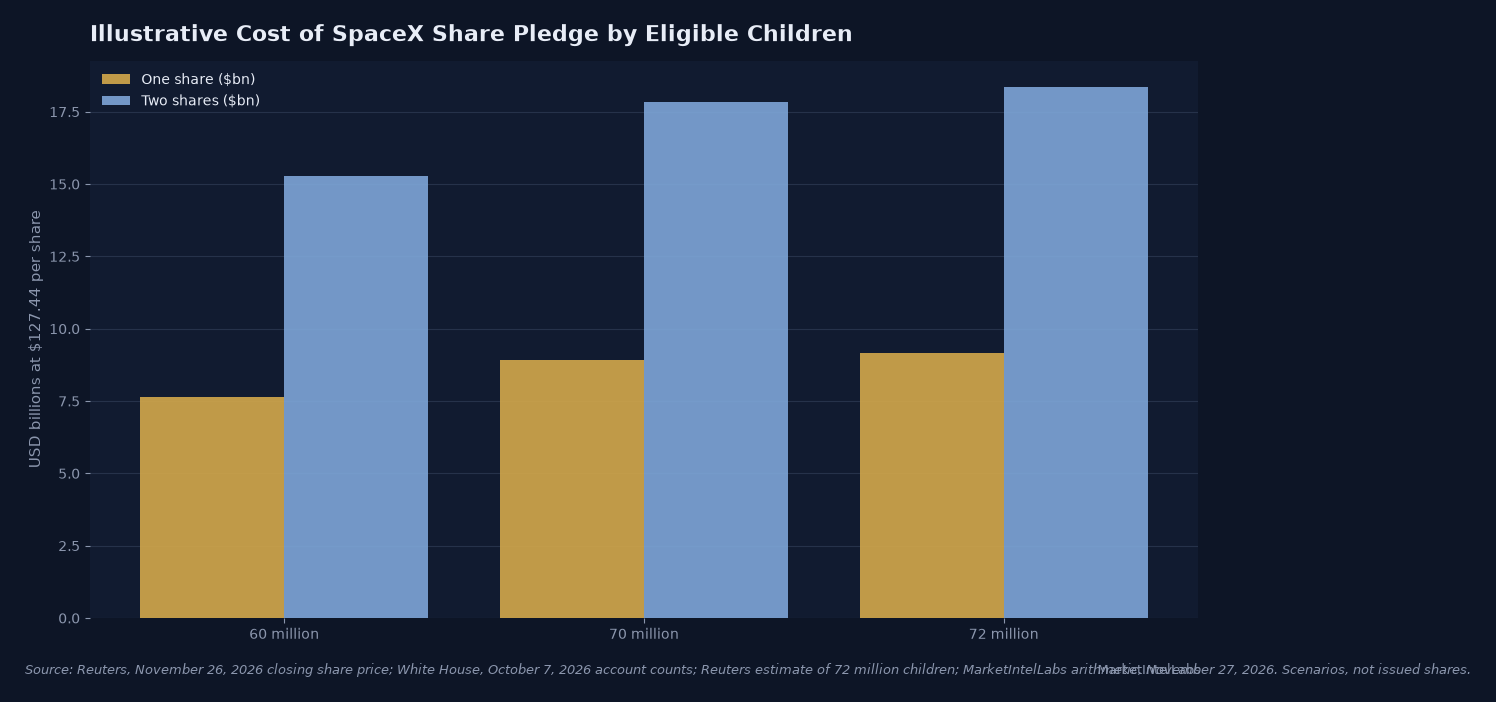
Reuters reported that SpaceX shares closed at $127.44 on November 25. Two shares at that price equal $254.88 per recipient. Applying that price to Reuters' roughly 72 million children produces about $18.35 billion. This is an illustrative mark-to-market value of stock, not $18 billion in cash going out of SpaceX's treasury. If the number of eligible accounts is smaller, or the trading price changes before delivery, the marked value changes too.
The original chart below uses the Reuters close and three recipient-count scenarios: 60 million as a rounded floor near the White House's automatic-enrollment count, 70 million near its created-account count, and 72 million from Reuters' broad child estimate. None of those sources says that its entire cohort meets SpaceX's undefined currently active test. The chart therefore compares scope assumptions; it does not forecast actual issuance. At 70 million recipients, the two-share mark would be approximately $17.84 billion, while the single corporate share would carry about $8.92 billion of market value at the same price.
There is another cost distinction. If SpaceX issues a new Class A share, the company gains no ordinary cash proceeds if the share is donated without payment, while existing holders own a slightly smaller fraction of the expanded share base. Accounting recognition and any tax effect require the terms of the actual transaction; neither can be read from the market value alone. Musk's personal share would leave the outstanding count unchanged if transferred from existing holdings. It would instead reduce his economic ownership of the class transferred, subject to whatever rights that class carries.
Reuters reported that Musk held about 6.42 billion SpaceX shares as of June. That aggregate cannot be used as a precise subtraction base for a November gift without identifying its classes, subsequent transactions and the gift's source. Reuters also reported a separate commitment by SpaceX president Gwynne Shotwell and her husband for shares benefiting more than 2 million children. SpaceX's November 25 release refers to Shotwell's personal gift of more than 2 million shares. Treat that as a separate program, not an extra share on top of Musk's two for every recipient.
How new shares would change SpaceX's cap table
SpaceX's September 30 Form 10-Q says that as of October 15 it had 8,246,541,218 Class A shares and 5,334,522,491 Class B shares outstanding. Those dated figures allow a scale check, not a current post-gift count. If 70 million new Class A shares were issued and nothing else changed, Class A outstanding would increase by roughly 0.85% from the October 15 base. Against the combined Class A and B shares then outstanding, the addition would be about 0.52%. These are illustrations from the SEC counts, not company guidance.
A 72 million-share corporate distribution would be a little larger; the personal transfer of the same number of existing shares would not add a second round of dilution. Mixing the two is an easy way to double-count. Any actual percentage would depend on the share count on the issue date, future employee awards, repurchases and other corporate actions. SpaceX's third-quarter results separately reported equity awards linked to its August Cursor acquisition, another reason an October denominator cannot be frozen indefinitely.
Class matters as well as count. SpaceX's June IPO prospectus filed with the SEC says Musk would be able to control matters requiring shareholder approval and elect a majority of directors through his Class B holdings. The company's November gift specifically names Class A shares. Even millions of new Class A owners do not automatically receive the founder's Class B board-election rights. The cap-table story is wider public economic participation with limited change to control unless a different class or governance arrangement is subsequently disclosed. Our report on the SpaceX merger and shareholder vote tracks a separate governance question; it should not be conflated with this gift.
SpaceX's June prospectus also describes a May 2026 five-for-one stock split reflected retrospectively in its share information. Do not compare old share prices with November's price without adjusting for the split. A nominal number of shares does not tell a reader the stake's worth on its own. Price, class, the count of outstanding shares and the transfer date are all part of the calculation.
How a child's account could receive a stock gift
The Internal Revenue Service's October 26 Internal Revenue Bulletin describes temporary rules for qualified general contributions to Trump Accounts. It says a qualified stock contribution can be stock of a domestic corporation that is publicly traded and meets other conditions. SpaceX's exchange-listed Class A shares satisfy the visible publicly traded part of that description; the IRS also requires that qualifying stock not be subject to pre-existing transfer restrictions when contributed. The IRS says qualified stock can be contributed directly into qualifying individual accounts rather than acquired with account funds; that matters because ordinary account investments during the growth period are otherwise restricted.
Those rules do not make SpaceX's announced plan self-executing. The IRS says a Treasury acceptance agreement will specify contribution details, and its discussion requires equal contributions to account beneficiaries in a qualified class as of an applicable record date. The contribution and its class must qualify under the rule; an issuer cannot declare an unspecified nationwide population delivered by press release. Account trustees must be able to book the stock, a responsible party must be identifiable for a minor, and the donor's actual shares must clear the relevant transfer restrictions. We cannot tell from the issuer release which trustee and record date will be used.
The same IRS bulletin describes a holding rule for qualified stock contributed to these accounts: generally no sale before the earlier of five years after contribution or the beneficiary's growth-period end, subject to listed exceptions. That is not a promise that the stock will retain the November trading price. A child's credited share could gain or lose value during the restriction period. The White House says a parent or guardian needs to claim an automatically created account to manage it; the practical sequence is account creation, verification and claim, acceptance of a qualifying contribution, trustee receipt, then confirmation in an account statement. SpaceX has not published those operational steps for its gift.
A personal share delivered outside a Trump Account could follow a different legal and tax path from a qualified contribution through that program. Reuters reported that SpaceX did not answer whether Musk's own donated shares would be linked to the accounts. That gap is material for eligibility, reporting, custody and whether the same restrictions apply to each of the two shares. The corporate release calls his match personal, but does not identify the transferring entity or specify whether it would go directly to trustees. Opening an account is not proof the stock has arrived.
Donor deductions, corporate tax treatment and a recipient's later taxes cannot be computed from a press release. The IRS temporary regulations establish a possible contribution route, not an individualized tax ruling for SpaceX or Musk. The final record must identify the donor, transfer price, trustee valuation and eligible beneficiaries. Tax questions warrant qualified professional advice; a market close is not a substitute for those transaction details.
Why this matters beyond a giveaway
The capital story is larger than the gift's publicity. SpaceX reported third-quarter revenue of $14.575 billion, including $7.560 billion from its Super Intelligence segment and $5.248 billion from Connectivity. It reported $19.593 billion of capital expenditure for the quarter, of which $16.444 billion was allocated to Super Intelligence. These are company-reported figures, not a claim that the giveaway pays for the buildout. In fact the gift of newly issued stock would not raise capital the way a share sale does.
That distinction gives the reported charm-offensive framing a testable meaning. Reuters presented the share pledge as a bid to broaden support for SpaceX's satellite and AI businesses amid scrutiny of computing infrastructure. SpaceX, meanwhile, reported in its third-quarter earnings release that nameplate compute had reached 1.7 gigawatts on September 30, up from 1.4 gigawatts on June 30. Inviting children into the shareholder register may change who has a financial stake in the company. It cannot by itself supply electricity, satellite capacity or regulatory clearance. The spending figures show where cash demand sits; the gift concerns ownership.
The Federal Communications Commission's November 25 order, DA-26-1273, grants SpaceX's orbital data-center satellite application in part and defers part, subject to conditions; the proposal involved 1 million satellites. That regulatory record is a separate milestone from the stock pledge, not evidence that a million satellites are already deployed or that future infrastructure costs are funded. The FCC's conditional, partial grant supplies a dated reason to examine the space and AI capital program. It does not guarantee commercial execution. Our coverage of litigation involving SpaceX and Grok shows another risk investors need to keep distinct from the donation headline.
For Tesla investors, the link is disclosed rather than imagined. Tesla's September 2026 quarterly filing says it holds a SpaceX equity investment, values it using a fair-value election, and records realized and unrealized changes in other income or expense. The filing lists that investment at $2.865 billion at September 30 and says its chief executive is also SpaceX's chief executive. A change in SpaceX's traded price may therefore affect Tesla's reported investment value, but a pledge by Musk or a new SpaceX share for a child is not a transfer of Tesla stock. The precise accounting effect depends on later fair-value measurement and the final gift terms, not on multiplying Tesla's stake by Reuters' $18 billion headline.
Other listed launch, satellite and defense companies face a sector signal rather than a direct entitlement. SpaceX's third-quarter results show a space segment with $1.767 billion of quarterly revenue and a $7 million operating loss, while Connectivity generated $2.367 billion of operating income. Investors comparing another launch operator with SpaceX should compare its contract backlog and operating economics, not assume the share donation raises a rival's cash flow. The pledge could deepen retail attention to the space trade. It is not evidence of any change to NASA procurement, national-security launch contracts or competitors' margins.
The largest uncertainty is whether the pledge becomes an account entry. SpaceX has put an issuer announcement on the record, and the SEC, IRS, White House and FCC records describe the corporate shares, account rules, enrollment baseline and satellite authorization; as of November 27, those public documents do not show a completed share distribution, a final recipient roster, or binding terms for Musk's separate personal transfer. A dated trustee acceptance agreement, issuance notice, shareholder count update or recipient statement would narrow that gap. Until then, $18 billion remains the market value of a reported plan under an assumed recipient count.
Frequently Asked Questions
Will every American child receive two SpaceX shares?
Reuters reported that Musk said every U.S. child would receive two shares. SpaceX's November 25 company announcement commits one newly issued Class A share to each currently active Trump Account and says Musk will match that number personally. The company has not published a final eligible-account count or proof of delivered shares, and Reuters said it got no answer on whether the founder's share would use the same accounts. The two formulations should not be treated as identical until delivery terms are published.
How much are two SpaceX shares worth for a child?
At the November 25 closing price of $127.44 cited by Reuters, two shares had a marked value of $254.88. That is a dated trading-price calculation, not cash available to a child and not the value on the day any stock ultimately arrives. The IRS describes restrictions on selling qualified stock contributed to a Trump Account during its holding period. A share's price can move in either direction while held.
When would the SpaceX shares arrive?
Reuters reported Musk's stated plan for company shares to transfer in December 2026 and his personally donated shares after his lockup expires in June 2027. SpaceX's November 25 release does not report a completed transfer or a firm trustee processing calendar. A family should distinguish the dates Musk proposed from an account statement showing the actual deposit.
Would the giveaway dilute SpaceX or change Musk's control?
New Class A shares issued by SpaceX would expand its share count and modestly dilute existing economic holders; an existing share from Musk would change ownership without expanding the count. SpaceX's October 15 Class A and B counts in its SEC filing make a 70 million-new-share scenario about 0.52% of the combined then-outstanding shares. Its IPO prospectus says Musk's Class B holdings give him control over board elections. A gift of Class A stock does not automatically transfer those rights.
Can parents sell or claim the shares now?
There is no completed SpaceX distribution in the company record as of November 27. The White House says a parent or guardian can claim an automatically created Trump Account through the program's app, but that is different from receiving donated SpaceX stock. The IRS temporary rules also impose a minimum holding period on qualifying donated stock, with specified exceptions. Families would need account-specific confirmation and the applicable terms before assuming any sale is possible.
Watch for the December 2026 corporate transfer Reuters reported Musk proposed, then for an issuer update that identifies the recipient test and the final issued-share count. June 2027 would be a separate check on Reuters' account of the founder's lockup and personal transfer. Until statements show credited shares, this remains an announced commitment with uncertain reach and value.
This content is for informational purposes only and does not constitute financial advice. Past performance is not indicative of future results. Consult a qualified financial advisor before making investment decisions.
What we don't know yet
- SpaceX has not published the final number of active Trump Accounts eligible for its new shares.
- SpaceX has not published a trustee acceptance agreement or a record date for the gift.
- Reuters reported that SpaceX did not answer whether Musk’s personal shares would go through Trump Accounts.
- The company has not reported completed delivery of either pledged share as of November 27.
Get daily intelligence delivered
Create a free account for the Daily Brief every weekday and The Week Ahead every Sunday. No card required.