Mortgage Rates Drop to 7.32%, First Weekly Decline After Two Weeks Pinned at 7.40%


The 30-year mortgage finally stepped down off the ledge it had been sitting on. Freddie Mac's weekly survey put the average 30-year fixed rate at 7.32% as of Oct 22, down from 7.40% the week before, the first decline after two weeks pinned to that round number. The 15-year rate slipped less dramatically, to 6.68% from 6.71%.
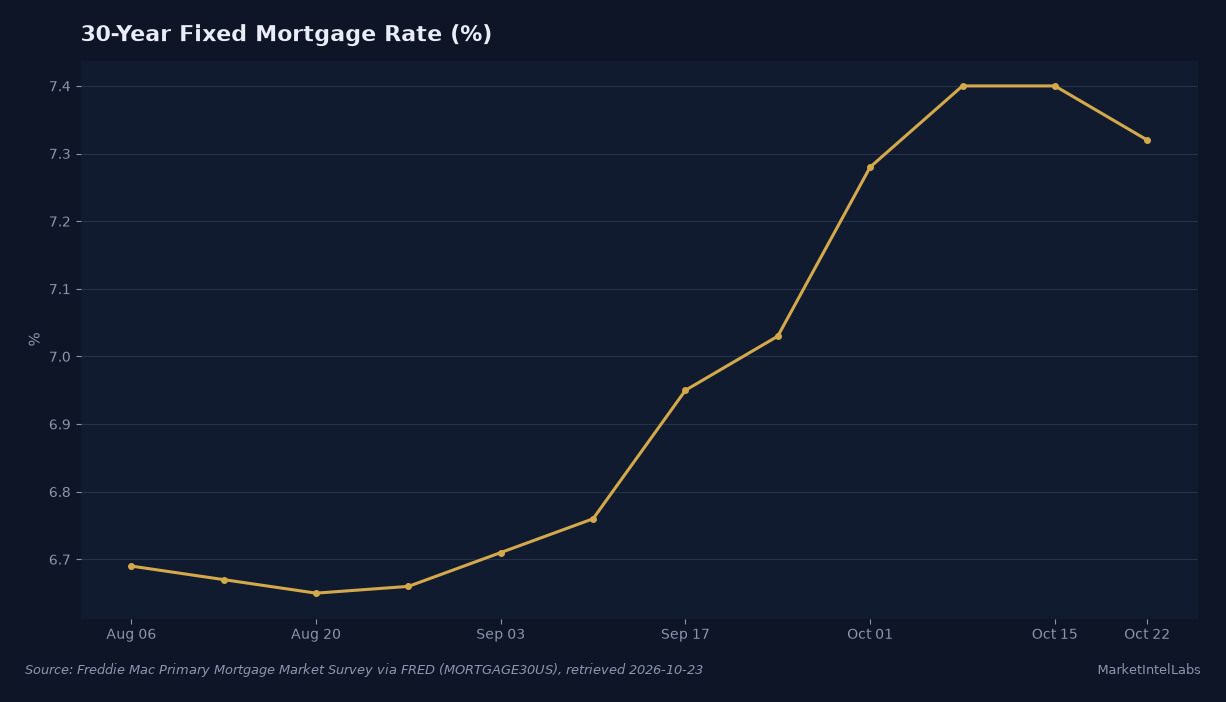
Call it a small breather, not a repricing. Eight basis points is a meaningful break after two straight weeks at 7.40%, but it takes the 30-year rate only back to roughly where it stood in early October. It is still about 1.1 percentage points above the 6.19% average of a year ago, and it does nothing on its own to move the housing market out of the deep freeze that recent prints have documented.
Related reading: Mortgage Applications Drop 5.3% Even as the 30-Year Rate Falls to 7.41%.
The affordability math shows why the headline understates the stress. On the $417,500 median existing-home price reported by the National Association of Realtors for September (its existing-home sales report, released Oct 13), a buyer putting 20% down finances about $334,000. At 7.32%, principal and interest run roughly $2,294 a month. That is about $18 less than at 7.40%, a rounding error against the bigger problem: the same buyer at last year's 6.19% rate would have paid about $2,043, or $251 a month less. A year of higher rates has added roughly $3,000 a year to the carrying cost of a median-priced home, and an 8 basis point drop takes back about a week's worth of that.
The decline is worth watching not because it is large, but because it is the first signal in a while that the upward grind may be pausing. The late-summer run pushed the 30-year rate to 7.40%, and mortgage costs have sat near three-year highs through early autumn. Falling alongside the broader rate complex this week, the move tracks a pullback in long-term Treasury yields rather than any shift in the Federal Reserve's posture; CME FedWatch data as of Oct 22 priced in roughly an 84% chance the Fed holds at its late-October meeting, with a small rate hike still carrying meaningful odds; a further rate hike, while not the base case, is not fully off the table.
Related reading: Mortgage Rates Hit 7.40% as Housing Demand Cools.
Demand has already responded to the earlier run-up, and it did not need rates at 7.40% to get there. The National Association of Realtors reported pending home sales fell 7.3% in September to an index of 66.0 (released Oct 20), the lowest reading since the series began in 2001, on top of the record-low activity already baked into the summer. The Mortgage Bankers Association's Weekly Applications Survey for the week ending Oct 16 put total application volume down 5.3%, with the seasonally adjusted purchase index slipping a further 7% even as rates showed signs of easing, and the NAHB/Wells Fargo housing market index sat at 29 in October (released Oct 19), a 14-year low. Put together, the market has been grinding down for weeks on rates below today's level; the buyers most sensitive to cost have already exited, so the marginal benefit of an 8 basis point drop is limited to a thin remaining slice.
Sellers feel the same squeeze on the other side. Inventory has crept up, with NAR counting 1.60 million homes on the market in September, a 4.8-month supply, but that supply sits against the weakest buyer demand in a generation. The lock-in effect, where owners with mortgages near 3% to 4% refuse to give them up for a 7% replacement loan, keeps turnover low and forces buyers to choose between scarce resale stock and a new-home market that is itself pricing in the higher debt cost. Builders, facing their own financing and labor costs, have cut prices rather than chase volume, which is its own indicator of how soft demand has become.
Related reading: MBA Mortgage Applications Fall 4.2% as Rates Hit 7.49%.
So what would make this week more than noise? The question is whether 7.32% holds or becomes the start of a genuine drift lower, and that depends almost entirely on the Treasury market and the Fed rather than on housing fundamentals. If long yields keep easing into the Fed's October statement, rates could give back a little more and draw back a sliver of the buyers who stalled at 7.4%. A snap back in yields, on the other hand, would put 7.40% back in play quickly, and the market has already shown it does not need rates that high to stall.
The next hard data points come quickly. The October Freddie Mac surveys land every Thursday, and the NAHB's next builder reading follows; new residential sales for September and the next existing-home sales print round out the picture. Each carries more weight than one weekly rate move. For now, a buyer watching a $2,294 monthly principal-and-interest payment on a median-priced resale has one thing this week that was missing last week: a payment that is no longer rising. That is relief, but it is relief measured in dollars per week, not dollars per year, and the market is nowhere near solving the affordability test that put it here.
Related reading: Mortgage Rates Hit 6.95 Percent and Locked-In Sellers Are Not Biting.
This content is for informational purposes only and does not constitute financial advice. Past performance is not indicative of future results. Consult a qualified financial advisor before making investment decisions.
Get daily intelligence delivered
Create a free account for the Daily Brief every weekday and The Week Ahead every Sunday. No card required.