Housing Week: 30-Year Rate Eases to 7.24% but Home Payments Stay 12% Higher Than a Year Ago

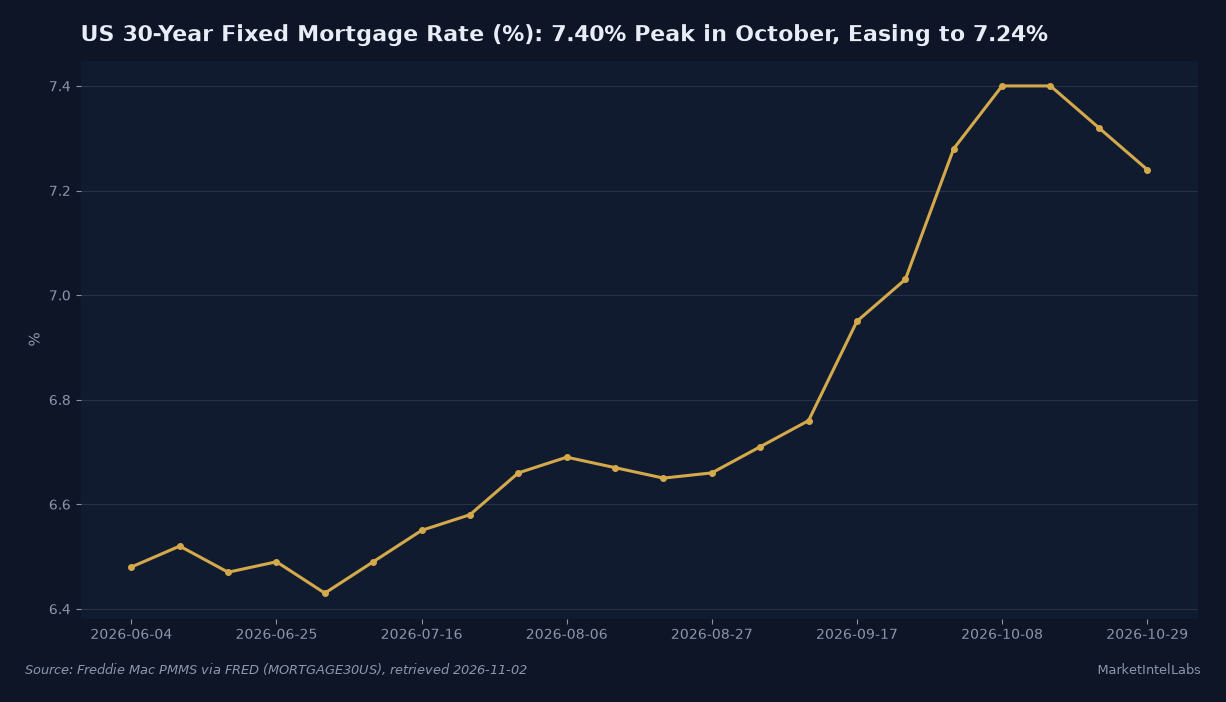
The 30-year fixed mortgage rate averaged 7.24% for the week ending October 29, Freddie Mac\'s Primary Mortgage Market Survey shows, the lowest reading in five weeks. That is a real step down from the 7.40% the survey printed for two straight weeks in mid-October. It is still roughly 1.1 percentage points above the 6.17% of a year ago, and that gap, not the single weekly print, is what keeps this market expensive.
Run the affordability math and the numbers bite. On a median-priced home around $432,900, with 20% down, the principal and interest payment at 7.24% is about $2,360 a month. The same home carried about $2,114 a month at last October\'s 6.17% rate. That is roughly $246 more per month, or about 12% higher, before taxes and insurance.
Related reading: Mortgage Rates Fall to 7.24%, Lowest in Five Weeks.
Reverse the lens and the purchasing power loss is starker. The $2,114 monthly budget that financed about $346,000 of principal at 6.17% a year ago funds only about $310,000 at 7.24% today, roughly 10% less home for the same money. That compression is the mechanism under a flat sales line: demand has not vanished, it has been repriced by the rate.
The new-home market printed its September numbers this week and the picture is one of slow digestion. New-home sales fell 5.3% to a 676,000 annualized rate, and months\' supply of new homes stayed near 8.4, well above the roughly six months that marks a balanced market. Total housing starts slipped to a 1.221 million annual pace, with single-family building holding up better than the overall count, and permits came in near 1.40 million. Builders are still pulling permits; they are simply not guessing on standing inventory.
Related reading: New Home Sales September 2026: Fall 5.3% to 676,000.
Prices this week showed the split that defines the autumn. Case-Shiller\'s national index rose 2.1% year over year in August, and the Q3 median existing-home price came in at $432,900, up 1.7% with about 78% of metros posting gains. But the heat is off the margin: pending home sales hit a record low in September, down 7.3% from a year ago, home price cuts are running near a four-year high, and the NAHB builder sentiment index fell to 29 in October, a 14-year low, as builders lean on incentives rather than on stickers.
Related reading: Home Prices: Q3 Median Rises 1.7% to $432,900.
Add the rate context and the near-term path is not a given. The Federal Reserve held its target range at 3.75%-4.00% at the late-October meeting, and the market still prices a possible December hike. Mortgage applications rebounded 3.4% in the latest weekly reading as the rate eased, a helpful sign, but a single week does not reset a 7% mortgage market. If long-end rates refuse to drift lower, the current easing in mortgage rates can stall as quickly as it arrived.
Watch the weekly Freddie Mac survey the way you would a tape. The number that fell from 7.40% to 7.24% in a month is the same one that rebuilt the market\'s sticker shock over the summer; a drift back toward 7.40% would do far more to the payment math than any single monthly report. October housing starts land in mid-November, the NAHB index returns in mid-November, and Case-Shiller\'s September reading follows later in the month. None of them lead the rate.
If the 30-year holds above 7% through the winter, expect the autumn pattern to persist: builders answer with incentives and smaller floorplans rather than outright price cuts, sellers who must move keep trimming list prices, and transactions grind sideways into the spring. The February and March purchase-season prints will decide whether demand absorbs payments near $2,360 a month on a typical home, or whether a softer market forces those prices down. The rate is the rationing instrument, so it stays the number to watch.
This content is for informational purposes only and does not constitute financial advice. Past performance is not indicative of future results. Consult a qualified financial advisor before making investment decisions.
Get daily intelligence delivered
Create a free account for the Daily Brief every weekday and The Week Ahead every Sunday. No card required.