Grocery Prices 2026: Diesel at $6.18 Starts Showing Up in Fresh Produce

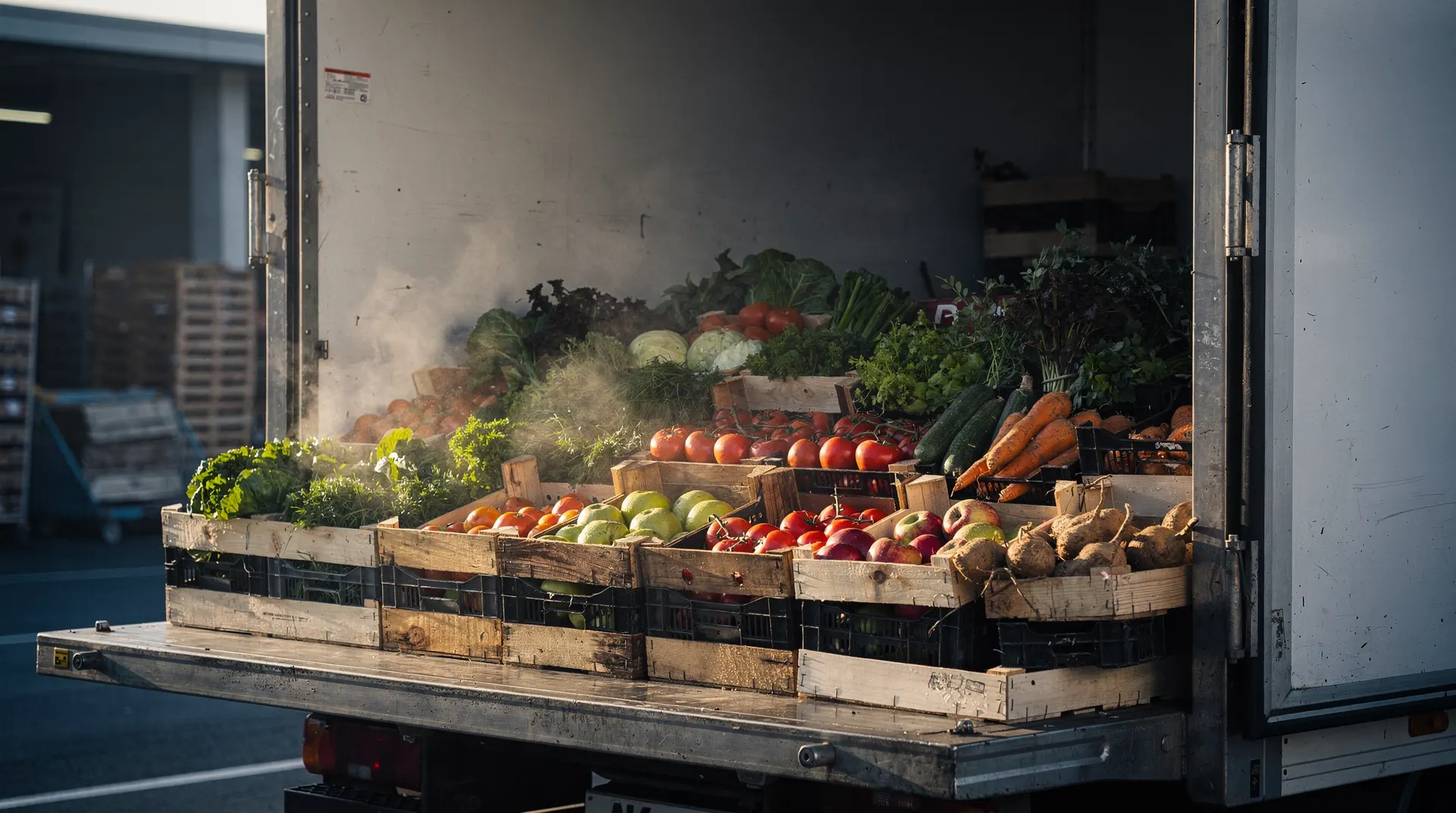
The grocery basket has been the quiet corner of this inflation cycle, and it is starting to get noisier. In the September consumer price index, fruits and vegetables rose 3.7 percent from a year earlier, the fastest moving category inside the food-at-home index, which itself was up just 1.8 percent. The divider between the two numbers is freight. A gallon of on-highway diesel averaged $6.179 in the week ending October 12, according to the Energy Information Administration, up from $3.665 in the same week a year ago. That is a 69 percent jump, and the products most exposed to it are the perishables that have to be hauled refrigerated and delivered fast.
Diesel is the workhorse fuel of the American food system. Almost everything a household eats spends part of its journey in a truck, and the heaviest, coldest, most time-sensitive loads are the ones that get to a grocery shelf only on a working diesel engine. When the price of that fuel climbs by two thirds, the freight contract a distributor signed a month ago does not cover the route anymore, and that gap has to land somewhere. The shelf price is where it lands.
Related reading: Diesel at a Record $6.53 Is a Household Number Too.
The data show the pattern starting to play out where the fuel load is densest. The Bureau of Labor Statistics put the fruits and vegetables index at 371.317 in September, against 358.019 a year earlier. Cereal and bakery products, in contrast, were up a far milder 0.3 percent over the same stretch, because a box of pasta moves cheaply and does not mind a warm warehouse. Dairy, at 1.4 percent, and the broader food-at-home index, at 1.8 percent, sit between the two extremes. The ordering is not random. It maps to how much fuel and cold chain each category consumes per dollar of retail price.
None of this shows up as a headline number yet, because the overall food-at-home index is still running below the 3.7 percent headline CPI. Groceries remain, on balance, the affordable part of the budget after two years of intense pressure. But the September print is the first month in several where the produce aisle outran the rest of the basket, and the diesel that moves it has stayed near its record even as pump gasoline has eased in recent weeks.
For the broader framework, see our Fed policy coverage.
Related reading: Diesel Prices Near $6.18, Up 69% Year Over Year: What Freight Costs Next.
The cream also sits on freight. Retail diesel hit a record $6.53 a gallon in September, per EIA data, and sits at $6.179 in the most recent weekly reading. Pump gasoline, by contrast, fell to a $4.2988 national average on October 18, per AAA, because drivers are pulling back on discretionary trips. Households can skip the occasional drive. They cannot skip putting food in a cold truck. That asymmetry is why fuel moves through the food list differently than it moves through the gas pump.
The household dollar cost is bigger than the food line alone. Economists at Moody's, speaking to the Associated Press, estimate the current war has cost the average American household about $2,000 a year, with roughly $1,100 of that in higher energy and another portion in interest costs. The energy share alone has been growing by about $50 a week. For a family that fills a tank twice a month, that is a bill that lands before a single grocery bag reaches the kitchen counter, and it does not appear in any single gas station sign.
Related reading: Diesel at $6.18 a gallon: the hidden cost in every delivery.
There is a real chance the food line stays tamer than the energy one through this cycle. Food retailers run thin margins and eat cost increases to hold market share, and the produce spike in September came partly from weather and partly from freight, not from a structural shortage. A supermarket chain absorbs a few weeks of higher delivery costs before it quietly reprints a price tag. That lag is exactly what makes the fresh produce number the signal to watch rather than the basket average. When processed and shelf-stable goods start to move, the freight increase has already been fully absorbed and the shock has run its course.
The bear side is just as real. Diesel at six dollars is not a rounding error that logistics budgets absorb. It feeds into everything from the lettuce in a warehouse to the orange juice on a pallet, and if crude stays elevated into the winter heating season, the pressure on refrigerated food and on trucking capacity compounds at once. The September produce number is one month, not a trend, but it is the first month where the fuel spike and the food line moved in the same direction after a stretch where they did not.
Related reading: Diesel Sets a New Record at $6.53 While Crude Slides. Your Groceries Don't Care About Crude..
The practical reading for a household is to watch the fresh produce and dairy lines in the coming CPI prints, confident that fruit is the canary for a fridge full of diesel-dependent groceries. A produce-heavy basket is up against the steepest freight climb in recent memory, and that is not a projection. It is the arithmetic of a food system that runs on diesel.
This content is for informational purposes only and does not constitute financial advice. Past performance is not indicative of future results. Consult a qualified financial advisor before making investment decisions.
Get daily intelligence delivered
Create a free account for the Daily Brief every weekday and The Week Ahead every Sunday. No card required.