Ether ETFs pull in $270M in a sharp reversal as regulators build slowly

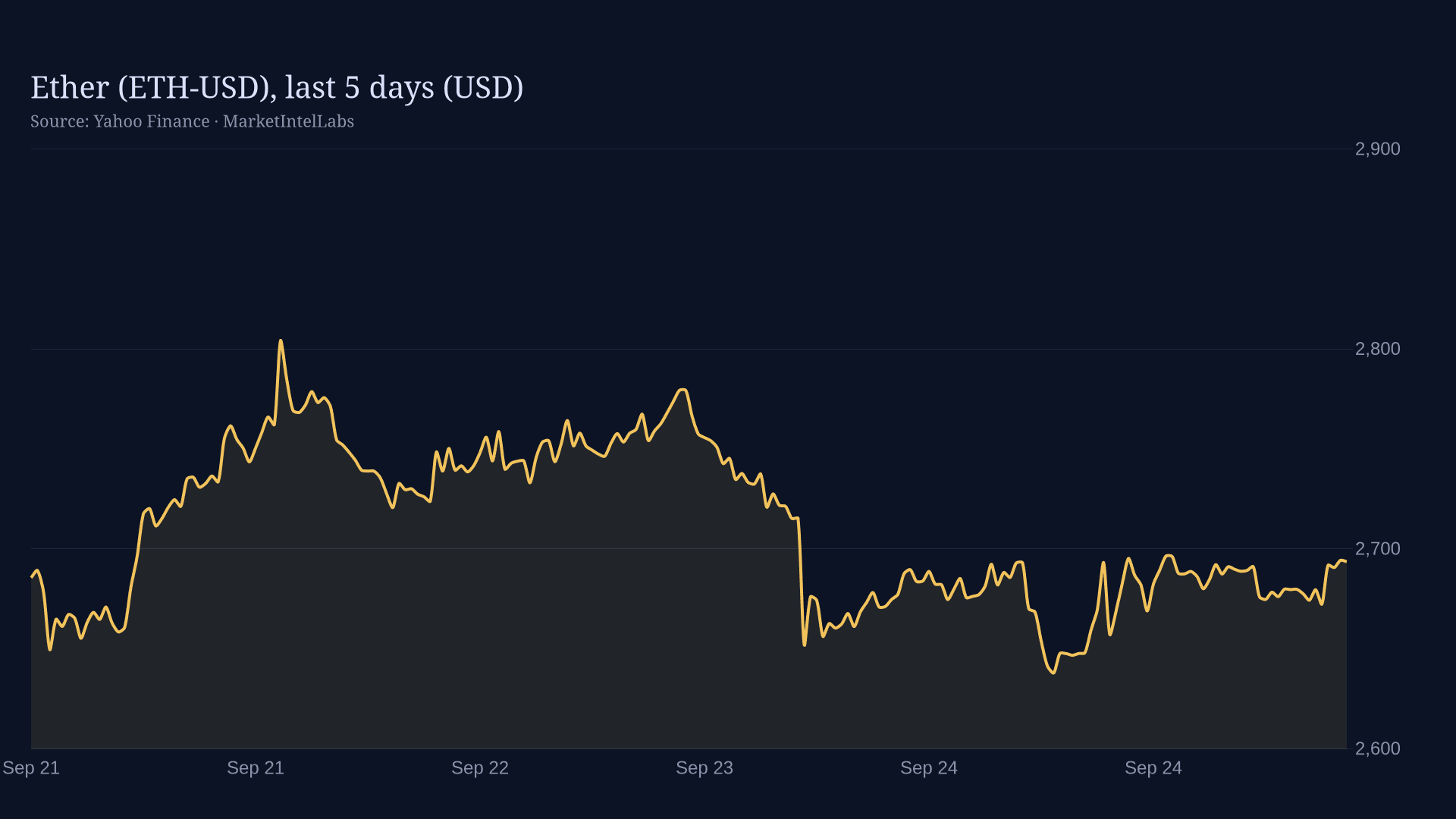
Bitcoin grabbed the week's flow headlines, with more than $2 billion of net creations across its spot ETFs in three sessions. The quieter institutional story sat right beside it: spot Ethereum exchange-traded funds reversed a roughly $140 million outflow week with a $270 million single-session inflow, and Ether was trading around $2,679, about 2.6% above last Friday's close.
The reversal in Ethereum fund flows is the more telling number of the two, because it signals that the institutional bid is broadening rather than concentrating in Bitcoin. On September 21, BlackRock's ETHA contributed $110 million to the session, taking its cumulative inflows to roughly $13.07 billion, while Fidelity's FETH added about $73 million, per mainstreamcryptonews. For the broader crypto week in review, see our Bitcoin and crypto coverage. The $270 million total assumes a different character after a week in which ether funds had collectively shed about $140 million. Fund flows in crypto are sticky once they turn; a single day does not make a trend, but it breaks one.
Ether's price action reflects that undercurrent. The coin ran to $2,779 intraweek before easing to about $2,679, roughly 2.6% above where it started the week. On-chain breadth supports the base: a record near 207 million wallets now hold a non-zero balance, per Independent Reserve data, a marker of widening retail participation even as the institutional flows lag Bitcoin's. The honest caveat is that Ether still trades about 40% below its August 2025 all-time high, so this is a recovery within a drawdown, not a breakout. It remains underpinned relative to Bitcoin's institutional bid, which is another way of saying the flow advantage sits with BTC until Ether funds string together more than one strong session.
The other quieter story of the week ran through the agencies. The SEC on September 17 issued a five-year Innovation Exemption allowing certain tokenized National Market System stocks to trade on public blockchains without exchange registration, an explicitly temporary scheme running to September 17, 2031, with permissioned trading and KYC required. The CFTC moved in the same direction: Chair Mike Selig called crypto market-structure rules under existing authority "go time," filed two pre-rules with the White House under RIN 3038-AF80, and issued a no-action letter covering wallet-app routing to regulated derivatives. The SEC also sent a crypto custody proposal to the Office of Management and Budget.
The counter-case deserves equal weight. Agency rules, unlike statutes, can be rescinded by a later administration, and a 2024 Supreme Court decision leaves them open to judicial challenge. Congress remains the durable backstop, and there the week ended with a setback that was procedural rather than final: the Senate failed to invoke cloture on the Digital Asset Market Clarity Act by a 49 to 50 vote, but the bill stays on the calendar. The direction of travel this week was set by regulators building around existing authority, not by lawmakers passing law.
What to watch next week is the same question that closes every flow-driven week: whether institutional creations persist or fade. For Ether specifically, the test is whether the September 21 reversal turns into a second and third day of inflows, because that is what would separate a one-off bounce from a genuine broadening of demand away from Bitcoin.
Disclaimer: This content is for informational purposes only and does not constitute financial advice. Past performance is not indicative of future results. Consult a qualified financial advisor before making investment decisions.
Get daily intelligence delivered
Create a free account for the Daily Brief every weekday and The Week Ahead every Sunday. No card required.