Container shipping rates: Drewry World Container Index drops to $4,389 as supply catches up

The week of November 2 brought another step down for container shipping costs. The Drewry World Container Index eased 1% to $4,389 per 40-foot container in the November 5 assessment, its second straight weekly decline, and the composite still stands a striking 124% above the same week of 2025.
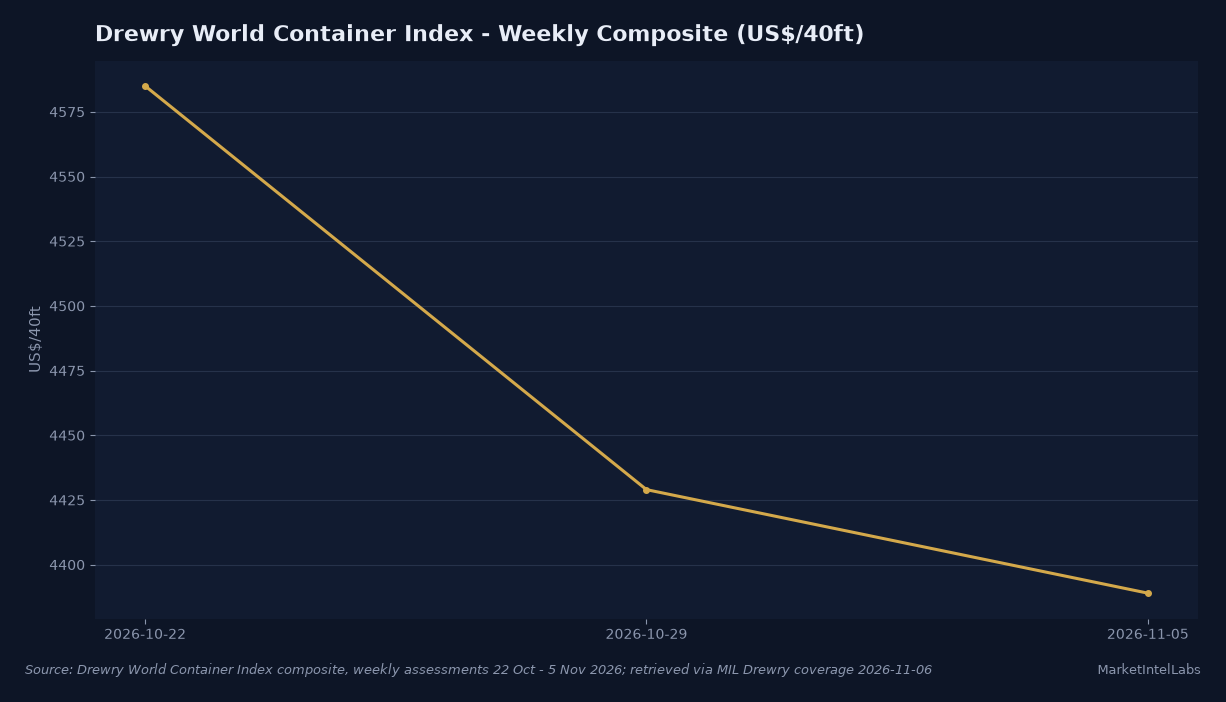
Drewry attributed this week's decline to lower rates on the trans-Pacific and Asia-Europe lanes as port congestion at major Chinese ports began to ease and demand softened at Chinese load ports. The drop follows a 3% fall in Drewry's 29 October World Container Index print, which took the composite to $4,429 per 40-foot container, so the index has slipped about 4% since the 22 October World Container Index reading of $4,585, when the market was still absorbing fall peak-season volume.
Related reading: Container rates snap back: Drewry WCI composite jumps 3% to $4,485 as Asia-Europe legs reprice.
On the trans-Pacific, the New York route carried the move: rates from Shanghai to New York fell 3% to $9,303 per 40-foot container, while Shanghai to Los Angeles held unchanged at $7,539. The unchanged Los Angeles leg in particular points to a market where the worst of the eastbound import surge has passed. Vessel waiting at Shanghai improved to about 35 hours last week, Drewry said, as better weather and softer demand cleared a backlog that had built over several weeks.
Carriers are responding by sailing lighter. On the trans-Pacific, Drewry counted three blank sailings announced for next week, down from five this week, a sign that effective capacity is rising even as schedules stay thin. On Asia-Europe the pullback is similar: five blank sailings are set for next week, down from eight this week. Fewer blanked voyages mean more ships actually sailing, and more supply pressing on rates.
Related reading: Container Freight Rates: Drewry WCI Falls 2% to $4,351.
Asia-Europe lanes were mixed in the November 5 print. Rates from Shanghai to Rotterdam eased 2% to $3,615 per 40-foot container, while Shanghai to Genoa held at $4,166. Carriers are trying to push through FAK increases in mid-November to firm up positions ahead of next year's contract negotiations, but effective capacity keeps climbing as Suez transits resume and shorten transit times.
The east-west market is under two-way pressure. Suez Canal transits are increasing, with roughly 60% of Asia-Europe capacity now routing via Suez and 53 vessels crossing in both directions last week. An accelerated return to Suez carries its own risk for shippers: overlapping arrivals from the Suez and Cape of Good Hope routes could cause vessel bunching and cargo congestion at European ports. Drewry also flagged an uncertain situation in the Strait of Hormuz after the United States carried out another limited round of strikes against Iran, and a potential watchmen's strike at the ports of Los Angeles and Long Beach as further risks to shippers.
Related reading: Container rates roll over from the peak as the front-loaded import surge cools.
Drewry's own projection is for a further decline in rates next week as effective capacity continues to build. For importers, the softening is welcome after a 12-month rally that has left ocean freight far above last year's levels, but the path is not smooth. The watchmen's strike risk at the two largest US container ports, plus any renewed Hormuz disruption, could reverse the easing quickly, and the mid-November FAK push shows carriers are still trying to defend rate levels into the contract season.
How far rates have come shows the scale of the past year's disruption. At $4,389 the composite still stands 124% above the same week a year earlier in Drewry's assessment, the footprint left by the Suez disruption and the fall import rush, and why even a soft multi-week pullback barely dents the year-over-year premium that importers are still paying against 2025 budgets. The weekly easing is a directional change, not yet an end to expensive freight.
Related reading: Suez Transits Jump 17% and Asia-Europe Rates Break First.
The watchmen's strike threat deserves particular attention because it sits on the US side of the busiest gateway. The ports of Los Angeles and Long Beach move a large share of US containerized imports, and a disruption to the watchmen who control vessel access would stall unloading even with no longshore picket. Drewry lists it among the risks to shippers this week, alongside the Hormuz uncertainty. Both are the kind of event that can interrupt a normal November for carriers that had been preparing for a calmer fourth quarter.
For anyone budgeting freight into 2027, the mid-November FAK increases are the near-term signal to watch. Carriers typically use the autumn months to set a floor ahead of contract negotiations, and Drewry notes the increases are being pushed through even as effective capacity climbs. A FAK push that partly sticks would cap how far spot rates fall in the next few weeks; one that fails would confirm that supply is winning the tug of war. Against that, the continued Suez return adds capacity from the other direction, which is why Drewry expects rates to stay flat to softer rather than rebuild.
What is dated next: the November 12 World Container Index print will show whether the second straight weekly decline continues, and the Los Angeles-Long Beach watchmen situation bears watching as a potential shock to the largest US gateway. The same forces that moved this week, port congestion trends, Suez routing and blank sailings, will set the tone for contract negotiations into 2027.
This content is for informational purposes only and does not constitute financial advice.
Get daily intelligence delivered
Create a free account for the Daily Brief every weekday and The Week Ahead every Sunday. No card required.