Container rates roll over from the peak as the front-loaded import surge cools


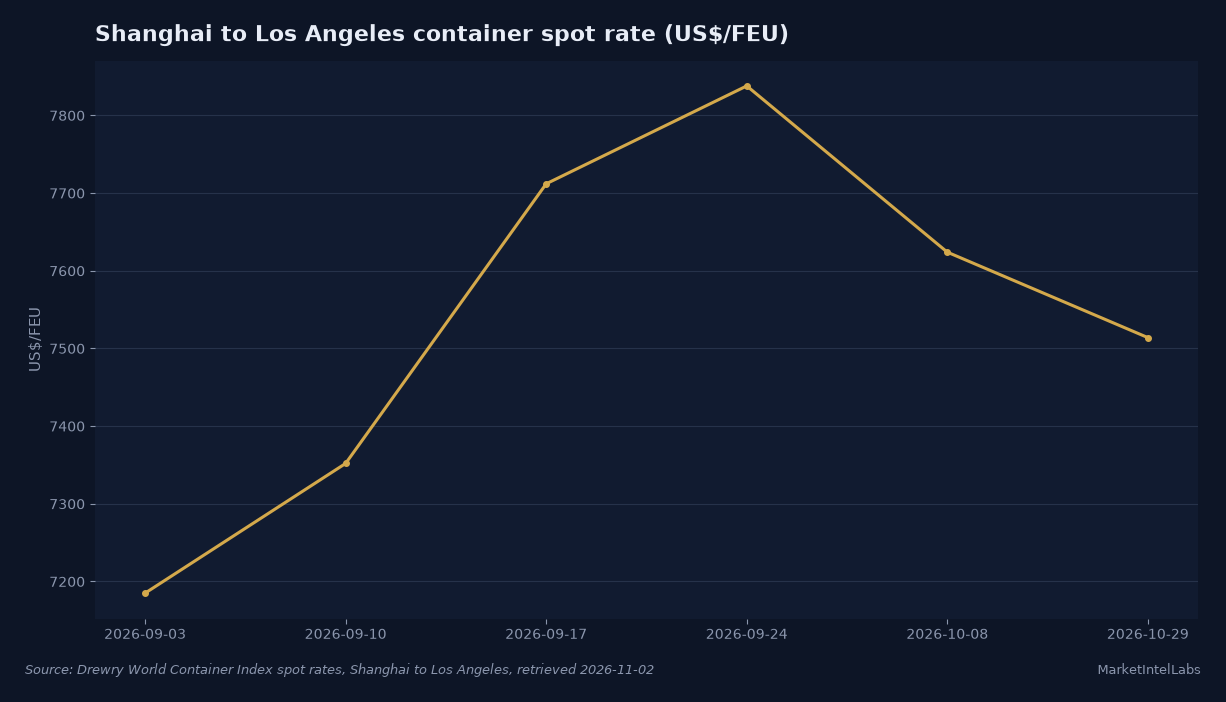
Container spot rates have turned over. Drewry's World Container Index fell 3% to $4,429 per 40-foot container in the 29 October assessment, and Shanghai to Los Angeles, the lane that carried most of the front-loaded surge, dropped 6% to $7,514 per FEU. Shanghai to New York slid 5% to $9,631. After a September in which the transpacific leg kept printing fresh highs, the weekly read is now lower for two reasons at once: the peak-season pull-ahead is paying out, and carriers are adding blank sailings faster than demand is adding cargo.
The pullback is best read against the run that preceded it. Through late September the composite hovered near $4,470 while the Shanghai-LA leg climbed from $7,185 in the first week of the month to $7,838 by the 24th. California's two biggest ports posted their busiest month ever in September, with Los Angeles at 1,042,652 TEU while Long Beach added a record of its own, so the physical surge was real. What changed is timing: importers pulled orders forward to land ahead of the holiday pipeline, and that pull-ahead borrowed volume from late October and November. The forward data now point down. Drewry's blank-sailing count on the transpacific went from five scheduled for last week to six for this one, capacity discipline that only delays the correction, and the consultancy expects rates to keep easing next week.
Related reading: Transpacific Container Rates Near Annual High at $7,884.
The question is whether this is the start of a sustained reset or a seasonal pause before the next wave, and the survey data point to the second reading. September's ISM Manufacturing PMI held at 54.5, in growth for a ninth straight month, and the internals do not look like a market that is overstocked. New orders rose to 55.3. Manufacturers' inventories contracted to 48.6, back below the 50 line, while customers' inventories came in at 41.6, which ISM labels too low. That combination, low customers' stock with order books still climbing, is the profile of a market that has burned down pipeline inventory rather than built it up, which tends to set a floor under the next restocking leg rather than extend a downturn. The one hot reading is prices paid at 77.9, up 6.8 points in a single month, a pace that says factories are absorbing cost increases even as the goods they ship get cheaper to move.
The softening is also not spreading to every leg of movement. Dry bulk is running the other way: the Baltic Dry Index closed at 2,714 on 30 October, a two-week high, and stands roughly 38% above a year earlier even after giving back about 13% from its fourth-quarter spike. And the energy leg of freight cost keeps climbing. On-highway diesel averaged $6.35 a gallon in the week to 26 October, up 71% from $3.72 a year ago and $0.17 higher than early this month. For a shipper that is the difference between a cheaper ocean leg and a dear trucking leg: the box rate is how goods cross oceans, but diesel is how they reach the shelf. Composite goods movement is not getting cheaper; the cost is just moving from the ocean to the road.
Related reading: Container freight rates: WCI composite falls 3% as trans-Pacific peak finally eases.
What to watch this week is whether manufacturing confirms the easing. The ISM Manufacturing Report for October releases this morning at 10:00 a.m. ET, and new orders plus prices paid are the two sub-indices that will tell you whether the September profile held or cracked. ISM Services follows on 4 November, the next Drewry World Container Index prints Thursday, and NRF's import numbers over the rest of November will show whether the 11% month-on-month drop in ocean volumes actually shows up at the dock. My read of the freight tape this week: the box leg is normalizing toward a lower plateau, not collapsing, because nothing in the inventory data says a glut is building. Landed cost, meanwhile, has not loosened, because diesel and the bulk fleet are not cooperating. For anyone buying goods into the holiday quarter, the takeaway is to watch the ISM new-orders line, not just the container index, to see whether the next restocking wave has already started forming.
Related reading: Container Freight Rates: Drewry WCI Falls 2% to $4,351.
Related reading: LA-Long Beach Cargo Record Signals a Front-Loaded Peak Season as Container Rates Climb.
This content is for informational purposes only and does not constitute financial advice. Past performance is not indicative of future results. Consult a qualified financial advisor before making investment decisions.
Get daily intelligence delivered
Create a free account for the Daily Brief every weekday and The Week Ahead every Sunday. No card required.