Two Container Ships Sink in Strait of Hormuz as Shipping Attacks Escalate

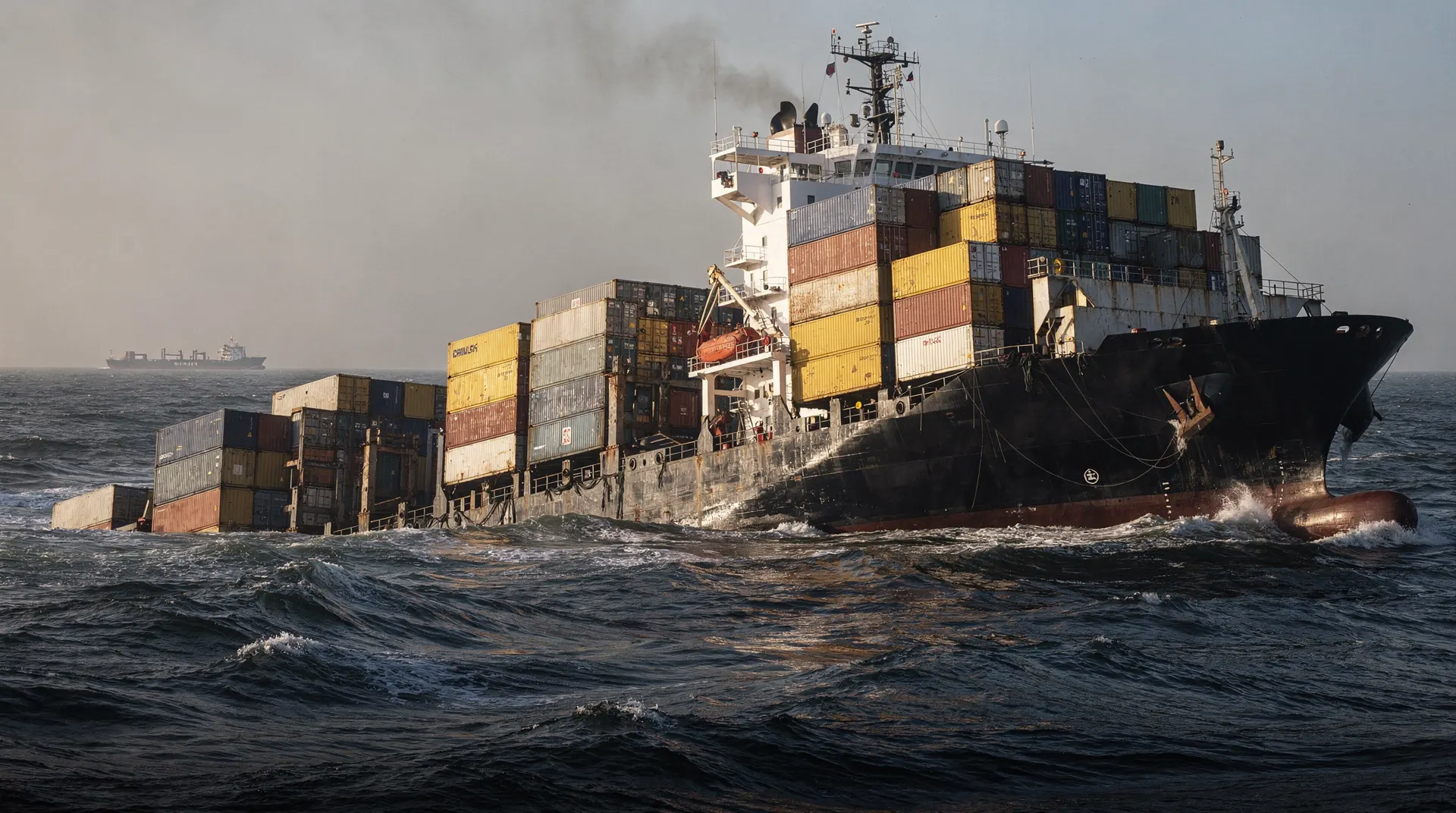
The world's most important oil chokepoint is now seeing confirmed vessel sinkings, not just strikes. The Maritime and Port Authority of Singapore (MPA) confirmed that two Singapore-flagged container ships, GFS PRIDE and GFS GISELLE, were hit by unknown projectiles while transiting the Strait of Hormuz on 13 and 14 October 2026 (Singapore time). GFS PRIDE caught fire and sank, with all 21 crew evacuated and no injuries reported; GFS GISELLE took hull damage and reached a safe anchorage under its own power, with all 22 crew safe and no Singaporeans aboard, per the MPA's official release.
What changed in the week since the house first covered a single tanker strike on 9 October is the jump from harassment to sunk and disabled hulls. The Guardian characterizes the past 48 hours as the sharpest uptick in Iranian attacks on shipping since the US-Israel war with Iran began, citing UKMTO's log of at least five incidents including drone strikes and six vessels attacked on a single Sunday. CNBC reports that more than 20 vessels, mostly oil tankers, have now been attacked this month across the Strait of Hormuz, the Persian Gulf and the Gulf of Oman. Iran's Revolutionary Guard, via the Tasnim agency, claims GFS PRIDE hit a naval mine; there is no independent evidence for that account, so the MPA's own framing of unknown projectiles remains the confirmed description.
Related reading: Freight This Week: Container Rates Slide as Tanker Costs Surge Through Hormuz.
The shifting risk registers in the insurance and freight market first. Tanker owners moving Gulf barrels now face war-risk premia that repriced upward as the Joint War Committee's listed-area scope confronts a strait where a hull literally went down. Diverted and paused loadings are the operational consequence to watch: when a refining port is set ablaze, as energy services cited around a 6% intraday oil jump on a UAE port fire, charterers reconsider the risk of loading at all rather than simply paying more for the freight. That is the mechanism that moves refined-product and crude tanker rates higher even before a single confirmed barrel is lost from the physical balance.
Brent and WTI have already responded. By 13:25 UTC on 14 October, WTI was up 1.33% to $95.39 and Brent had risen 13 cents to $105.56, a two-week high, after Brent spiked above $107 earlier in the session, per gvwire.com. A separate Houthi attack on the Saudi Aramco administration building in Dhahran, reported by the Wall Street Journal, adds a second front to the same war-risk calculus and is a contributor, not the driver, of Tuesday's premium.
For the broader framework, see our crude oil coverage.
Related reading: Strait of Hormuz oil shipping: crude flows recover to 10.3M bpd, attacks keep freight at $1M a day.
Balance this against the physical picture, because the premium is not yet confirmed barrels lost. FT analysis cited by the Guardian counts 24 ships hit in the two weeks to 11 October, of which three were refined-product tankers and two crude tankers; yet tonne-miles data show Gulf exports excluding Iran still near 81% of pre-war levels, and CENTCOM reported 19 million barrels moved through the strait on Monday. In other words, the chokepoint is still flowing at near-normal volume and the price move is traders' expectation of disruption, not the aftermath of it. That distinction matters to every downstream desk: the pass-through into freight rates, refined-product cracks and eventually retail fuel is real only to the extent the sinkings translate into rerouted or paused loadings, and that translation has not fully happened yet.
Who pays sits on both sides of the ledger. Importers and refiners of Gulf crude face higher landed costs as war-risk and freight repricing flow through, and consumers eventually feel it at the fuel pump. Gulf exporters lose if the fall-off in shipments persists, even though today's numbers argue the flow is holding. Tanker owners gain on rates in the near term but carry the physical and political risk in the hull itself. This is a repricing of risk, not yet a disruption of barrels, and the two halves of that sentence are trading in opposite directions.
Related reading: BIMCO Puts a Number on the Freight Party: 14 Million TEU of New Ships Are Coming.
The dated catalyst to watch is the US midterm elections on 3 November. Two officials cited by Reuters say Iran's stated aim before that date is to frustrate US efforts to bring down oil prices. The escalation signals are already consistent with that: a rising incident count, confirmed sinkings, and an oil curve adding war-risk premium. What converts the risk premium into a physical one would be further sinkings, a closure or partial closure of the strait, or a matching move in tanker charter rates that confirms loadings are actually backing up. Until one of those prints, the market is paying for the possibility, and the physical data says the barrels are still, so far, moving.
Related reading: Iran Strikes Tanker in Strait of Hormuz, Warns Wider Attacks.
This content is for informational purposes only and does not constitute financial advice. Past performance is not indicative of future results. Consult a qualified financial advisor before making investment decisions.
Get daily intelligence delivered
Create a free account for the Daily Brief every weekday and The Week Ahead every Sunday. No card required.