CISA KEV: Broadcom, SAP, Cisco flaws face Nov 23 deadline


CISA added four vulnerabilities to its Known Exploited Vulnerabilities catalog on Friday, November 20, and three of them sit in products made by US-listed vendors Broadcom, SAP and Cisco. All four entries carry the same federal patch deadline: Monday, November 23. For a compliance clock like the KEV list, a same-day batch with a shared deadline is how disclosed exploitation turns into a dated remediation requirement.
The three listed-vendor entries
CVE-2026-123890 covers Broadcom's VMware vCenter, an authentication bypass in the VMware Directory Service that lets an unauthenticated attacker with network access bypass authentication and reach the system. vCenter is the management plane of most virtual estates, so a bypass there reads as an entry point into the layer that runs the workloads, not a single product. CVE-2026-76466 covers Cisco's Expressway Series, a hard-coded credentials weakness that lets a remote attacker with network access execute commands as root on a clustered device through the database service. Expressway sits on the collaboration edge, which is reachable from outside the trust boundary by design. The third, CVE-2025-42884, is SAP NetWeaver Enterprise Portal, an injection flaw in data query logic that lets an unauthenticated attacker disclose or modify server information through JNDI property injection.
Related reading: CISA adds Cisco Expressway and VMware vCenter flaws to known exploited vulnerabilities catalog.
Seen together, the three entries describe different rungs of the same ladder. The Cisco Expressway weakness is a hard-coded credential that gives a remote caller root on a clustered appliance, because collaboration edge systems are built to accept connections from untrusted networks. The VMware vCenter bypass defeats authentication in the directory service that guards virtualization management, because that layer, once entered, controls the host infrastructure underneath every workload. The SAP NetWeaver injection works at the application tier, through JNDI lookups, letting an unauthenticated caller read or alter server information in the enterprise portal. An attacker with all three would move from the edge, to the management plane, to application data, which is the shape of a multi-vector incident rather than a single-product bug. KEV cataloging the three together is CISA stating, in effect, that all three are being exploited in the wild and must be treated as active.
The deadline itself is the operative number. CISA dated the additions November 20, a Friday, and set the due date at November 23, the next business day. For that reason the batch is not an advisory to be triaged; it is a dated requirement with a hard stop, which is what separates a KEV entry from a routine patch bulletin. Agencies that run vCenter, Expressway or NetWeaver have to remediate by end of day today, and the vendors carry the burden of having patches and mitigations in place for the rest of the installed base to follow.
Related reading: CISA KEV Adds OpenSSH Auth Bypass and Three More Exploited Flaws, All Due Nov 12.
The volume context
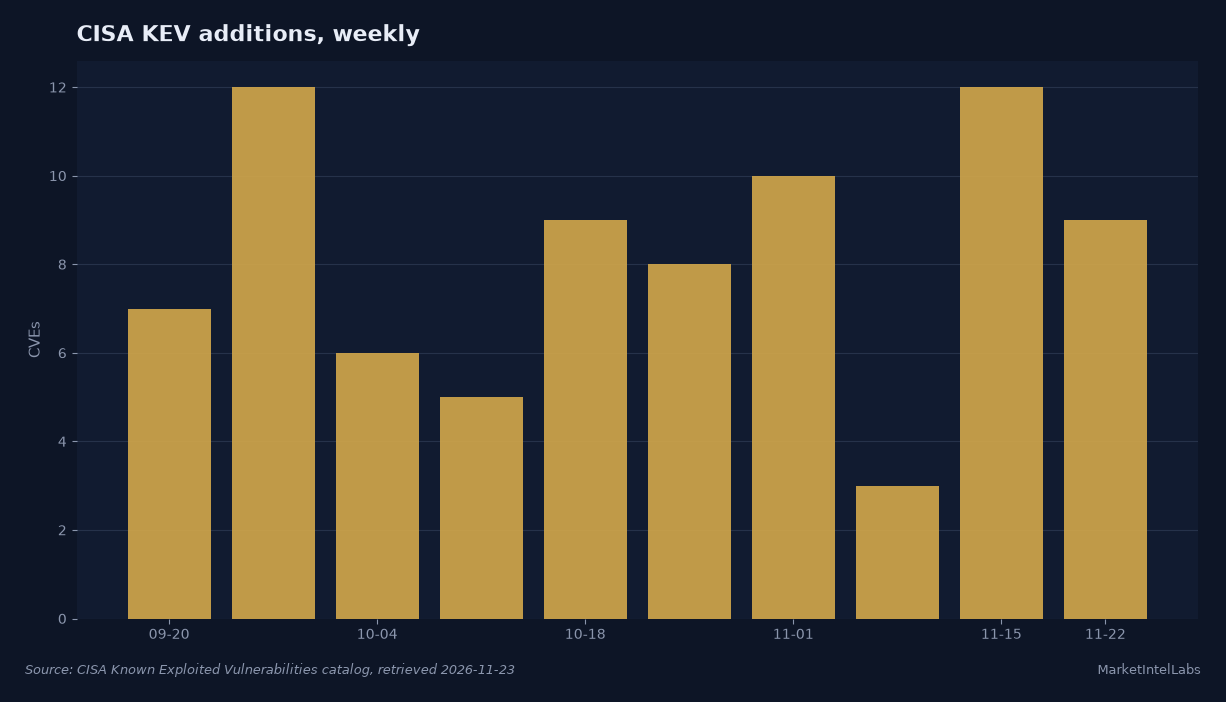
The week ending November 22 logged 9 KEV additions. That is roughly in line with the recent cadence, 8 in the week a month earlier, but it is about three times the 3 additions CISA made in the same week a year ago. The catalog's weekly flow has ranged from 3 to 12 over the last 10 weeks, so the sustained level, more than this single batch, is the trend worth watching.
What the market priced
The same Friday that the KEV batch landed, the cyber-focused ETF HACK closed at 115.30, down from 121.24 the prior session, a drop of about 4.9 percent, and Broadcom, Cisco and SAP shares also closed lower with what was a broad technology selloff. There is no evidence the KEV listings drove that move; a KEV addition is a compliance clock, not a price catalyst. The more useful read is operational: a hard-coded credential in a reachable cluster product and an authentication bypass in the virtualization management plane are the kinds of conditions that feed cyber insurance underwriting and incident response budgets, because they describe entry paths, not per-share outcomes.
Related reading: CISA KEV list: week adds 10 exploited CVEs, four on listed-vendor products.
The week's wider paper trail held one Item 1.05 8-K: microcap telecom operator iQSTEL filed a material cyber incident disclosure on November 20, the only issuer to use the cyber-specific item in the period. It is separate from the KEV batch, but it is a reminder that the disclosure register and the exploited-vulnerability catalog run in parallel, one naming the affected filer, the other naming the affected vendors.
The chain runs from CISA to the agencies bound by the deadline, to the vendors named in the entries, and then to the customer base running vCenter, Expressway and NetWeaver in environments that overlap the federal supply chain. For that customer base the near-term dates are the patch release notes from Broadcom, SAP and Cisco and any follow-on disclosures, including an Item 1.05 8-K should any issuer choose to use that form, though none has so far. The next KEV refresh will show whether the batch was a one-off or the start of a busier phase.
Related reading: CISA KEV adds six exploited flaws, names Microsoft Outlook, Chromium, BroadWorks.
This content is for informational purposes only and does not constitute financial advice.
Get daily intelligence delivered
Create a free account for the Daily Brief every weekday and The Week Ahead every Sunday. No card required.