Barr Put a Number on the Housing Problem and Left Rates Higher for Longer

The Federal Reserve's vice chair for supervision used a housing summit on Wednesday to do two things at once: put a hard number on America's affordability crisis and reiterate that the policy response to inflation is far from finished. The number is stark. The signal is hawkish.
In prepared remarks delivered at the Federal Reserve Bank of Chicago's "Housing Affordability 2026" summit, Governor Michael S. Barr devoted much of the speech to shelter costs, but the market's attention settled on the monetary policy passage that framed them. "Inflation is above our 2 percent target and not clearly trending toward target in a timely way," he said. "Moreover, risks to achieving our inflation target have increased, while risks to the labor market have receded."
That framing explains the decision the Federal Open Market Committee reached last week. "The FOMC took important action to that end last week by increasing the policy rate, which I supported," Barr said. "In my view, given changes to the economy, we were out of position, and we made an adjustment in the right direction." It was the first increase since 2023, and Barr was explicit that he does not expect it to be the last. "In my base case, further policy adjustments are likely to be needed to ensure inflation comes down to target in a timely fashion," he said.
Compared with the recorded expectations for the event, which flagged housing affordability and financial inclusion as topics and pointed to Barr's supervisory role, the prepared remarks delivered a clear directional shift on the rate path. Barr attributed the upward pressure to a run of overlapping shocks: tariffs, conflict in the Middle East, continued disruptions from Russia's war on Ukraine, and a surge in investment demand tied to the AI buildout. For a rates market already positioned for tightening, the message was confirmation plus persistence, an explicitly hawkish read that another hike is the base case.
The shelter data delivered the analytical core. Barr cited the Atlanta Fed's Home Ownership Affordability Monitor, which measures whether a median income family can afford a median priced home at the current mortgage rate. A value below 100 means it cannot. "Homes were, on average, affordable after the housing price crash of 2006 until the COVID-19 pandemic hit, when the affordability index fell sustainably below the threshold of 100 and kept falling to a value of 68 in July 2026, the lowest in 21 years," he said. On the rental side, Barr noted that in 1980 about 55 percent of rental units rented for $1,000 or less; adjusted for inflation, that $1,000 equals roughly $3,500 today, yet only 20 percent of homes rent for less than that price. Around half of all renters are cost burdened, paying 30 percent or more of income on rent, and about a quarter dedicate at least half of their income to rent.
Barr located the root cause in supply. He put the U.S. housing shortfall at roughly 2 million to 5.5 million units against a housing stock of roughly 150 million units, and named four drivers: land use and zoning restrictions, weak construction productivity, the lasting damage from the housing bust, and post-2020 inflation in materials and labor. He also flagged the lock-in effect, noting that about half of outstanding mortgages still carry rates of 4 percent or lower and nearly 80 percent are below 6 percent, which chokes housing market dynamism.
On the supervisory and regulatory front, the signal was essentially unchanged from prior public positions. Barr reaffirmed the Community Reinvestment Act as "a cornerstone of U.S. affordable housing policy" and noted the Fed administers it for the banks it supervises, pointing to over $430 billion in CRA related loans and investments during 2024. He endorsed the Low Income Housing Tax Credit and cited recent bipartisan legislation expanding rental assistance and addressing zoning barriers. No new rule-making or supervisory action was announced; the regulatory posture held steady even as the monetary posture moved.
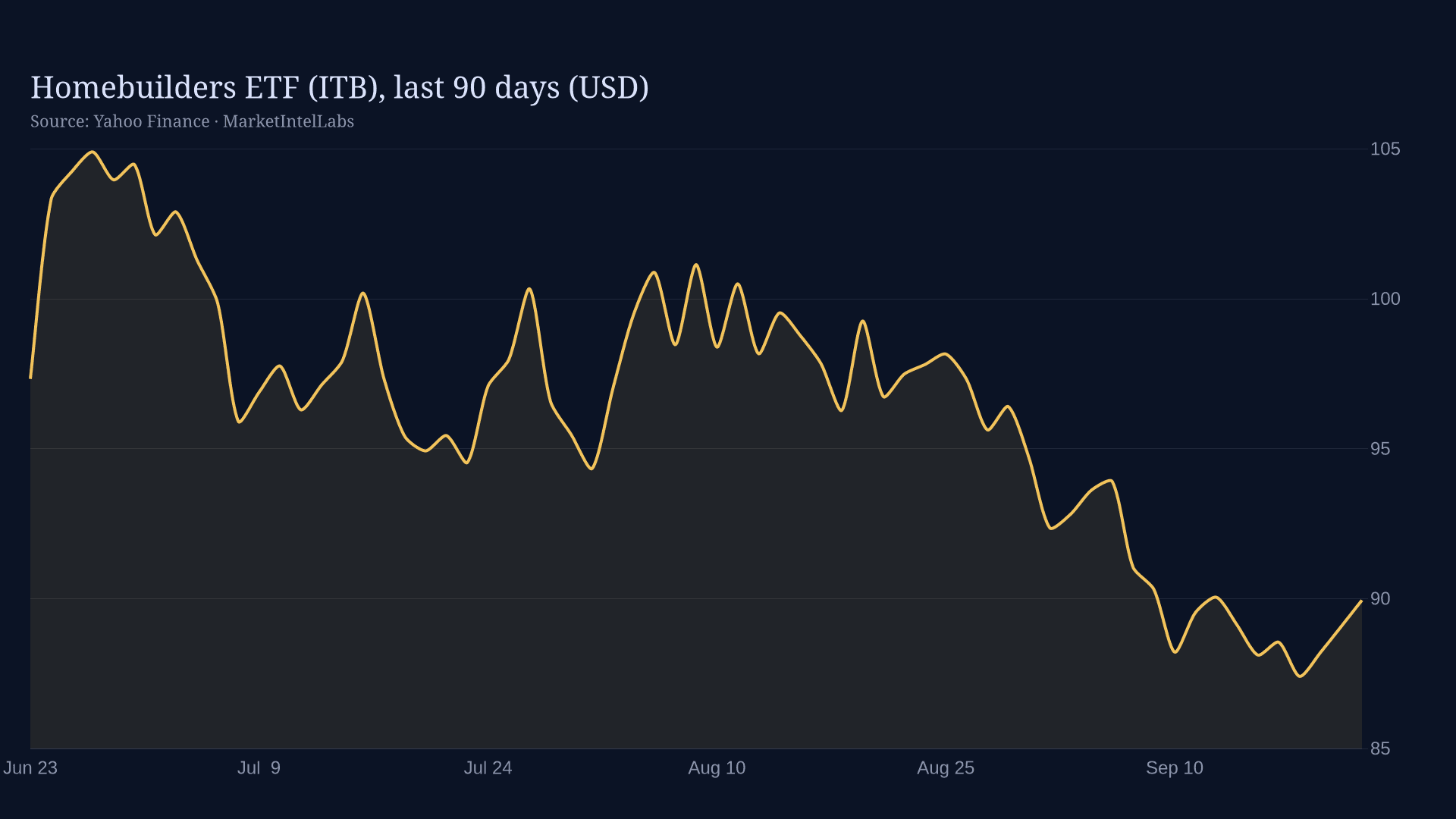
The first market response tracked his base case. Rates-sensitive names led the move lower. The iShares 20+ Year Treasury ETF fell 1.21 percent, the Russell 2000 tracker dropped 1.59 percent, and the homebuilder ETFs XHB and ITB dropped roughly 1.6 percent and 1.5 percent respectively, against a 0.57 percent decline in the S&P 500 ETF, as of 14:51 UTC during U.S. trading (Yahoo Finance, retrieved September 23, 2026).
Barr's through line, that a stable macro backdrop achieved through higher rates is the precondition for affordable shelter, was consistent with his prior public statements on the Fed's role. What changed was emphasis: with labor market risks judged to have receded and inflation risks to have grown, he endorsed last week's hike and expects more. That is the sentence traders will carry into the October decision, and the housing data gives the FOMC an awkward political rationale for staying the course even as households feel the pinch in rent and mortgage payments.
What to watch next is whether the data validate the base case. If inflation prints keep running above target into October, Barr's "further policy adjustments" stop reading as a forecast and become the working assumption. With shelter inflation still running near 2.75 percent annually and rents 34 percent above pre-pandemic levels, an affordability index of 68 leaves little margin for error either way. For the full policy backdrop, see our Fed policy coverage.
Related Reading
This content is for informational purposes only and does not constitute financial advice. Past performance is not indicative of future results. Consult a qualified financial advisor before making investment decisions.Get daily intelligence delivered
Create a free account for the Daily Brief every weekday and The Week Ahead every Sunday. No card required.