Baltic Dry Index Slips to 2,628 as Panamax Rates Fall to Lowest Since July 30


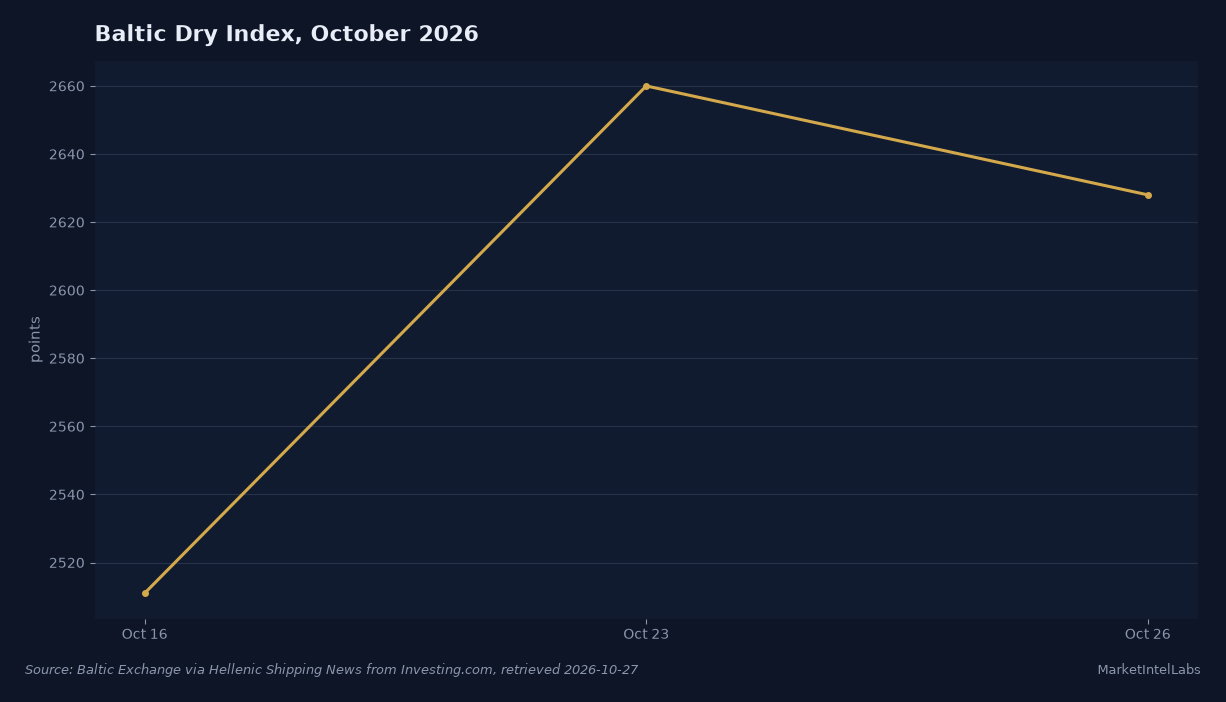
The Baltic Dry Index, the benchmark for what it costs to move dry bulk cargo by sea, snapped a week-long rebound on Monday, slipping 32 points, or 1.23 percent, to 2,628, its lowest print in nearly a week. The decline pulled both major vessel classes lower and cooled what had looked like the strongest sustained dry-bulk run since early October.
Monday's print reversed three straight days of gains. In the previous week the Baltic Exchange noted a steady recovery, with the index climbing from 2,511 on October 16, a level the weekly report flagged as the lowest in over three months, to 2,660 by the close of October 23. Monday put a 32-point dent in that run, and the slide came from both ends of the dry-bulk fleet.
Related reading: Baltic Dry Index Falls to 2,667 as Capesize Rates Drag on Eight-Day Streak.
The capesize index, tracked by the 150,000-ton iron ore and coal carriers that are the largest dry-bulk ships, fell 65 points, or 1.71 percent, to 3,726, also close to a one-week low. Average daily earnings for capesizes dropped $585 to $30,292. That still leaves the segment near a level that looked strong last week, when the Baltic trades the five time-charter routes pushed earnings from about $30,518 on Monday, October 19, to $34,380 by Friday, October 23, before the market faded on late-week fixture chatter.
The more telling move was in the panamax market. The panamax index dropped 34 points, or 1.61 percent, to 2,075, the lowest for that segment since July 30. Panamax vessels, typically around 75,000 to 80,000 tons, carry the grains, coal and smaller mineral parcels that keep the mid-size dry-bulk trade moving, and that part of the market has now rolled over while capesize earnings still hover near $30,000 a day.
Related reading: Baltic Dry Index Drops to 2,511 as Capesize Rates Slide.
The split between the two classes maps closely onto where the cargo actually is. Over last week the capesize market found its strength in the Pacific, where the West Australia to China iron ore route, the benchmark C5, advanced from the low $12s a ton to a $14.15 to $14.25 range by midweek, helped by renewed operator demand and talk of weather-related delays in China. The Brazil to China route also firmed as forward bids moved higher. The panamax market, by contrast, spent the week under pressure: the Atlantic stayed weak on thin grain and mineral enquiry and an oversupply of tonnage, and even though the Pacific proved comparatively more resilient, the overall panamax index declined consistently as the week progressed.
China is the fulcrum on both sides. Iron ore traded in a narrow range on Monday, with market participants balancing expectations of seasonally weaker Chinese demand, China being the world's largest consumer, against the possibility of additional stimulus from Beijing to support the world's second-largest economy, per the Baltic Exchange figures carried by Hellenic Shipping News from Investing.com. On the dry-bulk index, that tension resolves into a two-sided bet: hopes of state support underpin floor buying, while softening seasonal demand weighs on how far the October rally can extend.
Related reading: Baltic Dry Index Rebounds to 2,593 as Capesize Rates Firm.
The bear case for dry bulk leans on the panamax rollover. If the mid-size segment is already back at a three-month low while the iron ore routes merely hold, the argument runs, then the headline index is being propped up by one strong leg, and a China demand surprise to the downside would expose how thin the support is. Capesize earnings below $30,000 would then follow panamax down, and the index would give back a larger share of its October gains.
The bull case rests on the same demand engine from the other direction. Stimulus out of Beijing, or an early restart of Chinese infrastructure procurement, would lift iron ore flows straight onto capesizes, and last week's reports of miners covering November positions suggest the buying is not done. On that view Monday's dip is a normal breather inside an uptrend, not the start of a reversal.
Related reading: Dry Bulk Splits in Two: A $28,550 Daily Gap Between Capesize and Panamax.
For the weeks ahead, the panamax market is the number to watch. It has already undercut its recent range, and a further drop would confirm the mid-size segment is rolling over on its own. Capesize earnings staying near $30,000 with the index holding above 2,600 would point to a pause; a slide below that band, with panamax still weakening, would mark the end of the October run and put the dry-bulk freight complex back on the defensive into the quieter winter demand season.
This content is for informational purposes only and does not constitute financial advice. Past performance is not indicative of future results. Consult a qualified financial advisor before making investment decisions.
Get daily intelligence delivered
Create a free account for the Daily Brief every weekday and The Week Ahead every Sunday. No card required.