Baltic Dry Index Rebounds to 2,593 as Capesize Rates Firm

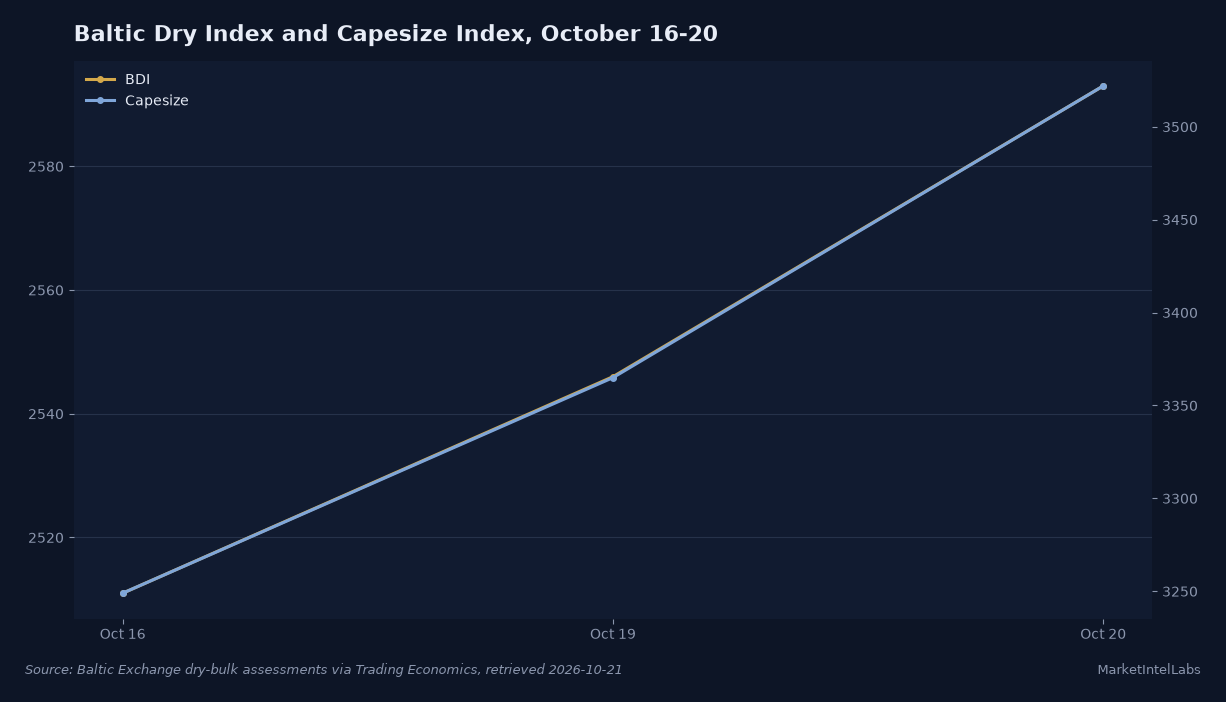
The Baltic Dry Index climbed for a second straight session on Tuesday, October 20, rising about 1.9 percent to close at 2,593, a near one-week high, according to Baltic Exchange data compiled by Trading Economics. The move is a partial recovery from the sharp slide of the previous week, when the benchmark closed at 2,511 on Friday, October 16, its lowest since June 30. What matters in this print is the shape of the bounce, because it is telling a very specific story about where dry bulk freight sits.
Capesize drove the July-to-October swoon in the composite freight measure from the start. The Baltic Capesize Index fell about 25 percent in a single week into October 16, and average daily earnings for the standard five time-charter routes dropped from $37,618 per day to below $26,000, a 31 percent hit. The capesize index closed that Friday at 3,249, its lowest since early April. On Tuesday that index climbed 4.7 percent to 3,522, and average daily earnings recovered toward $27,000 per day in Monday's assessment, per the Baltic daily assessment report published Tuesday.
Related reading: Baltic Dry Index Drops to 2,511 as Capesize Rates Slide.
So the first question is whether the rebound has legs. The Baltic Dry Index gained 1.39 percent on Monday, October 19, snapping a ten-session losing streak, and added another 1.9 percent Tuesday. That is two consecutive up days for the first time since the slide began. The capesize segment, which carries 150,000-tonne cargoes of iron ore and coal, is doing the heavy lifting, adding 3.57 percent Monday and another 4.7 percent Tuesday. Panamax, by contrast, slipped 1.7 percent to 2,247, and supramax sat flat at 1,868. A capesize-led rebound with the other size segments flat or down is a narrower recovery than a headline index reading of 2,593 suggests.
Iron ore is the fundamental driver behind the turn. Futures on the metal firmed this week after data showed China's third-quarter economic growth beat expectations and steel output increased, according to the Baltic daily assessment report published Tuesday. That is the same China demand channel that broke down in October, when weak steel sentiment and an Atlantic tonnage surplus hammered capesize earnings. The difference now is that the demand scare has partly eased on the growth beat, but traders have been careful to note that underlying iron ore fundamentals remain soft.
Related reading: Baltic Dry Index Falls to 2,667 as Capesize Rates Drag on Eight-Day Streak.
That split between a firmer near-term demand signal and a weak underlying balance is why the freight market's reaction has been cautious. Spot iron ore itself bounced on Friday, October 16, on dip buying after its own slide, and that support carried into the new week alongside the Ocean-pegged fixtures. But the West Australia to Qingdao benchmark route, the C5, is still well below the levels that drove capesize earnings to their late-2025 highs, and the Atlantic continues to hold spare tonnage. A freight recovery built purely on a China GDP beat has to overcome that tonnage overhang to become a real trend.
The counter-case is worth stating plainly because it has data behind it. One reason the capesize market fell as far and as fast as it did is that the forward paper market had already priced a rebound. November capesize contracts were trading near $33,250 per day even before the physical market stopped falling, which told shippers and operators that the futures curve expected a second-half recovery that fixtures had not yet confirmed. Now the physical market is starting to catch up to that paper signal, and two up days in the index is consistent with the forward curve, not a contradiction of it. The risk is that paper led physical by too much and the two converge from the wrong direction.
Related reading: Dry Bulk Splits in Two: A $28,550 Daily Gap Between Capesize and Panamax.
Atlantic-tonnage overhang remains the clearest risk to the bounce persisting. Capesize supply in the basin has been running ahead of cargo demand for weeks, and that is precisely the condition that produced the 31 percent weekly earnings collapse. Panamax weakness on the same day underlines the point: if grain and coal demand were genuinely firming across the dry market, panamax would not be sliding while capesize jumps. The recovery is currently held up by the one cargo class with a clear near-term catalyst, iron ore, and iron ore's own fundamentals argue for a modest signal, not a sustained surge.
For shippers, the practical takeaway is that the violent capesize repricing of the past two weeks has not fully unwound, and the direction over the next month hinges on Chinese steel output staying at or above the levels that supported the growth beat. The Baltic Dry Index has now retraced about 7.5 percent of the ground it lost from its September highs near 3,600, leaving the benchmark still roughly 28 percent below those levels. A stabilizing capesize market at current earnings is a meaningful shift after the panic selling of the prior week, even if the index has to work to hold these gains.
Related reading: Crude Tanker Rates Hold Near Record as Baltic Primorsk Loadings Face a New Strike Threat.
Shippers get their next confirmation points from the West Australia to Qingdao and Tubarao to Qingdao routes, where fixture levels will show whether the iron ore demand signal is translating into actual cargo movement rather than paper positioning. On the standard 180,000-tonne, 42-day Australia-China round voyage, the C5 level that lines up with the $27,000 per day five-route average is nearer $6 to $7.50 per tonne, and the capesize recovery has a physical basis only if it holds a rate in that earnings-consistent range. If it slips back, the two-day bounce will read as a technical correction inside a bearish trend, and freight buyers who stepped in on the dip will be watching the Atlantic tonnage numbers for the truest signal of where dry bulk rates settle into November.
This content is for informational purposes only and does not constitute financial advice. Past performance is not indicative of future results. Consult a qualified financial advisor before making investment decisions.
Get daily intelligence delivered
Create a free account for the Daily Brief every weekday and The Week Ahead every Sunday. No card required.