Baltic Dry Index Falls to 2,667 as Capesize Rates Drag on Eight-Day Streak


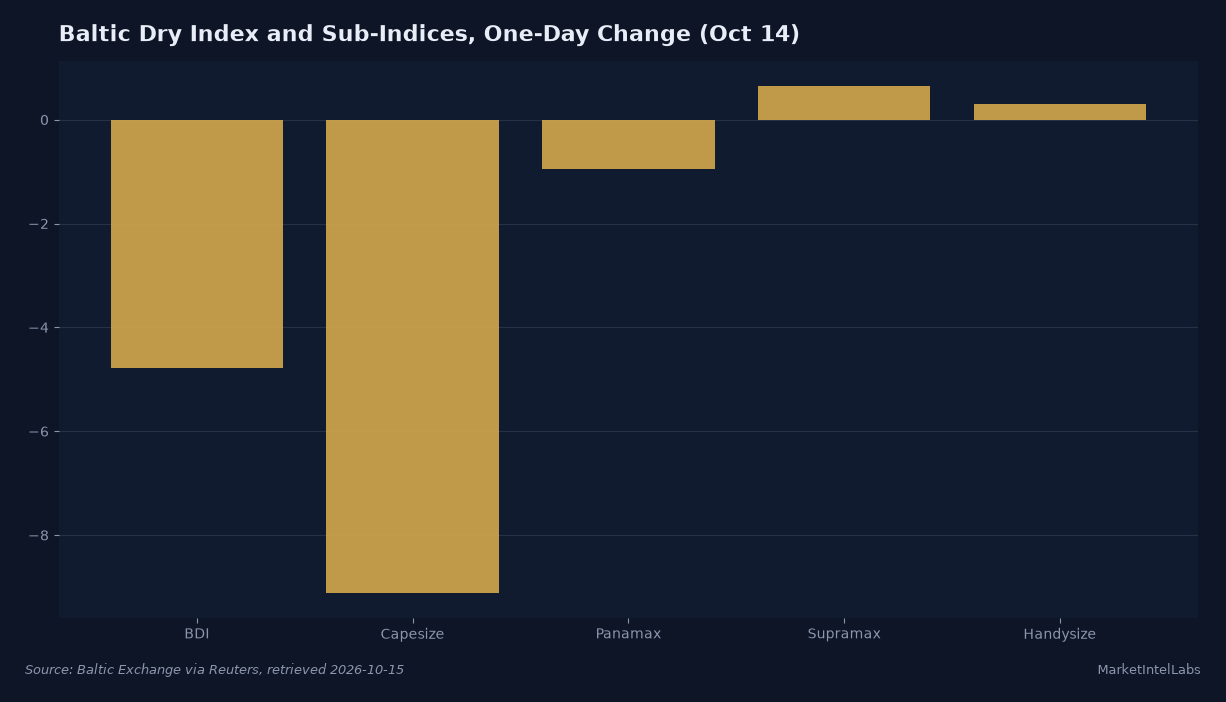
The Baltic Exchange's dry bulk benchmark keeps sliding. The Baltic Dry Index dropped 4.78% to 2,667 points on Oct 14, its eighth consecutive losing session and its lowest reading since July 29, according to Reuters. The drag is concentrated in the largest vessels, where capesize rates fell 9.11% in a single day.
The index, which prices the cost of moving iron ore, coal and grain by sea, has now given back the ground it built during a strong freight stretch. A day after the eighth loss, the composite sat at 2,667, still up sharply on the year: the Baltic Exchange's front-page data shows a 2026 year-to-date gain near 108% and a 52-week range from a low of 1,261 to a high of 2,845. The recent slide is a correction within an elevated market, not a collapse, but the speed of the capesize descent is what freight traders are watching.
Related reading: Dry Bulk Splits in Two: A $28,550 Daily Gap Between Capesize and Panamax.
Capesize vessels, the 150,000-tonne haulers that move iron ore and coal, took the heaviest hit. The capesize sub-index fell 364 points to 3,630, its lowest level since late June, while average daily earnings dropped $3,302 to $29,417, per Reuters. That is the leverage of the whole index: when the biggest ships stop earning, the composite follows.
The driver behind the capesize slump is Chinese iron ore demand. Dalian iron ore futures fell on Oct 14 as rising blast furnace maintenance in China dampened demand, while higher port inventories in Australia and Brazil pointed to ample supply, Reuters reported. Iron ore itself traded near $106 per tonne, down about 1% on the day. When the world's largest buyer is idling furnaces and warehouses are full, there is less reason to book transoceanic cargoes, and spot freight rates respond.
Related reading: Container Freight Rates: Drewry WCI Falls 2% to $4,351.
The rest of the dry bulk complex was softer but less dramatic. The panamax index, tracking the 60,000 to 70,000-tonne vessels that carry coal and grain, slipped 0.95% to 2,409, with average daily earnings down $206 to $21,680. Smaller ships offered a counterpoint: the supramax index edged up 0.65% to 1,845 and the handysize gauge added 0.30% to 1,003, per Baltic Exchange data. That divergence, big ships down hard while small ships hold, is the signature of an iron ore led selloff rather than a broad freight downturn.
The speed of this pullback matters more than its depth. Reuters charting shows the capesize gauge is at its weakest since late June, which means the largest ship class has unwound months of gains in roughly a week and a half. The eight-session losing streak at the composite level marked the longest such run on the benchmark's recent tape, and it reversed what had been a strong autumn for dry bulk haulers, a stretch that had carried the index to within a few percentage points of a yearly high near 2,845.
Related reading: Truck Tonnage Fell Again in August, and Capacity Is Doing the Rest.
For charterers, the direction of travel is now favorable on paper. Falling freight means cargo owners pay less to bring iron ore and coal into China, and spot earnings for owners compress. For shipowners, the pivot is uncomfortable after a year in which dry bulk earnings have run far above their early-2026 lows: at 3,630 the capesize index still stands well above its 52-week low of 1,261 on the parent gauge, so the correction is being measured against a historically strong baseline rather than against a weak one.
The question for the rest of the week is whether Chinese furnace maintenance clears. Port stocks in Australia and Brazil, the two dominant seaborne iron ore suppliers, remain high, which keeps the pressure on capesize fixtures. If maintenance extends, expect the losing streak to stretch; if mills restart and restock, the benchmark has room to snap back from a level still far above its year low.
Related reading: Shanghai to New York Freight Rose 7% to $10,428 as WCI Fell 1%.
The next scheduled datapoint is the Baltic Exchange's daily fixings across Thursday and Friday, which will show whether the composite finds its footing or extends to a ninth and tenth session of losses. Dry bulk differs from the container market in the same week, where the Strait of Hormuz disruption has pushed rates on war-risk lanes higher. The two are driven by different fundamentals: containers react to rerouting and war-risk premia, while bulk follows Chinese raw material restocking.
For U.S. readers, the dry bulk slide is a quieter input than the container headlines of the same week. But iron ore freight is a bellwether for global industrial activity, and a sustained capesize pullback signals easing raw material restocking in China, the marginal buyer that sets the tone for bulk shipping worldwide.
This content is for informational purposes only and does not constitute financial advice. Past performance is not indicative of future results. Consult a qualified financial advisor before making investment decisions.
Get daily intelligence delivered
Create a free account for the Daily Brief every weekday and The Week Ahead every Sunday. No card required.