Average Credit Card APR: 22.36% as Margin Over Prime Peaks


A household carrying the average credit card balance now pays 22.36 percent a year in interest, according to the Federal Reserve's August bank survey, and the gap between what lenders charge and what it costs them to fund that money is the widest on record. Revolving credit shrank 4.2 percent at an annual rate in August, down $4.8 billion and the sharpest fall of the year, per the G.19 consumer credit release published October 7. That pairing, a record lending margin alongside households that have started to pay balances down, is the quietest cost-of-living story of the week.
The headline number is not the rate itself, though 22.36 percent is high. It is the spread. Banks set card rates as prime plus a fixed margin, and that margin has kept climbing even as the policy rate swung around it. The prime rate averaged 6.75 percent in August and the effective federal funds rate just 3.63 percent, yet the average card APR sat at 22.36 percent, leaving a 15.61 point gap over prime and an 18.73 point gap over the funds rate. Both are the widest in the Fed's data, and both widened by roughly a quarter of a point over the past year even as the funds rate moved lower, according to calculations from the Federal Reserve G.19 and H.15 series saved in mid-October.
Related reading: Credit Card Rates Stay Above 21% as Revolving Debt Falls in August.
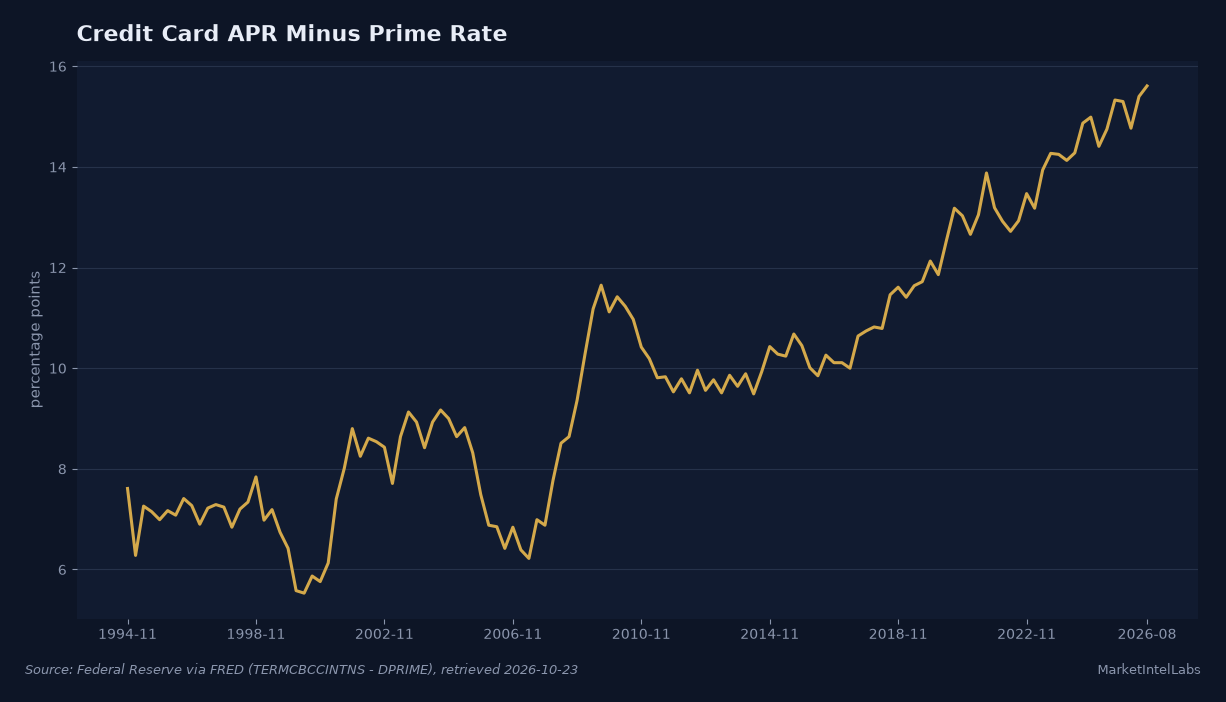
The margin is not pure profit. It has to cover credit losses, servicing, rewards and the cost of funds. But the direction is what matters for a household budget: lenders have been pushing the fixed part of the rate up even as the policy rate fell, so households got little relief from the card's most expensive line item. The APR on accounts charged interest has drifted from 23.37 percent in August 2024 to 22.15 percent in May 2026 and back up to 22.36 percent in August, a level that refused to fall as far as the funds rate did.
The dollars translate cleanly. Card balances that carry interest totaled roughly $1.352 trillion in August, the G.19 shows. A household revolving the average $6,600 balance at 22.36 percent pays about $1,476 a year, or $123 a month, in interest alone. That is a grocery bill's worth of money every month that goes to the lender, which is a large part of why revolving credit turned down. August's 4.2 percent annualized decline follows a spring that saw balances climb from $1.297 trillion at the end of 2024 to a July peak of $1.357 trillion. Households did the arithmetic and started paying down.
For the broader framework, see our Fed policy coverage.
Related reading: Household Debt Service After the FOMC: What the New Fed Funds Level Means for Your Monthly Payments.
This is the split-screen of the current consumer economy. Car loans and personal loans are getting slightly more affordable, with the average new 60-month car loan at 7.54 percent in August and a 24-month personal loan at 11.90 percent, both down from two years ago. Credit cards are the exception: unsecured, revolving, high-loss products that lenders repriced aggressively. The result is that the most expensive kind of consumer debt anyone can carry is the kind that does not dent the CPI the way a car payment does, which is why it can stay expensive without showing up in the inflation report.
What comes next hinges on the Federal Reserve, which turned back toward tightening in September, lifting its target range to a 4.00 percent ceiling and pushing the prime rate to 7.00 percent. Card rates are set off prime, so a move in either direction is felt quickly across the 22 percent band. The deeper question is whether the record margin persists. If charge-offs keep climbing, lenders may protect the margin rather than compete it down. That is the scenario where the average card APR stays near historical highs no matter what happens to policy.
Related reading: The Fed Hiked to 4%. The 20.94% APR on Your Card Is About to Climb..
The next readings come fast. The Fed's November card survey publishes in the G.19 roughly five weeks after the month ends, and markets will watch whether revolving credit keeps contracting. For a household, the practical takeaway is that it is not the rate itself sitting at a record - the APR runs below the 22.83 percent of a year ago - but the margin over prime that is: a 15.61 point spread leaves lender floors higher than at any point since 1994, so paying down a revolving balance remains one of the highest-yielding uses of cash available right now. That is not advice to buy or sell anything; it is just the arithmetic of a 22.36 percent APR against a prime rate now back at 7.00 percent.
Related reading: Eggs Down 37 Percent. The Grocery Bill Is Not..
This content is for informational purposes only and does not constitute financial advice. Past performance is not indicative of future results. Consult a qualified financial advisor before making investment decisions.
Get daily intelligence delivered
Create a free account for the Daily Brief every weekday and The Week Ahead every Sunday. No card required.