AI Debt Fears Send Global Chip Stocks Lower as Credit Costs Climb

AI infrastructure valuations repriced hard on October 15 as the financing model that carried the sector's buildout came under its sharpest scrutiny in years. The one-day global drawdown in chip and neocloud shares, a first-in-months circuit breaker on South Korea's main index, a record turn in credit-default-swap spreads across hyperscaler and neocloud borrowers, and a research report warning of trillions in potential write-downs moved together, and the common thread was the cost and availability of AI debt.
Credit, not a single company's results, started the move. In a report published October 14 and released to clients on October 15, Gartner estimated that AI providers will spend roughly $1 trillion on AI infrastructure in 2026 and a further $6 trillion between 2027 and 2030, and that those owners would need cumulative revenue of $8.5 trillion to cover announced capital spending, financing costs and a 12 percent return on invested capital. Gartner said attributable enterprise and consumer AI revenue over the period is forecast to reach no more than $3.6 trillion, a gap it said pointed to more than $3.5 trillion in exposure to impairment by 2030 and more than $4 trillion in asset value exposed to write-down risk through 2032.
Related reading: SoftBank's 8.2% Bond Yield Is the AI Buildout's Real Cost of Capital.
CDS spreads led equities on October 15. Reuters reported on October 15 that the cost of default protection on AI-linked debt had climbed to record levels, with CoreWeave five-year credit-default-swap spreads above 1,000 basis points, a level traders read as implying roughly a 63 percent probability of default within five years. Oracle's protection cost roughly 288 basis points, up from about 260 a week earlier, and SoftBank's protection widened toward record territory as well. Reuters said Amazon, Alphabet, Meta and Nvidia also saw their CDS spreads reach record highs, with demand for derivatives hedging AI-infrastructure debt near record levels.
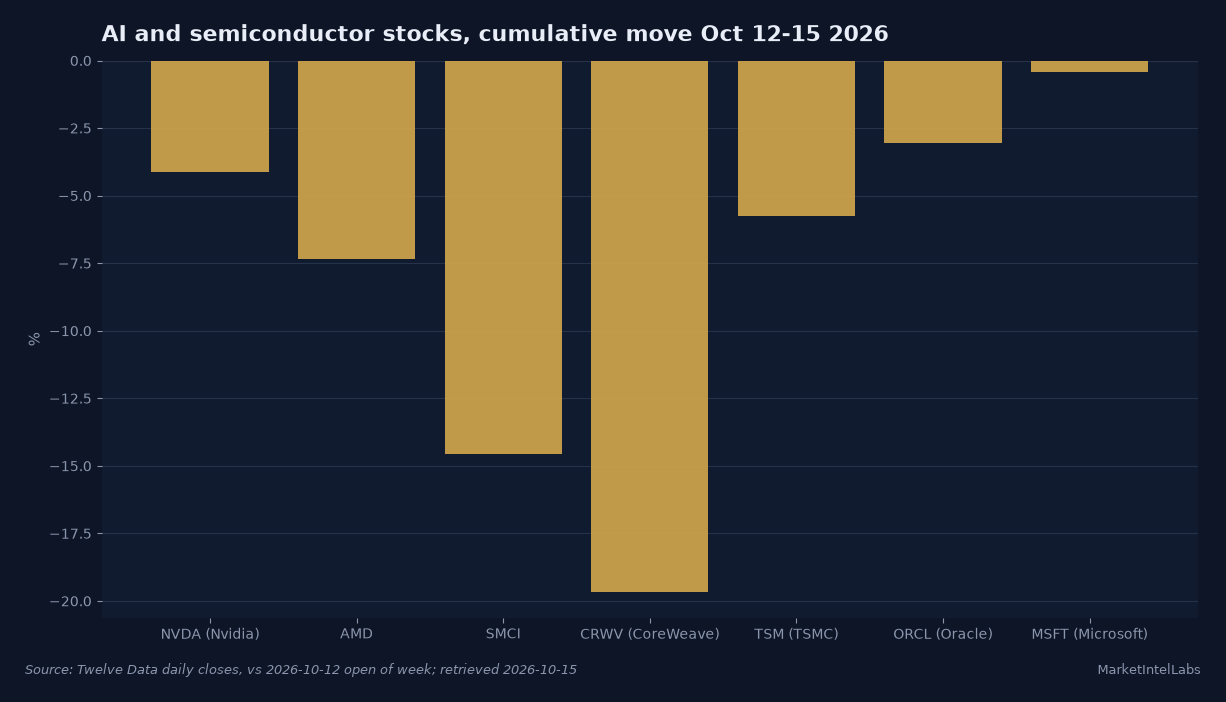
Equities around the world repriced in response to it. South Korea's KOSPI fell more than 7 percent on October 15, triggering a sell-side circuit breaker for the first time since late July, after seven consecutive sessions of losses, its longest run since September 2024. Samsung Electronics fell about 9.7 percent and SK Hynix about 11.4 percent, according to Reuters, while Japan's Nikkei dropped about 4.9 percent and SoftBank Group fell roughly 8 percent. Taiwan's TSMC was down about 2 percent in US trading, and in the United States on October 15 Nvidia traded about 2 percent lower, Advanced Micro Devices down more than 4 percent, CoreWeave down roughly 4 percent and Super Micro Computer down about 5 percent, while Microsoft traded modestly higher.
Related reading: Goldman Puts 2027 AI Capex at $1.4 Trillion, and $400 Billion of It Will Be Borrowed.
The move landed on top of already sharp weekly losses. CNBC reported on October 15 that twenty of the most valuable global AI and semiconductor stocks had shed more than $1 trillion in market value so far this week, as investors weighed what a higher-for-longer rate path means for companies borrowing heavily to build data centers. September consumer price data that came in hot, and a 10-year Treasury yield that has traded above 5 percent, raised the hurdle rate on the multi-hundred-billion-dollar credit the industry depends on.
Neoclouds sit at the center of the repricing. Gartner's model is blunt about the mismatch: these asset-heavy borrowers must generate returns from AI-optimized infrastructure-as-a-service spend that Gartner projects will grow from $66 billion in 2027 to $174 billion in 2030, a pace it argues is too slow for most compute providers to recover their investment before the current generation of AI semiconductors is replaced. CoreWeave, the most visible of the group, had already drawn attention October 14 when its shares and bonds slid and yield on its 2031 bonds moved above distress thresholds. The October 15 session extended that pressure across the whole funding stack, from the most heavily indebted borrower to the most diversified hyperscalers.
Related reading: Who Pays for the Datacenters: Debt, Leases and the Hidden Cost of AI Capex.
The distinction that matters for investors is that this is a financing story, not yet a demand story. Gartner's revenue projection is a model with wide uncertainty, and the analyst firm itself framed consolidation as the likely path, with neoclouds ceasing independent operations through acquisition or partnership as often as outright failure. Hyperscalers with diversified revenue, Gartner noted, can plausibly sustain AI investment for years, even if thinly capitalized neoclouds cannot. The equity market is pricing that asymmetry more sharply by the day.
What comes next is dated and specific. Nvidia reports in mid-November, with hyperscaler capex commentary and any signs of order pushback the key read-throughs. TSMC releases its October monthly revenue in early November without waiting for earnings season, and its monthly print is the cleanest early signal on whether AI silicon demand is intact. The more immediate catalyst is the next inflation and rate signal: a higher terminal rate extends the pressure on every borrower in this chain, while a downside print would take the sting out of the spread widening. For now, the market is asking a question the models are only beginning to answer: whether the dollars committed to AI infrastructure can earn their cost of capital back on time.
Related reading: AI chip demand: Samsung and Micron results set the bar for TSMC.
This content is for informational purposes only and does not constitute financial advice. Past performance is not indicative of future results. Consult a qualified financial advisor before making investment decisions.
Get daily intelligence delivered
Create a free account for the Daily Brief every weekday and The Week Ahead every Sunday. No card required.