Meta Stock Drops 6% After Lifting 2026 AI Capex Floor to $135 Billion

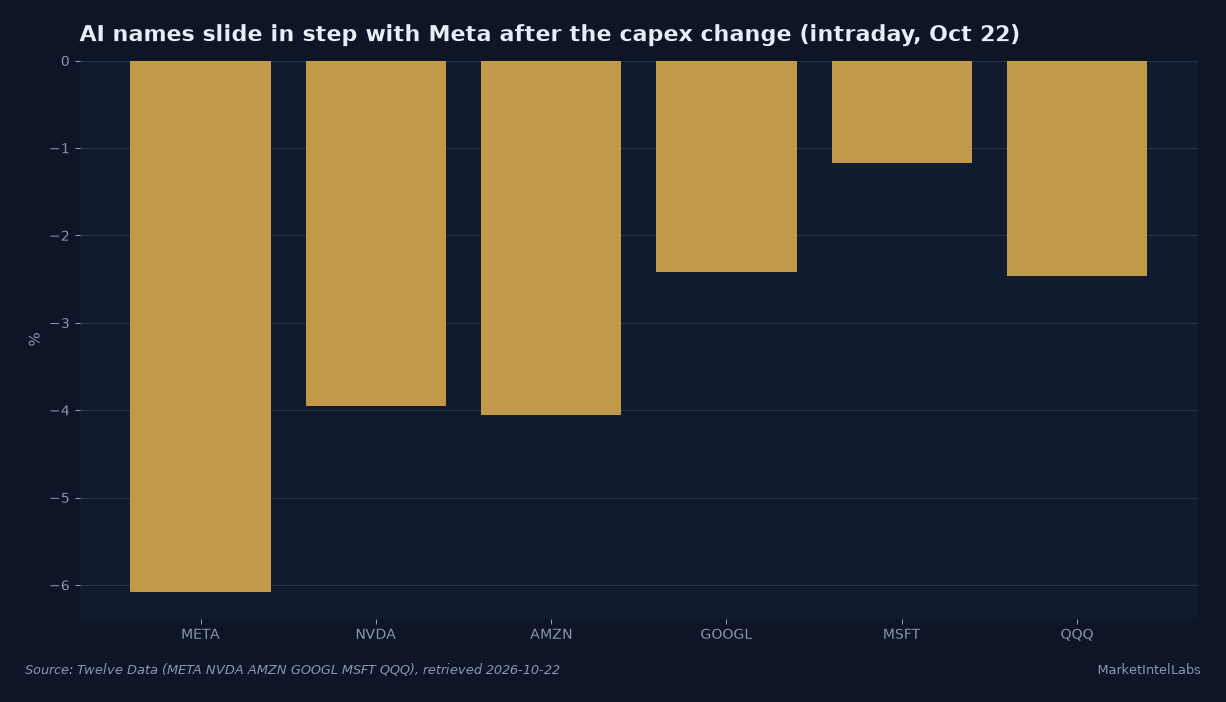
Meta Platforms shares fell about 6.5% in Thursday trading after the company raised the floor of its 2026 AI capital expenditure outlook and reported negative free cash flow for the third quarter, a combination investors read as confirmation that the hyperscaler cost curve is steepening. The slide reached far beyond one stock, dragging Nvidia, Amazon and Alphabet lower as the market repriced what the AI buildout will cost to fund.
Selling was sector-wide rather than Meta-specific. Nvidia, the primary supplier to the AI buildout, was changing hands near $213, down 3.8% in intraday trading. Amazon was off 3.9% to about $252 and Alphabet down 2.3% to about $327, while the Invesco QQQ, the Nasdaq-100 tracker, was 2.3% lower near $708. Microsoft, the other big-cap AI spender, fell a more measured 1.3% to about $526. All prices per Yahoo Finance around 15:00 UTC on Oct 22.
Related reading: Meta Q3 2026 Earnings: Capex Floor Raised to $135 Billion as New Share Class Funds AI Spend.
Meta's report was the clearest AI-specific trigger in a session with more than one: Brent crude traded above $112 as Iran and Saudi Arabia escalated (CNBC, Oct 22; WSJ, Oct 22), and Tesla cut its full-year capex target to $20 billion (Oct 21). Within the AI trade the focus settled on Meta's third-quarter report, released after the close on October 21. Revenue rose 26% to $64.60 billion and diluted earnings came to $3.83 a share, which includes a $9.89 billion charge tied to the August agreement with state attorneys general; the release's own adjusted-EPS bridge values that charge at $3.57 a share, so the ex-charge figure comes to about $7.40. Fourth-quarter revenue was guided to $73 billion to $76 billion.
Costs carried the day in the third quarter. Costs and expenses climbed 68% to $51.61 billion, and operating margin fell to 20% from 40% a year earlier, partly from a $9.89 billion charge tied to the August agreement with state attorneys general, but infrastructure costs, depreciation and third-party AI compute also rose. Free cash flow turned negative at $2.12 billion in the quarter.
Related reading: Amazon's Nvidia Financing Talks Meet a $7.6 Billion Cash Flow Gap.
Capital expenditure is the number the market is focused on now. Meta narrowed its full-year 2026 outlook to $135 billion to $145 billion, lifting the bottom of the range by $5 billion from the prior $130 billion to $145 billion. Through nine months the company has spent roughly $86 billion, which implies a heavy fourth quarter. Raising the floor while keeping the ceiling unchanged does not raise the total outlook, but it does signal the buildout is accelerating into year-end.
Investors are also weighing a second signal: the new Class C common stock. Meta's board approved a non-voting Class C class, distributed one share for each outstanding Class A and Class B share, which is effectively a two-for-one split, effective January 19, 2027. The company said the new class would be used for capital raising, employee compensation and potential acquisitions. Markets are reading the creation of a new issuance vehicle as a financing tool for still more spending. Our earlier piece on the print lays out the mechanics of the capex floor and the share structure in detail.
Related reading: Five AI Deals in One Day, and Not One Was About GPUs.
For suppliers, the spillover is direct: hyperscaler capex is the AI supply chain's order book. When Meta signals that spending accelerates even as returns stretch further out, the market marks down the revenue assumptions embedded across compute, memory and power. Nvidia's roughly 4% fall in step with a 6.5% drop in its customer is the coupling working in real time.
What Meta reported against how the market reacted is the tightest thread of the session. Meta reported a company that beat on revenue and earnings while spending more to defend them. The market is answering the question at the center of the debate: not whether the buildout is happening, but how much of future profit it consumes before it pays back. Negative free cash flow in a peak-revenue quarter is the arithmetic that turns a beat into a selloff.
Related reading: Meta earnings: How a $130B to $145B capex plan tests cash flow.
Bull-case support rests on the underlying numbers. Meta's ad revenue remains strong, daily active people across its apps averaged 3.64 billion, and management said AI investments are already adding incremental advertising revenue, with strong 2027 growth expected even without a published number. Investors have historically forgiven concentrated spending when engagement and monetization followed, and the Class C structure protects founder control, a factor shareholders have valued. The market is now demanding evidence that the spend converts to margin, and negative cash flow makes that evidence slower to arrive.
Next on the calendar are the remaining hyperscaler reports in this earnings cycle, where investors will compare how much each company is spending against how much it is converting to revenue. Inside Meta, the Class C effective date of January 19, 2027 and the fourth-quarter report in early 2027 are the next fixed marks. Until then, the AI trade is trading on guidance momentum rather than delivered margins.
This content is for informational purposes only and does not constitute financial advice. Past performance is not indicative of future results. Consult a qualified financial advisor before making investment decisions.
Get daily intelligence delivered
Create a free account for the Daily Brief every weekday and The Week Ahead every Sunday. No card required.