The Weekend Brief: Term Premium Returns - How the 4.8% Treasury Repriced Risk Assets

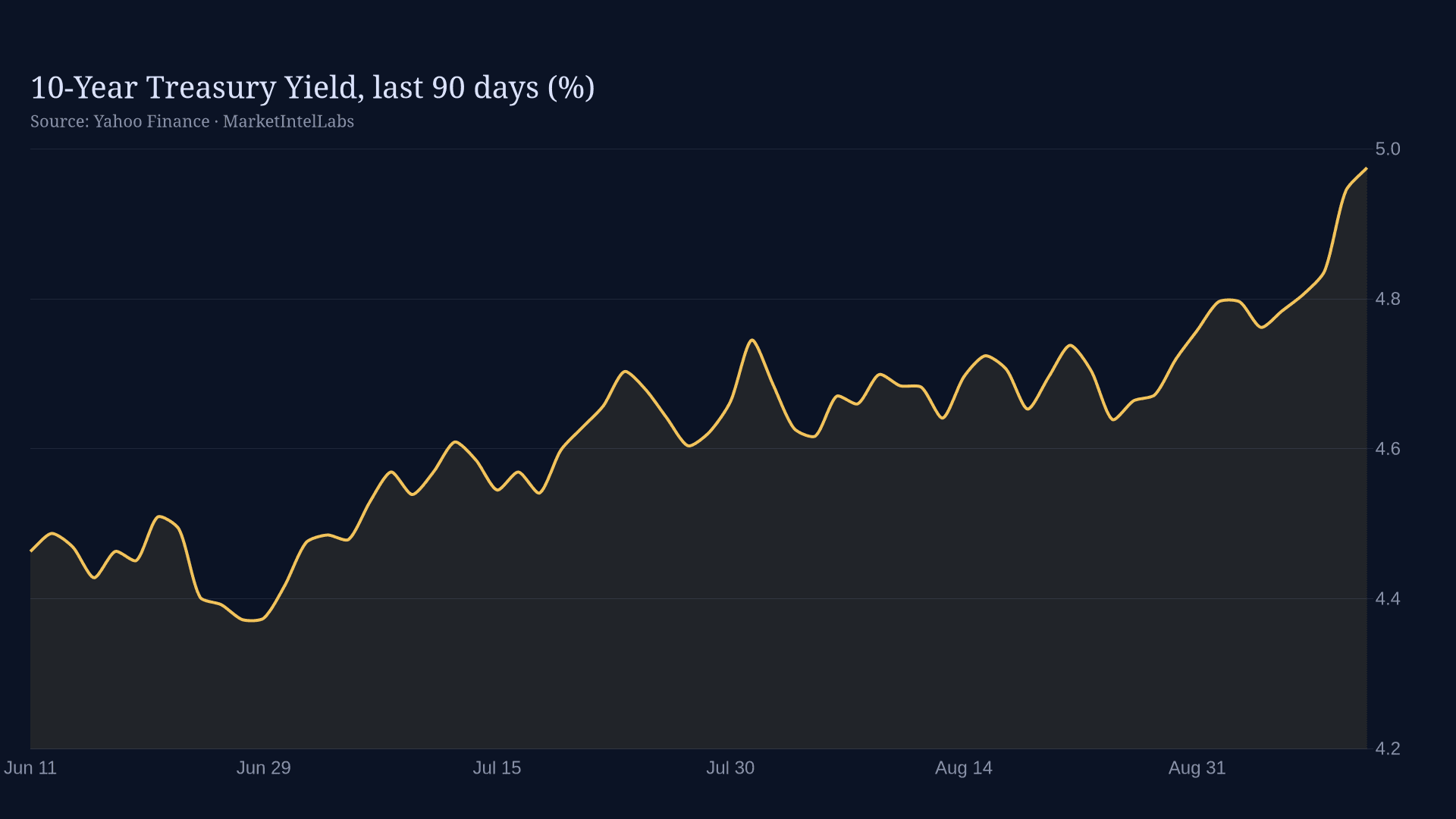
The 10-year Treasury yield spent most of the week sitting just below 4.8 percent, and then it stopped sitting. By Thursday the benchmark note traded near 4.95 percent, up roughly 11 basis points in a single session as investors braced for the August CPI print, while the 30-year bond pushed to 5.37 percent, its highest level of the month. That move refused to stay contained to fixed income.
Equities sold off, defensive sectors took the worst of it, small caps fell, and gold slipped below $4,450. What the week handed the market is a question it has dodged for most of 2026: has the term premium finally come back, and if it has, what does a more expensive 30-year loan mean for every asset priced against it?
Lede
Start with how the week actually began. On the first trading day, the 10-year was changing hands near 4.79 percent, and nothing about the tape suggested drama. The curve was positively sloped, the 2s10s gap was a routine 40 basis points or so, and investors were doing the mature thing of waiting for the data.
That calm is what makes what happened next worth studying, because a bond market does not reprice a whole market in a day unless something structural underneath it shifted. When the 10-year took 11 basis points in a single pre-CPI session and the 30-year followed to 5.37 percent, the market was not reacting to one print. It was reacting to a realization that the long end had stopped being cheap by default.
Bond people have a way of describing this. For years the standing assumption was that the Fed's eventual policy path would keep longer yields anchored, and that even if short rates stayed high, the premium for taking duration risk would stay thin because the trajectory was always toward cuts. That assumption put a lid on long-dated yields no matter what the level was.
It also quietly subsidized every asset that borrows long against the future: the homebuyer, the corporate treasurer, the equity investor whose stock is worth more when the discount rate is lower, the gold owner who pays carry for holding a metal with no coupon. When that lid comes off, all of those positions get repriced at once, and that is exactly the transmission the week delivered.
The numbers frame it. DGS10, the Federal Reserve's daily 10-year constant maturity series, moved from 4.78 percent on September 4 through 4.80 on the 8th and 4.83 on the 9th to 4.95 on the 10th, and that last step is the one that mattered, because it came on the eve of CPI. The 2s10s spread had been hovering near 40 basis points all week, but the 30-year's push above 5.3 percent told the truer story: this was a move at the far end of the curve, the part that prices not the next Fed meeting but the next two decades.
Long-duration risk was getting repriced, and the front end was barely resisting.
The precise shape is worth spelling out. The 2s10s spread sat near 39 basis points on Thursday, but the 5s30s gap, the part of the curve most quoted as the term-premium reading, widened to roughly 62 basis points, and that is the substantive signal. The front end, priced off the next two committee meetings, barely moved. The 30-year, priced off the next twenty years of monetary policy and foreign demand, carried the whole move.
That is what a term-premium episode looks like in the data: the compensation for taking duration, not the expectation of where the funds rate goes next, is what repriced. When the back half of the curve starts demanding more than the front half by a widening margin, the market is telling you it no longer believes the long end is a free rollover. That belief, not any single yield print, is the thing that quietly upholds the value of every long-dated asset.
There is a temptation to read a bear steepening, long-end rise as an inflation story, and the week gave the market a fresh one. August PPI came in 0.9 percent month over month, ahead of a consensus that had looked for a decline, and the first rise after three months of falling producer prices. Headline CPI landed at 0.4 percent, double the 0.2 percent the market had marked.
Together they complicate the Fed story at the exact moment the committee wanted to declare victory and hold. A Fed that signals no cuts into a hot wholesale inflation number is a Fed that is, in effect, content to let the long end do tightening work it is not doing with the policy rate.
And the market responded as a well-oiled transmission should. The VIX jumped 8.4 percent. Defensive health care, the crowded trade for calm, fell 2.5 percent.
Small caps, the most rate-sensitive cohort, led the way down. Gold slipped below $4,450 as rising real yields raised the carry cost of a zero-coupon store of value, while silver held on industrial demand that is indifferent to the discount rate. One rate moved, and the whole board repriced in sympathy.
That symmetry is the definition of a term-premium event, and it is why this week earns a structural read rather than a single-market one.
None of this has to be bearish in aggregate, and that is the part worth being precise about. A higher term premium is not automatically bad for growth; in a normalizing post-pandemic world, a steeper curve that compensates lenders for duration is closer to healthy than the inverted and flat regimes that preceded it. The tension the week exposed is narrower.
It is that risk assets have been priced for years as though the long end would stay artificially cheap, and any fair repricing of that assumption lands first on the assets that leaned on it hardest. The question the market is asking itself now is whether this is a one-time adjustment or a new standing level, and that distinction, not the level itself, is what will decide whether the pain is done.
What would break the bear case is the labor market and the pipeline. The jobs data this week argued the economy can take it. Nonfarm payrolls rose 162,000 in August, unemployment held at 4.1 percent, and initial claims at 206,000 show no cracks.
That is a backdrop in which a central bank can hold and a long end can rise without an imminent recession, which is the condition under which a term-premium repricing is survivable rather than catastrophic. The gold-silver divergence and the defensive-trade unwind both fit that read: the market is not bracing for collapse, it is discarding trades that no longer pay to hold and repositioning toward the growth that can fund itself at a higher cost of capital.
The professional way to hold this week is not to predict where the 10-year closes on Friday but to track the condition that would change the answer. If the wholesale inflation persistence shows up again, and if the Fed sticks to no-cuts into it, the long end has room to repudiate the whole flat-curve assumption and the repricing has legs. If producer prices fade back toward their three-month decline and sheer positioning unwinds the 11-basis-point spike, then Thursday will read as a scar, not a seam.
The data, not the drama, is what should be watched, and the next prints plus the FOMC will do the talking.
What the week leaves behind is a market that stopped being able to ignore its own repo market, its own inflation pipeline, and its own Fed in the same breath. That is a mature and overdue reckoning. The good news for investors is that a higher term premium is something markets can price, once they believe it is real.
The patience test now is whether the long end holds its new level through a quiet week, because a premium only becomes structural if it survives the absence of drama. If it does, every investor on the board has to re-run their numbers at a 5.3 percent 30-year. If it does not, Thursday becomes a footnote.
Right now the respectful move is to treat the number as real until the data says otherwise.
AI and technology
If any sector escaped the rate scare, it is the one that buys the most infrastructure and worries least about the cost of capital: AI. Equinix reported another burst of data-center demand, and the read across the AI capex trade is that the build-out is still accelerating even as the discount rate rises. Equinix's stock, at $1,037.72, is up sharply off its lows, and the thesis is straightforward: hyperscale cloud providers need colocation and interconnection capacity regardless of what the 10-year does, because the demand for AI inferencing is a real, metered revenue stream, not a forward promise.
NVIDIA's Groq acquisition tells the same story from the hardware side. The company is shipping the racks from its $20 billion Groq deal, with a Groq 3 LPX rack delivering roughly 3,400 tokens per second in inference workloads, and the first deployment is set to land at a single cloud provider later this year. The finance lens is what matters for the index: this is capex turning into shipped units and booked revenue, which is the difference between an AI bubble narrative and an AI earnings story.
For index impact, it means the technology complex remains the primary beneficiary of AI spend, and it means the duration-sensitivity that punished other sectors this week is muted in the names that can show actual AI revenue.
Who pays for all of this? Ultimately the customers of the cloud providers who buy the inferencing compute, which is why the durability of enterprise AI spending is the swing factor. If AI spend were a fad, a rising 10-year would expose it quickly, because none of these businesses would be able to justify the borrowing.
Instead, the deployments are accelerating through a rate shock, which is the strongest evidence that the AI capex cycle is being funded by demand rather than by cheap money. Watch the rate sensitivity here as a tell: if the AI trade holds while the rest of the market reprices, that is the market telling you where the real growth is.
Security and sanctions
The geoeconomics thread this week ran through the Treasury, and it is a finance story disguised as a policy story. OFAC's September 10 notice flips the default setting on Iran-specific license applications to a presumption of denial, pairs it with new terrorism-financing designations, and closes with a $1.43 million enforcement settlement. Read as plumbing, what changed is the expected value of every future sanctions exception request: because the default is now denial, applicants must carry a much heavier burden of proof, and the cost and probability-weighted outcome of engaging with the U.S. dollar system for Iran-adjacent trade just went up.
The oil-market transmission is the immediate channel. WTI surged 2.4 percent to $93.70 after a Houthi attack struck a Saudi Aramco refinery, and the oil complex was already tight before the sanctions move tightened expectations of Iranian supply. A presumption of denial on Iran exceptions reduces the prospective supply cushion from a major producer, and at current prices that matters.
The secondary-sanctions risk also does work here: lenders and shippers now face higher odds that a transaction touching Iranian oil draws U.S. enforcement, which is a real cost for the financing layer even where the underlying barrels are not U.S.-dollar denominated up front.
For the dollar plumbing, this is a reminder that the sanctions machinery is not just a foreign-policy tool but a structural feature of how the dollar and its payment system function. Each tightening of the exceptions process reinforces the incentive to stay inside the U.S. financial system rather than test its edges. That is force for the dollar at the margin, and it is a reason the greenback's strength has persisted through a week of rising yields.
The finance read is simple: sanctions architecture shifts real capital costs, and this week's changes leaned against Iranian supply at the same time a hot producer-price print was leaning against the bond market.
Jobs and sectors
The defensive rotation is the cleanest read on both the labor backdrop and the Fed path. Health care fell 2.5 percent, small caps dropped, and the VIX jumped 8.4 percent, and that pattern is not random. Defensive sectors tend to be the crowded, low-volatility end of the market where investors hide when they expect calm; a bond selloff and a hot inflation print are the signal that calm is over, so the crowded trades unwind first.
The rotation out of ballast and into the direct AI-growth trade is the intra-market version of the same repricing the 10-year did to the whole board.
The labor data does not support a Fed that needs to panic. Nonfarm payrolls rose 162,000 in August per the FRED series, unemployment held at 4.1 percent, initial claims sit at 206,000, and job openings were an elevated 7.27 million in July. That is a stable backdrop, and a stable backdrop is precisely what lets a central bank hold rates and let term premium do the tightening.
Nothing in the jobs numbers forces a cut, and the Fed's hawkish commentary this week said as much. The defensive selloff is therefore not a recession signal; it is a positioning signal, and positioning signals reverse faster than fundamentals.
What to watch is whether the rotation persists into next week. If small caps keep falling and health care keeps selling off while the long end holds, the market is telling you it is comfortable with a higher cost of capital and is simply reallocating toward the growth that can pay for it. If the VIX stays elevated and breadth narrows further, that is a risk-off posture that would eventually catch AI stocks too, because no sector escapes a discount-rate repricing forever.
The 4.1 percent unemployment rate and stable claims are the backstop: they argue the economy can absorb higher long rates without cracking, which is the bull case for this being a repricing rather than the start of something worse.
From the Investigative Desk
This weekend we investigate how the sanctions machinery quietly changes what it means to do business near the edges of the U.S. financial system, looking behind OFAC's shift in its Iran exceptions posture and what the new presumption of denial means for the oil trade, the financing layer, and dollar plumbing. The full examination, Treasury Flips the Default Setting on Iran Sanctions Exceptions, is live on the site, and it connects the policy change to the market transmission covered here. You can read it at marketintellabs.com/research/ofac-iran-sanctions-presumption-denial.
The week ahead
Monday's Week Ahead brief takes a fuller look at the calendar around the September FOMC decision, the follow-through in producer and consumer prices, and how the term-premium repricing repositions the sectors most exposed to the long end. This brief is meant as the read on what the week just did; the Week Ahead is where the tactical calendar lives.
This content is for informational purposes only and does not constitute financial advice. Past performance is not indicative of future results. Consult a qualified financial advisor before making investment decisions.
Get daily intelligence delivered
Create a free account for the Daily Brief every weekday and The Week Ahead every Sunday. No card required.