Two wars, one squeeze: Hormuz down to 8 ships a day, EU diesel up 38%

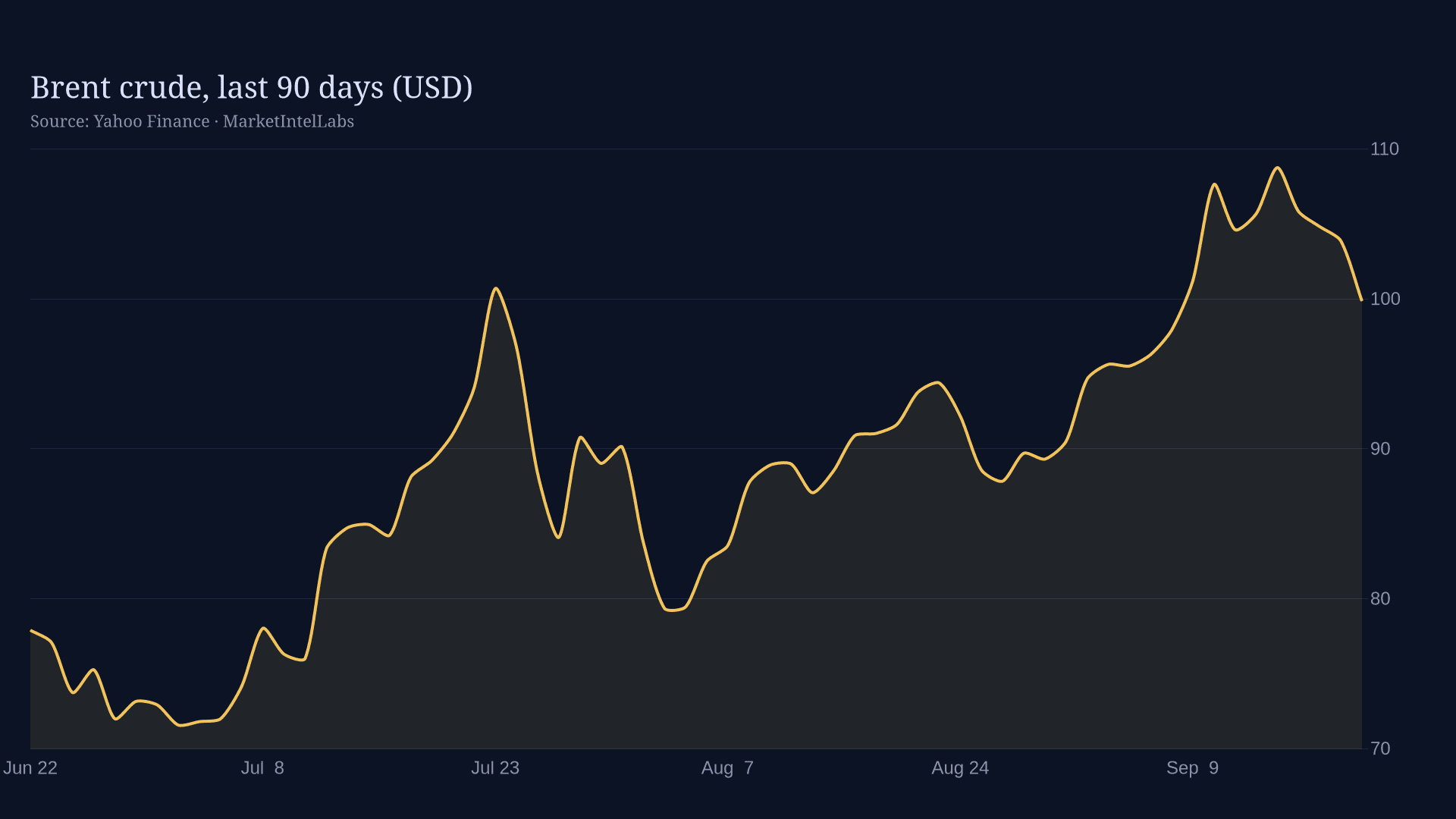
Two wars have stripped the world's shock absorbers at the same moment, and Europe is the economy sitting between them. This is not one conflict with two fronts. The crude market is a Hormuz trade, the diesel and diesel-adjacent market is a Ukraine trade, and the continent's gas is a little of both. That split is why a barrel of Brent can ease while the bill at a European pump keeps climbing.
The premise check: two wars, not one
Call it the same escalation and the numbers stop making sense. The Strait of Hormuz moved about 85 tankers a day before the US-Iran war that began in late February; IMF PortWatch puts current transits at about 8 a day, a collapse of more than 90% on the world's single most important oil chokepoint. In a separate war, Russia has lost roughly a third of its refinery runs to a sustained campaign against its refining capacity, per the IEA's September Oil Market Report, which put June runs near 3.8 million barrels a day, about 30% below a year earlier. The two shocks are independent in origin and opposite in what they tighten: one blocks crude at the source of the Gulf, the other erases the refined product Europe leans on.
Neither reserve is neutral to the other. The point of the two-wars frame is transmission, not scenery. A closure in Hormuz raises the crude that feeds every refinery in Asia and Europe, and a refinery strike in Russia removes the diesel and gasoline those refineries would have produced. When Shell and Equinor warn that the market's shock absorbers are weakening, this is the map they mean: one shock hitting barrels, the other hitting the refining spread, with little spare capacity left to blunt either.
Crude is a Hormuz trade
Brent settled at $103.87 a barrel on Sept 18 after trading above $104 for front-month delivery, against about $72 before the war began and a peak above $126 (Euronews, ICE settle). The story in the headline number is the chokepoint. The US re-imposed its naval blockade of Iranian ports on July 13 and has kept it in force, according to Al Jazeera, while Riyadh leans on the Saudi East-West pipeline to export via the Red Sea. A drone attack on that line, which Al Jazeera reported on Sept 14, threatened roughly 4% of global supply and removed the one workaround that was keeping Gulf crude flowing around the strait.
The diplomatic hinge did not hold. A two-week ceasefire that began April 8 collapsed into the failed Islamabad talks, and the June 17 memorandum did not survive, with fighting resuming in July, per Reuters and Wikipedia's account of the blockade. The US position, per Al Jazeera's reporting, is that it is clearing Hormuz traffic even as futures sit above $100; the contending view, held by shipping insurers and the transit data itself, is that a handful of escorted sailings a day is not a reopened strait.
Diesel is a Ukraine trade
Crude gets the headlines; the refinery spread is where consumers actually feel the second war. Across the EU, petrol is 24% higher year over year, diesel 38% higher, and jet fuel costs more than twice what it did, with benchmark gas at 81 euros per megawatt-hour, up 150% year over year (Guardian). Russian seaborne diesel and gasoil loadings are down to roughly 150 kb/d against a five-year average near 790 kb/d, an 81% collapse (Vortexa via the MarketIntelLabs Russia refinery brief), and the ULSD crack against Brent sits near $104 a barrel as the market bids up scarce distillate.
The mechanism is refining capacity, not barrels in the ground. ECB experts calculate refining margins now make up about 19% of the euro-area retail diesel price and about 8% of petrol, and they see diesel margins peaking only in October (Euronews). That is the tell that this is the Ukraine war, not the Middle East one: crude can ease and the pump price keeps rising because the bottleneck is the refinery, and the refinery was the strike target. The IEA's September report frames it as roughly a third of Russian runs offline, a supply loss no spare European capacity is absorbing.
Gas is both
European gas is where the two wars compound instead of splitting. Storage sits near 68% full, far below the seasonal average with winter ahead, and refilling it will draw supply well into next year (Reuters via MarketScreener, GIE AGSI+). The 81 euro benchmark, with analysts eyeing the 100 euro zone, is a hard threshold: the higher the refill price, the more LNG gets drawn away from Asia and the more structurally bid the market stays into 2027 (Guardian).
Gas inherits risk from both sides. Hormuz matters because Gulf LNG and the shipping lanes that move it run through the same contested chokepoint, and Ukraine matters because the refinery and infrastructure campaign sits directly on the product Europe imports. A reopening of one war without the other would not restore the picture, which is the core of the two-wars thesis: neither cure is sufficient on its own.
Europe in the middle
Europe is the economy with the least cushion and the most exposure. It holds the world's largest gas-storage swing and imports more refined product than it produces, so it takes the crude shock, the product shock, and the gas shock in one. On top of the energy bill, the money story is unresolved. Ukraine faces an estimated $27bn 2026 budget shortfall and a wider 2027 gap, per the Ukrainian outlet NV, even as the EU's fight over roughly 210 billion euros of immobilized Russian central-bank assets remains unsettled (Intellinews).
The European Central Bank (ECB) context matters here: the European Central Bank is tightening into a slowdown, and eurozone energy inflation was 14.3% in the latest reading, per Euronews. The accession question has moved past its old procedural blocker, with the Orban veto lifted in April and accession Cluster 1 opened on June 15, so the live tensions are now fiscal and energy, not procedural. Iran and Russia sanctions were signed into law on Sept 18, adding another layer to both wars at once (White House).
What the rest of this week's pieces will answer
This opener sets the frame; the franchise fleshes it out across the week. The Hormuz premium piece works through how much of the crude bid is insurance and how much is physics, and what the July blockade ruling did to the risk curve. The refinery campaign piece goes strike by strike through the capacity the tracker has confirmed offline and ties it to the crack spread that is driving diesel. The winter math piece runs the storage number and the refill threshold through the actual weather risk. The 27 billion piece digs into the money fight in Brussels and what the 2027 gap means for both wars' staying power. The other blockades piece maps the grain and Danube-route disruptions, including Ukrainian grain exports down about a third in August and the Russia-damaged bridge on a key export rail line (RANE, Reuters).
None of those is a spoiler for a single takeaway; they are the individual wires that the two-wars frame holds together. If you take one thing from this series, let it be that crude, diesel, and gas now answer to different wars, and that Europe is the one economy that catches all three.
Every piece in the franchise draws its figures from one shared table, refreshed daily by the commodities desk. This is the standing set as of publication:
| Figure | Value | As of | Source |
|---|---|---|---|
| Brent settle | 103.87 $/bbl | 2026-09-18 | Euronews (ICE settle) |
| Hormuz transits (daily) | 8 vs 85/day baseline | 2026-09-13 | IMF PortWatch via Straits brief |
| EU diesel price y/y | 38% | 2026-09-19 | Euronews / ECB |
| EU gas storage | 68% | 2026-09-17 | Reuters via MarketScreener (GIE AGSI+) |
| Ukraine 2026 budget shortfall | 27 $bn | 2026-09-15 | NV / NYT |
| Immobilised Russian central-bank assets | 210 EUR bn | 2026-09-15 | Intellinews |
| Ukraine grain exports, August | 774 kt (down a third) | 2026-09-02 | RANE |
| Fed funds target | 3.75 to 4.00% | 2026-09-16 | Reuters stagflation graphic |
| China / India share of Russian crude exports | 50 / 37 % (Dec 2022 to Aug 2026) | 2026-09-18 | BBC |
| Russian refinery crude runs | 3.8 mb/d (June; ~30% below year earlier) | 2026-09-11 | IEA Oil Market Report, September |
| Russian seaborne diesel/gasoil loadings | 150 kb/d (down ~81% vs 5-yr average) | 2026-09-18 | Vortexa via MIL research brief 2026-09-20 |
| ULSD (HO) crack vs Brent | 104 $/bbl | 2026-09-18 | CME/ICE settles via yahoo-finance (MIL brief 2026-09-20) |
| Russia 2026 budget Urals assumption | 59 $/bbl | 2026-09-16 | Reuters (via MarineLink) |
| Urals crude (western ports FOB) | above 110 $/bbl | 2026-09-16 | Reuters (via MarineLink) |
| Urals premium to Brent (mid-Sep) | 8 $/bbl | 2026-09-16 | Reuters (via MarineLink); Izvestia |
| Russia federal budget revenue Jan-Aug 2026 | 25.93 tn (+9.2% y/y) RUB | 2026-09-13 | MinFin via Xinhua / lowdown.today |
| Russia oil & gas revenue Jan-Aug 2026 | 5.02 tn (-16.7% y/y) RUB | 2026-09-13 | MinFin via Xinhua / lowdown.today |
| Russia oil & gas revenue Sep 2026 | 739.9 bn (+15% vs Aug 642.7bn; Jul 811.3bn) RUB | 2026-09-21 | MinFin via mind.ua |
| Russia federal budget deficit | 6 tn (Gazprombank est; H1 5.73 tn ~2.5% GDP) RUB | 2026-09-07 | Gazprombank; Reuters |
| NWF liquid assets | 3.6 tn (~$46.8 bn) RUB | 2026-07-01 | The Insider |
| CREA: Hormuz spike extra Russia export revenue | 31 EUR bn (6 months) | 2026-09-13 | CREA via lowdown.today |
| Trump-Xi White House meeting | 2026-09-24 | date | BBC |
| Sanctioning Russia and Iran Act signed | 2026-09-18 | date | White House |
| Shell / Equinor shock-absorbers warning | 2026-09-16 | date | Reuters |
| US blockade of Iranian ports re-imposed | 2026-07-13 | date | Al Jazeera |
| Danube-route bridge strike (Reuters) | 2026-09-17 | date | Reuters |
transits (daily) 8 vs 85/day baseline; Brent settle 103.87 $/bbl; ULSD (HO) crack vs Brent 104 $/bbl; EU diesel price y/y 38%; Russian refinery crude runs 3.8 mb/d (June; ~30% below year earlier); EU gas storage 68%; Ukraine grain exports, August 774 kt (down a third) (oldest figure as of 2026-09-02).
Two-wars dashboard: Hormuz transits (daily) 8 vs 85/day baseline; Brent settle 103.87 $/bbl; ULSD (HO) crack vs Brent 104 $/bbl; EU diesel price y/y 38%; Russian refinery crude runs 3.8 mb/d (June; ~30% below year earlier); EU gas storage 68%; Ukraine grain exports, August 774 kt (down a third) (oldest figure as of 2026-09-02).
This content is for informational purposes only and does not constitute financial advice. Past performance is not indicative of future results. Consult a qualified financial advisor before making investment decisions.
Get daily intelligence delivered
Create a free account for the Daily Brief every weekday and The Week Ahead every Sunday. No card required.