September Payrolls Rose Just +29,000: Hiring Is Cooling, Layoffs Aren't


September's jobs report settled one debate while leaving the harder question open: hiring is cooling, but layoffs are not. Nonfarm payrolls rose just 29,000 last month and the unemployment rate ticked up to 4.2%, yet weekly initial claims sit at a low 197,000, a combination that reads as a slowdown in new hiring rather than a surge in firings.
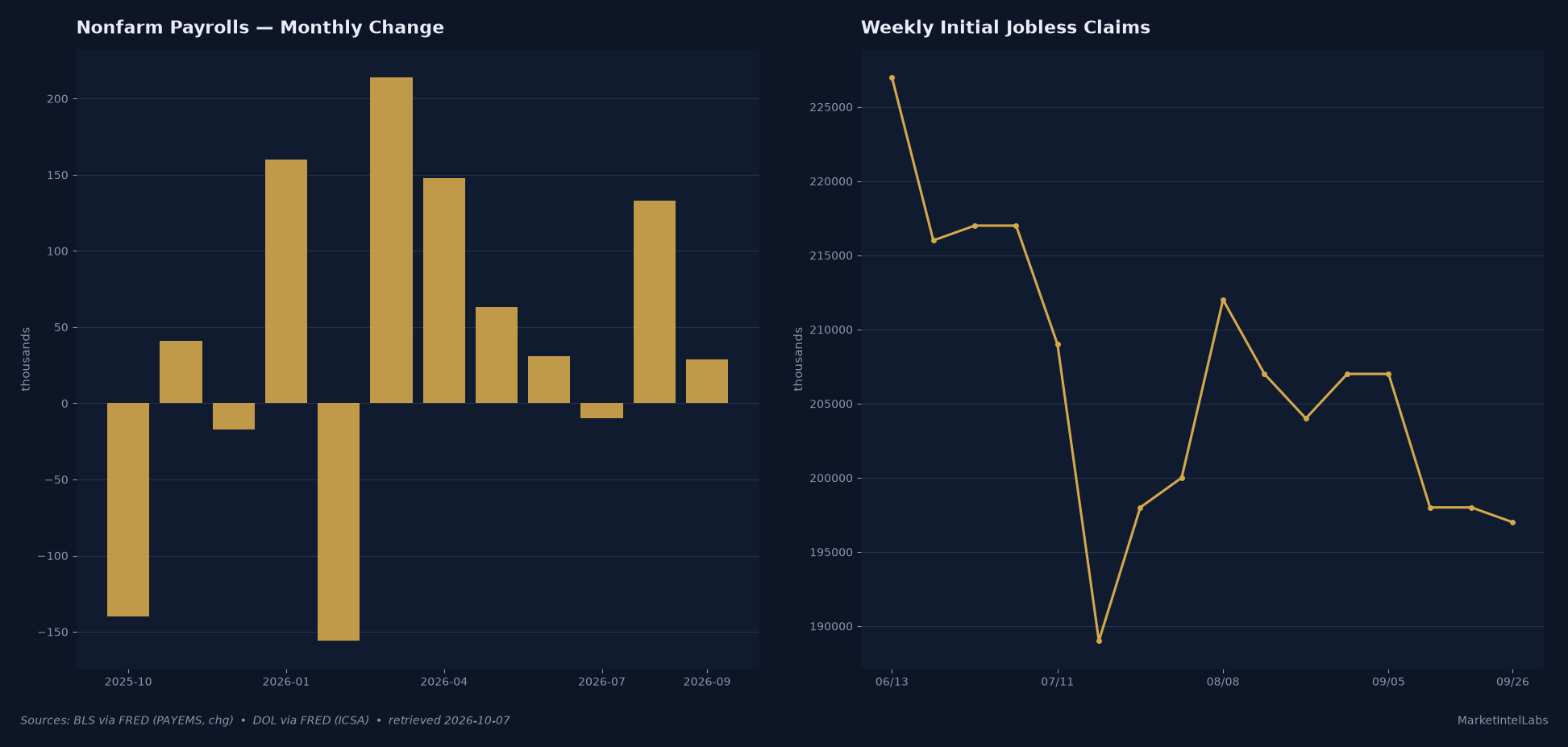
Start with the headline number. The dashboard below stacks the two signals that define this report: hiring rolling over, layoffs holding firm. Total nonfarm payroll employment rose to 159,044,000 in September from 159,015,000 in August, a gain of about 29,000 according to FRED's PAYEMS series. That is far below the pace a still-growing economy would normally produce, and it fits the pattern the BLS flagged in its September Employment Situation summary: total employment changed little in the month. The unemployment rate, at 4.2% in September after 4.1% in August, is creeping up, though from levels that are low by historical standards.
Related reading: 29K payrolls cut October hike odds to near 20% from 70%.
The reason this does not look like an outright recession is the third number. Weekly initial jobless claims for the week ending September 26, released October 1, came in at 197,000, down 1,000 from the prior week, according to oui.doleta.gov and FRED's ICSA series. When firms are actually shedding workers at scale, claims surge into the 300,000s or higher. A 197,000 print is the signature of a tight labor market where employers have simply stopped adding as aggressively, not one where they are handing out pink slips.
| Metric | Latest reading | What it signals |
|---|---|---|
| Nonfarm payrolls (Sep) | +29,000 | New hiring has cooled sharply |
| Unemployment rate (Sep) | 4.2%, up from 4.1% | Slightly more slack, still low |
| Initial jobless claims (wk Sep 26) | 197,000 | Layoffs have not surged |
| Real GDP (Q2 2026, annualized) | +2.2% | The economy is still growing |
| Fed funds target range | 3.75%-4.00% | On hold after the September hike |
| Fed funds rate, SEP end-2026 | 4.1% median | One more hike, then a long hold |
Now the part that matters most for markets: what this means for the Federal Reserve's next move. The Fed held its target range at 3.75%-4.00% after the unanimous September 16 hike, with effective funds near 3.88%, and its September Summary of Economic Projections still implies a median funds rate of 4.1% at end-2026 and end-2027. That is one more hike then a long sit, not the easing cycle some payrolls headlines invited. A single soft month does not overturn a rate path built on inflation that is not bending: headline PCE was 3.42% year over year in August and the Cleveland Fed's nowcast puts September CPI near 0.5% month over month.
For the broader framework, see our Fed policy coverage.
Related reading: September Jobs: Revisions Cut 60K From a Weak 29K Gain.
Set the two competing reads against each other. The bearish view, and the source of recession chatter, is that 29,000 payroll additions are barely positive, the unemployment rate is drifting higher, and the lagged effect of the Fed's tightening campaign has yet to hit hiring fully. If the job market rolls over while inflation runs near 3.4%, the Fed would be boxed in, no cuts and an economy slowing, the most difficult configuration for risk assets. The more resilient read leans on the rest of the data: Q2 real GDP grew at a 2.2% annualized pace, claims at 197,000 show no wave of layoffs, M2 money supply re-accelerated to 5.66% year over year in August, and the Treasury curve is positively sloped at +48 basis points on the 10s-2s, the shape economies typically produce when growth is intact.
The honest answer is that one report does not settle it, which is why the next print matters. The initial claims number for the week ending October 3 lands Thursday, October 8, with consensus anchored near 197,000 to 200,000 given the low four-week average. A claims spike into the 220,000s-plus would validate the firing-did-start worry and force a reassessment; another sub-200,000 print would confirm the story told by this report, that September was about employers pausing new hires, not cutting existing workers. September CPI follows on October 14, and it will carry more weight with the Fed than any single payroll month, because the rate path turns on whether that 3.4% inflation has anywhere to go.
Related reading: 197,000 Claims Meet a 51K Payroll Pace.
Watch the claims number Thursday, then the CPI print next week. A cooling hiring trend with stable layoffs is the single most consistent reading of the current data, and it argues the Fed can keep its one-more-hike path intact. A break in claims changes that calculus quickly.
Related reading: September payrolls added 29,000 as revisions erased 60,000.
This content is for informational purposes only and does not constitute financial advice. Past performance is not indicative of future results. Consult a qualified financial advisor before making investment decisions.
Get daily intelligence delivered
Create a free account for the Daily Brief every weekday and The Week Ahead every Sunday. No card required.