September Jobs: Revisions Cut 60K From a Weak 29K Gain


Employers added only 29,000 jobs in September, and the unemployment rate held at 4.2%. July and August were revised down by a combined 60,000, leaving the July-to-September payroll average at 50,700. The headline is weak, but revisions and claims point to a labor market losing speed without a broad wave of layoffs.
Payrolls tell a slow-growth story
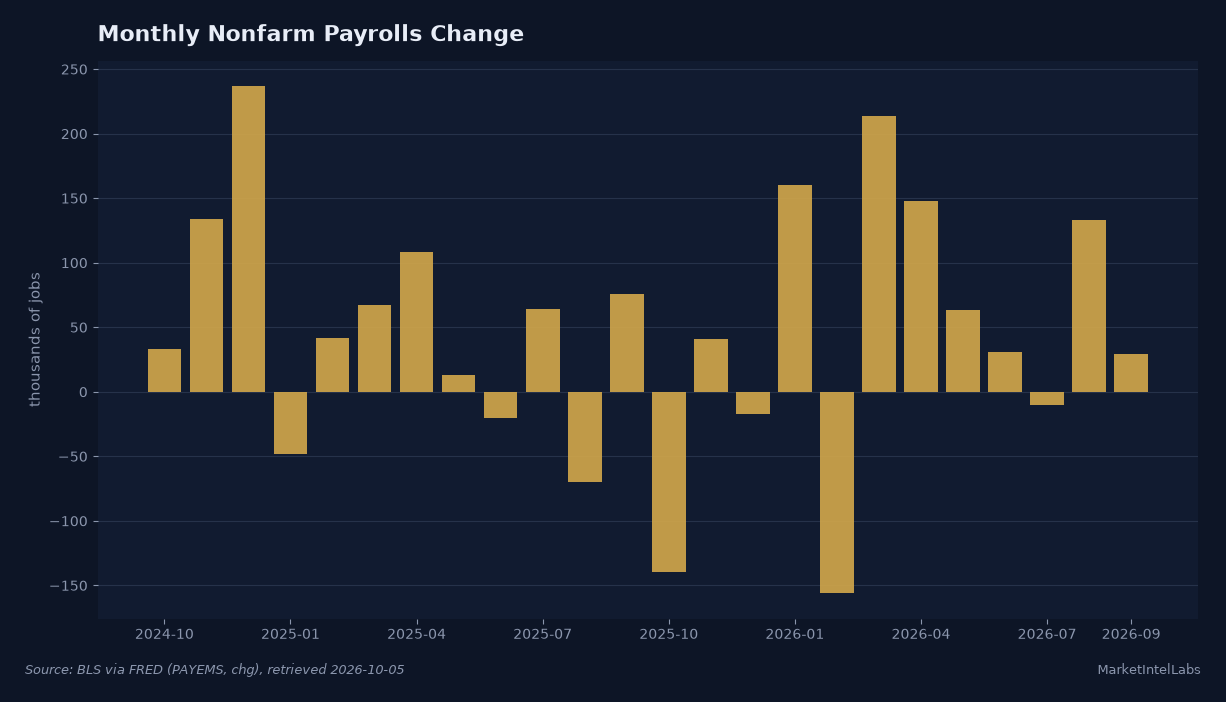
The Bureau of Labor Statistics reported the September payroll gain on October 2, below the 45,000 average monthly increase over the prior 12 months. The revisions matter: July moved from a 21,000 gain to a 10,000 decline, while August was revised from a 162,000 gain to 133,000. Those changes cut the two-month total by 60,000. Revised July and August plus September show 152,000 jobs added over three months, or about 50,700 a month.
That pace is not a collapse, but it leaves little room for another soft month. Health care added 17,000, less than its 33,000 monthly average over the previous year. Construction gained 11,000, near its 10,000 trend, while manufacturing rose 9,000. BLS said employment across major industries changed little. The report looks less like a broad hiring freeze than a month without a clear engine.
The household survey gives a mixed read. Unemployment was 4.2%, within a 4.1% to 4.3% range since March. Participation edged to 61.8% from August's 61.6%, still below September 2025's 62.5%. The employment-population ratio was 59.2%, little changed over the month or since January. A stable jobless rate does not mean labor supply has returned to last year's level.
Long-term unemployment remained at 1.9 million, or 27.1% of all unemployed people. Part-time work for economic reasons held at 4.5 million. Those measures do not show a sudden deterioration, but they describe workers who may be feeling a weaker market before layoffs appear in claims.
Low layoffs, cautious hiring
Initial claims offered the week's clearest counterweight to the soft payroll number. The Labor Department's October 1 report put seasonally adjusted claims at 197,000 for the week ending September 26, down 1,000 from a revised 198,000. The four-week average fell 2,500 to 200,000. One week is noisy, yet the average is consistent with employers still holding on to workers rather than cutting them rapidly.
Continuing claims, reported for the week ending September 19, declined 11,000 to 1.701 million. That series can help distinguish a low layoff rate from difficulty finding a new job, though its one-week movement is not a hiring gauge. Claims for the comparable September 2025 week were 226,000 initially, against 197,000 now, according to the DOL's seasonal table. This is a year-over-year improvement in new claims, even as payroll growth has cooled.
See also: Wage Growth Just Hit a Four-Year Low While Claims Sit at 196,000. Something Has to Give.
The latest JOLTS release, published September 29 for August, showed 7.1 million openings, unchanged on the month, and 5.2 million hires. The quits count stayed at 3.1 million, a 1.9% rate; layoffs and discharges held near 1.6 million, a 1.0% rate. The openings rate was 4.3%. These August figures show subdued job switching and hiring before the newest payroll report. The July openings estimate was revised up by 64,000 to 7.3 million. That revision is a reminder that the survey moves as responses arrive.
See also: Hiring Fell to Its Lowest in Two Years While Openings Kept Climbing. August JOLTS Lands Tomorrow.
Challenger, Gray & Christmas counted 43,281 announced job cuts in September, down 18% from August and 20% from September 2025. Hiring plans rose to 90,787 from August's 12,325, but remained 23% below a year earlier. Challenger said seasonal hiring plans were muted. The firm tracks announcements, not completed layoffs or net employment, so this is a noisy lead. Technology announced 10,799 cuts in September and 165,925 year to date, up 54% year over year. The concentration does not point to a uniform reversal across industries.
Wages and the next checks
Average hourly earnings reached $37.81 in September, up from $37.76 in August and $36.70 a year earlier. That is about 0.1% growth in the month and 3.0% over 12 months. September's real-earnings comparison is not yet available; BLS schedules that release for October 14. The August report showed real hourly earnings down 0.1% for the month and 0.3% year over year, while real weekly earnings rose 0.2% monthly. Nominal wages are rising, but the next release will better show what workers retain after inflation.
For the Federal Reserve, the data cut both ways. Weak payroll growth and modest wage gains may ease labor-cost pressure. Stable unemployment, low claims, and limited layoffs do not show a clear labor-market break. The report alone cannot settle the next rate decision; inflation and other data also matter.
See also: The Labor Differential Is One Bad Month From Zero.
Next on the calendar, weekly claims arrive October 8. September JOLTS is scheduled for November 3, followed by the October Employment Situation on November 6. The next payroll average will help show whether September's gain was a pause or a lower run rate.
This content is for informational purposes only and does not constitute financial advice. Past performance is not indicative of future results. Consult a qualified financial advisor before making investment decisions.
Get daily intelligence delivered
Create a free account for the Daily Brief every weekday and The Week Ahead every Sunday. No card required.