Hiring Fell to Its Lowest in Two Years While Openings Kept Climbing. August JOLTS Lands Tomorrow.


Job openings in July rose to 7.271 million while hiring fell to 5.054 million, the weakest monthly hires figure in the BLS JOLTS series since February 2024. That spread, more openings chasing fewer hires, is the number that makes Tuesday's August JOLTS report worth reading closely. The Bureau of Labor Statistics releases the August data at 10:00 AM ET on Tuesday, September 29, 2026.
Here is the split that has defined this labor market all year. Firms keep posting vacancies, but they are not filling them at anything like the old pace. July openings rose 89,000 from June to 7.271 million, and they now stand 2.6 percent above the 7.089 million posted in July 2025. Hiring went the other way, down 278,000 from June's 5.332 million to 5.054 million, and down 171,000 from July 2025's 5.225 million. The last time monthly hiring ran this low was February 2024.
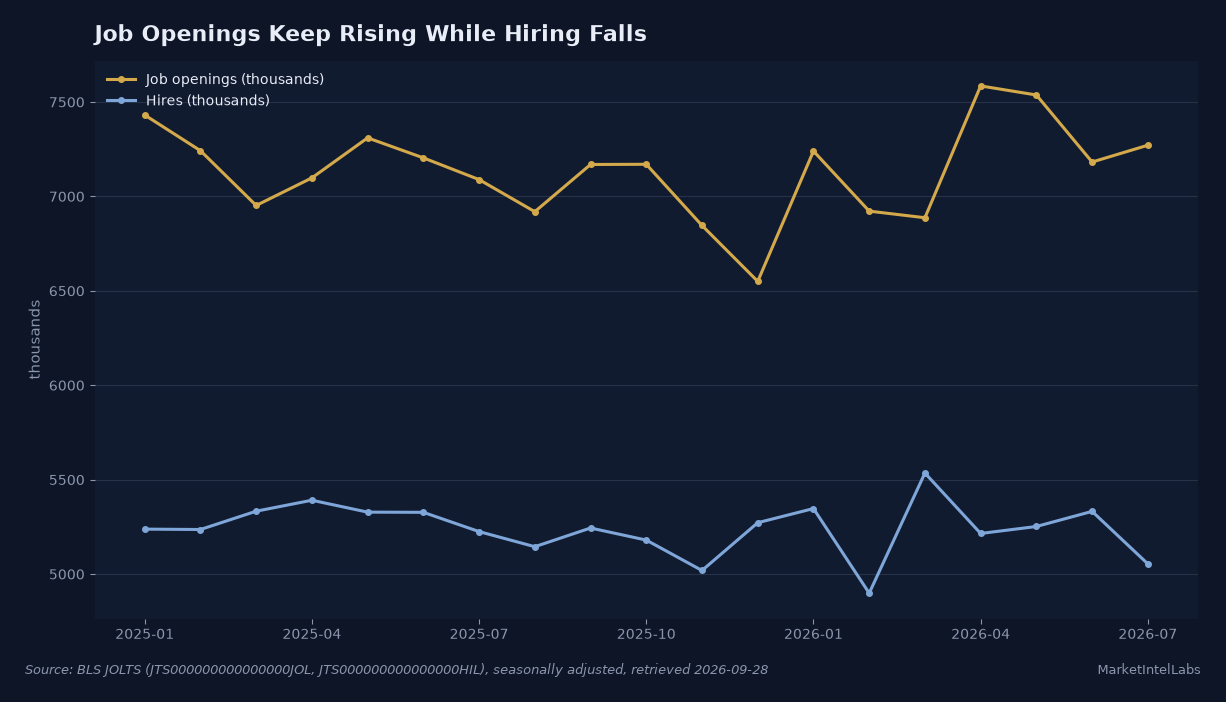
A market where openings rise while hiring falls is not a market with more demand for workers. It is a market with less movement in it. Employers post a role, hold it open, and either wait for a cheaper candidate or quietly shelve the requisition without ever deleting the posting. Economists who study the JOLTS series have argued for years that a chunk of measured openings is exactly that, wishful listings. When hiring is the lowest it has been in more than two years, the postings look more like placeholder than promise. The July report that opened that gap is covered in our breakdown of the July JOLTS report.
The quits side confirms the freeze. The quits rate sat at 1.9 percent in July, unchanged from April, against 2.0 percent in July 2025 and 2.0 percent in June. Voluntary job switching is how most American workers get their raises. When quits sag, wage pressure cools with them, and that is precisely what the wage data show. Average hourly earnings reached $37.75 in August, up 3.1 percent from $36.62 in August 2025, the slowest annual pace of this expansion and a figure my colleague covered from the claims angle on September 24.
One part of the report is genuinely strong rather than frozen. Layoffs and discharges fell to 1.652 million in July, down from 1.734 million in July 2025 and the lowest for any July in the current cycle. Firms are not cutting. Initial claims, the weekly tell for the same thing, came in at 197,000 for the week ending September 19, and continuing claims have dropped to around 1.719 million, the lowest since January 2024. Companies are holding on to the workers they have and declining to add more.
That combination, rare layoffs, record-low churn, and hiring at a two-year low, is what a labor market looks like when it has stopped growing but not started shrinking. The Atlanta Fed's wage tracker and the BLS average hourly earnings series both point the same way, nominal wage growth near 3 percent with participation down at 61.6 percent in August from 62.1 percent in January. Fewer people are looking for work, fewer people are changing jobs, and the people who hold jobs are seeing the smallest raises in four years.
What should a reader watch in the August report on Tuesday? Three things, none of them the headline openings number. First, the hiring level. If August hiring prints below 5.0 million, the two-year low becomes a trend, and , starts to look like a one-month bounce inside a hiring recession. Second, the quits rate. A break below 1.9 percent would be the lowest since 2020 outside the pandemic months and would signal that the freeze has tightened. Third, whether openings get revised down. The July figure is preliminary, and this series has a habit of giving back its gains on revision.
The implication is straightforward for the Federal Reserve. A labor market that is not firing anyone but is not hiring anyone either puts the risk on the demand side of the mandate. Wage growth at 3.1 percent year over year, using August average hourly earnings against August 2025, is close to a pace consistent with the Fed's inflation target once productivity is added back. That gives the committee room to ease if it wants it, and the September 29 JOLTS print lands one week before the next Employment Situation release on Friday, October 2, 2026. Watch Tuesday's hiring number. It is the one that tells you whether the freeze is thawing or hardening.
This content is for informational purposes only and does not constitute financial advice. Past performance is not indicative of future results. Consult a qualified financial advisor before making investment decisions.
Get daily intelligence delivered
Create a free account for the Daily Brief every weekday and The Week Ahead every Sunday. No card required.