Polymarket's Duma Seat Ladder Priced 340-354 at 81 Cents. The Count Says 324.


Polymarket's markets on Russia's State Duma election traded $11.2 million across the party markets in the 24 hours before the count closed, and $12.8 million across all 21 Russia election markets on the board, and by early Monday the venue had called the headline question almost perfectly: United Russia to win the most seats traded at 99.95 percent as of 07:00 UTC Monday, against preliminary Central Election Commission figures giving the party 324 of the 450 seats. The seat-count ladder did not do as well. The band covering 340 to 354 seats is marked at 81 percent as of early Monday, September 21, while the preliminary count sits at 324, a band below it that the same ladder had priced at 1.5 percent.
The volume is the first fact worth sitting with. Russia does not have an open political market, its elections are not contested in any way an event contract can settle on surprise, and yet Polymarket's books on the September 18 to 20 vote were among the venue's busiest of the day. The "gain the most seats" market on United Russia alone showed $7.4 million of 24-hour volume and $23.8 million cumulative, with $727,000 of liquidity against it. New People's equivalent drew $1.5 million in a day and the Communist and Liberal Democratic markets $800,000 and $700,000 respectively. That is real money pricing an election whose outcome every participant could describe before putting a cent down.
What the ladder said versus what the count says
Preliminary results reported by Interfax on Monday, September 21 put United Russia at 324 seats: 126 on federal lists and 198 in single-mandate districts. The Communist Party took 57 mandates, A Just Russia 27, the Liberal Democratic Party 21, and New People 13. On the federal list vote, United Russia drew 49.82 percent, down from 57.7 percent mid-count readings carried by state media on Sunday, and turnout closed at 56.66 percent per the Central Election Commission.
Polymarket's seat ladder disagreed with itself in an instructive way. Through the weekend the 355-plus band traded between 5 and 9 percent, which was a defensible read of preelection polling. Between 04:00 and 05:00 UTC early Monday, the 340 to 354 band spiked from 26 percent to 81 percent, and the 355-plus band jumped from 7 percent to 69.9 percent, both moves landing hours after the preliminary count had already made 355 arithmetically unreachable. The 325 to 339 band, where the preliminary count stands, spent the same early Monday tape at 1.5 percent.
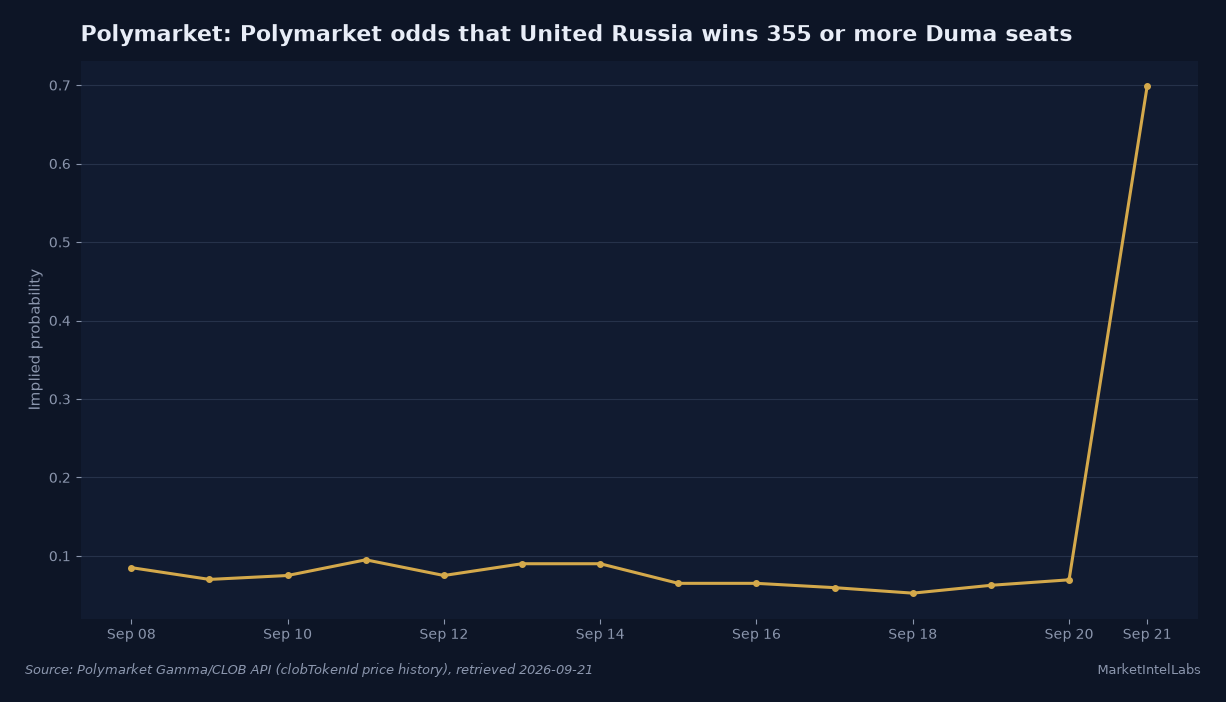
The pattern reads like late settlement-chasing on thin books rather than information. A similar pattern showed up in our own desk showed Kalshi’s September rate ladder missing its count at 87 percent, where a ladder priced near-certainty one bucket over the eventual print. The 355-plus market shows about $4,000 of liquidity and $209,000 of cumulative volume as of early Monday, and a ladder of mutually exclusive bands whose bands carry liquidity from $4,000 to $180,000 can gap between adjacent prices without anyone paying much to arbitrage them. A buyer pushing the 355-plus band to 70 cents was paying for a result the federal count had already foreclosed. The venue's UMA resolution status on several of these markets was still listed as "proposed" at 07:00 UTC Monday and remains open, so the final settlements have not printed yet.
The turnout bands swung harder than the vote did
The hourly tape on the 59 to 62 percent turnout band is the sharpest example. It opened Sunday, September 20 near 28 percent, moved through 43 percent by 09:00 UTC as day-three turnout figures came out, and then ran to 76 percent at 14:00 UTC, back to 59 percent by 16:00, up to 92 percent at 04:00 UTC Monday, and sat around 75 percent as of 07:00 UTC. The official figure, 56.66 percent, sits in the band below the one the market was paying up for through early Monday. The 62-plus band, by contrast, never traded above 1 percent and will settle correctly at effectively zero.
Neither band had a price-discovery job in the usual sense. Turnout in Russian federal elections is an administrative number, published progressively by region, and the bands were tracking the CEC's own running tally. The whipsaw is what a thin market looks like when its underlying is a slow official feed and its participants are deciding late whether the published number will land in one bucket or the next. We catalogued the same thin-ladder whipsaw on the October Fed-CPI books as the CPI strip quietly repriced. The information was public the whole time; the pricing of it was not.
Resolutions
The desk's track-record ledger carried no markets due for resolution this morning, so the section below records the markets this piece covers as they stand as of early Monday; each will be updated when UMA and the Central Election Commission final numbers, due after September 25, settle them.
United Russia to win the most seats stood at 99.95 percent at 07:00 UTC Monday and, as of early Monday, was on track to settle YES on the preliminary count of 324 seats. The 355-plus band, at 69.9 percent in the same tape, is on track to settle NO. The 325 to 339 band, priced at 1.5 percent, is on track to settle YES. The 59 to 62 percent turnout band, near 75 percent, is on track to settle NO on official turnout of 56.66 percent, and the 53 to 56 percent band below it, which traded at 0.5 percent, is on track to settle NO as well by a margin of roughly 0.7 points. When the final prints land, the gap between what these bands charged and where the count settled is the desk's grade.
The tradeable lesson here is not about Russia and it is not a pick, because there is no pick to make in a market that finishes at 99.95 cents. It is about venue structure. We have seen the same venue move from six cents to a coin flip in a single repricing on the Fed side, where a market can re-rate hard on one book. A book can be simultaneously excellent at its headline question and badly calibrated one bucket over, and the error concentrates exactly where liquidity is thinnest and the underlying is a slow official tally. Anyone reading event-contract prices as a clean probability surface should read the 340 to 354 band's tape through early Monday before trusting the next ladder they see.
This content is for informational purposes only and does not constitute financial advice. Past performance is not indicative of future results. Consult a qualified financial advisor before making investment decisions.
Get daily intelligence delivered
Create a free account for the Daily Brief every weekday and The Week Ahead every Sunday. No card required.