October job cuts fall to three-year low: Challenger Gray & Christmas October 2026 Report


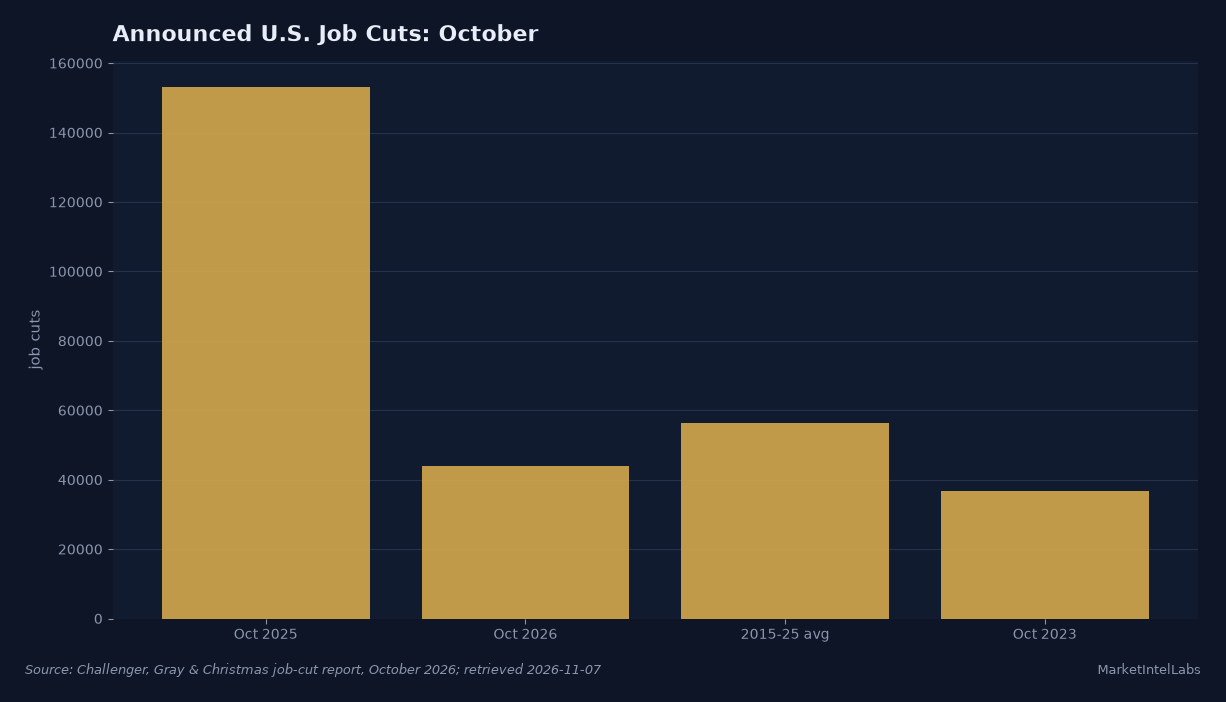
U.S. employers announced 43,994 job cuts in October, the fewest for the month since 2023 and a 71% drop from the same month a year earlier, according to outplacement firm Challenger, Gray & Christmas. It was the eighth month this year that announced layoffs ran below their year-earlier level, extending what the firm calls a low-fire hiring environment in which companies hold on to their workers but refuse to commit to permanent headcount.
The headline numbers
October's total of 43,994 announced cuts was up 2% from September's 43,281, a reminder that the trend is flat at a low level rather than falling month to month. The meaningful comparison is annual: cuts were down 71% from the 153,074 announced in October 2025, the lowest total for the month since 2023, when 36,836 were logged, and well below the 56,348 average for October across the prior decade. Through the first 10 months, employers have announced 617,189 cuts, down 44% from 1,099,500 at this point last year.
Related reading: August job cuts hit 52,881, lowest August in four years.
That tally does not count every lost job. Challenger's number is not a government measure: the firm counts announced layoffs it culls from company press releases and SEC filings, so it logs intentions rather than jobs that have actually disappeared. That makes it a leading, noisy indicator, not a payroll alternative. A single large announcement can swing the monthly figure, and the firm only counts voluntary exit programs once workers accept them or a company states a reduction target. Microsoft's offer of buyouts to 60,000 employees in October, for example, is not in the total.
Where the cuts landed
Food companies delivered the deepest single month of any industry in October, with 9,677 announced cuts, the sector's largest monthly total this year. That lifted Food's 2026 total to 39,370, up 43% from a year earlier and the most for a January-to-October stretch since at least 2012. Technology, by contrast, posted its smallest monthly total of the year at 5,576 cuts in October, yet it still leads the country for the year with 171,501 announced cuts, about 28% of the national total and already above all of 2025's 154,445. The pressure has narrowed to a few pockets: Transportation has announced 44,838 cuts this year, up 188%, and FinTech 11,979, up 543% from a small base of 1,863 a year ago. Twenty-two of the 30 industries Challenger tracks have announced fewer cuts than they had at this point last year.
Related reading: September Layoff Plans Fell, Seasonal Hiring Stayed Thin.
The industries in the crosshairs map to specific workers. A more than fivefold jump in FinTech reductions and a near-tripling in Transportation put those payrolls under the most strain, while Food's October surge hit a sector that rarely makes the layoff headlines. The decline is also concentrated by geography: California accounted for 10,032 of October's cuts and 20% of all cuts announced this year, and the West region has announced 265,340 cuts in 2026, 43% of the country's total. Washington, New York and Ohio each announced more than 4,500 cuts in October as well.
The reasons employers give have shifted in a way that matters for the jobs beat. Market and Economic Conditions was cited for 16,407 cuts in October, 37% of the total, and at 130,531 for the year it has overtaken AI as the leading cause of 2026 cuts, while AI citations fell to their lowest monthly level of the year at 1,265. Demand Downturn attributions are up 145% for the year. Plainly, the driver of cutting has moved from a technology story to a demand story, a more cyclical and more cautious signal.
Related reading: Challenger Hiring Plans Reach 90,787, but Holiday Surge Falls Short.
October's cuts arrived alongside a burst of announced hiring, though the two are not substitutes. Companies said they planned to add 444,692 workers in October, up 57% from a year ago and the most for the month since at least 2009, but most of it is short-term. Seasonal hiring plans through October total 470,400, up 26%, with Amazon announcing 300,000 seasonal roles and UPS 100,000; Amazon's is the largest single seasonal announcement Challenger has ever tracked. Seasonal positions now make up 72% of all announced hiring for the year, and the plans are concentrating into fewer companies, five this year against 11 at this point in 2025. Retail is the cleanest example of the split: retailers announced 3,692 cuts in October while also planning 13,300 holiday hires.
What it means for the labor market
For the jobs and labor beat, the October report is a reminder that layoff announcements are a leading, noisy gauge, not a payroll figure. At the current pace, announced cuts for the year are running 44% below 2025's, which lines up loosely with the hiring strength and lean claims data of recent weeks. The signals to watch are whether the seasonal wave converts into permanent roles and whether the cited reason for cutting reverts to technology as demand holds up. In our read of the September report, we flagged the same pattern of thin early seasonal hiring giving way to a later surge, and October confirmed it. The direction is a holding pattern: employers are not cutting deeply, and they are not committing to permanent headcount either. That is compatible with a labor market that is cooling without breaking.
Related reading: Restructuring Replaced AI as the Top Reason Employers Cut Jobs in August, and the Hiring Plans Keep Piling Up Unfilled.
This content is for informational purposes only and does not constitute financial advice. Past performance is not indicative of future results. Consult a qualified financial advisor before making investment decisions.
Get daily intelligence delivered
Create a free account for the Daily Brief every weekday and The Week Ahead every Sunday. No card required.