September Layoff Plans Fell, Seasonal Hiring Stayed Thin


U.S. employers announced fewer job cuts in September, but the seasonal hiring plans that usually offer a glimpse of holiday staffing were unusually light. Challenger, Gray & Christmas counted 43,281 planned cuts, down 18% from August and 20% from September 2025, while September hiring plans fell 23% year over year. The report points to less layoff pressure overall, but it does not show employers preparing for a typical seasonal expansion.
The distinction matters. Challenger's figures track announcements, not a count of workers who have already lost jobs or started new ones. The September report, published October 1, 2026, therefore reads best as a measure of employer plans. Its split is striking: fewer announced cuts than a year earlier, alongside a weak seasonal hiring pulse.
Across the first nine months of 2026, employers announced 573,195 cuts, 39% below the 946,426 announced over the same period in 2025. That year-over-year decline is flattered by government announcements: excluding government, Challenger said cuts were down 15%, to 550,185 from 646,671 through September. Those are still lower totals, but the comparison shows why the headline year-to-date drop should not be read as a clean measure of private-sector improvement.
The third-quarter figure gives the same broad message with less distortion from one month. Challenger counted 129,591 announced cuts in the third quarter of 2026, down 43% from the 226,242 in the second quarter and 36% from the third quarter of 2025. One quarter does not settle the trend, and announcements can be delayed, revised or never completed. Still, September did not add evidence of a fresh surge in planned dismissals.
Seasonal hiring is the weaker signal
Employers announced plans to hire 90,787 workers in September 2026, compared with 117,313 in September 2025, Challenger reported. Although the September total rose from 12,325 in August 2026 as seasonal announcements began, it was the lowest September hiring-plan total since 2011, when Challenger counted 76,551. This is not a payroll count. It is a sign that the usual late-summer ramp in announced seasonal staffing has been muted.
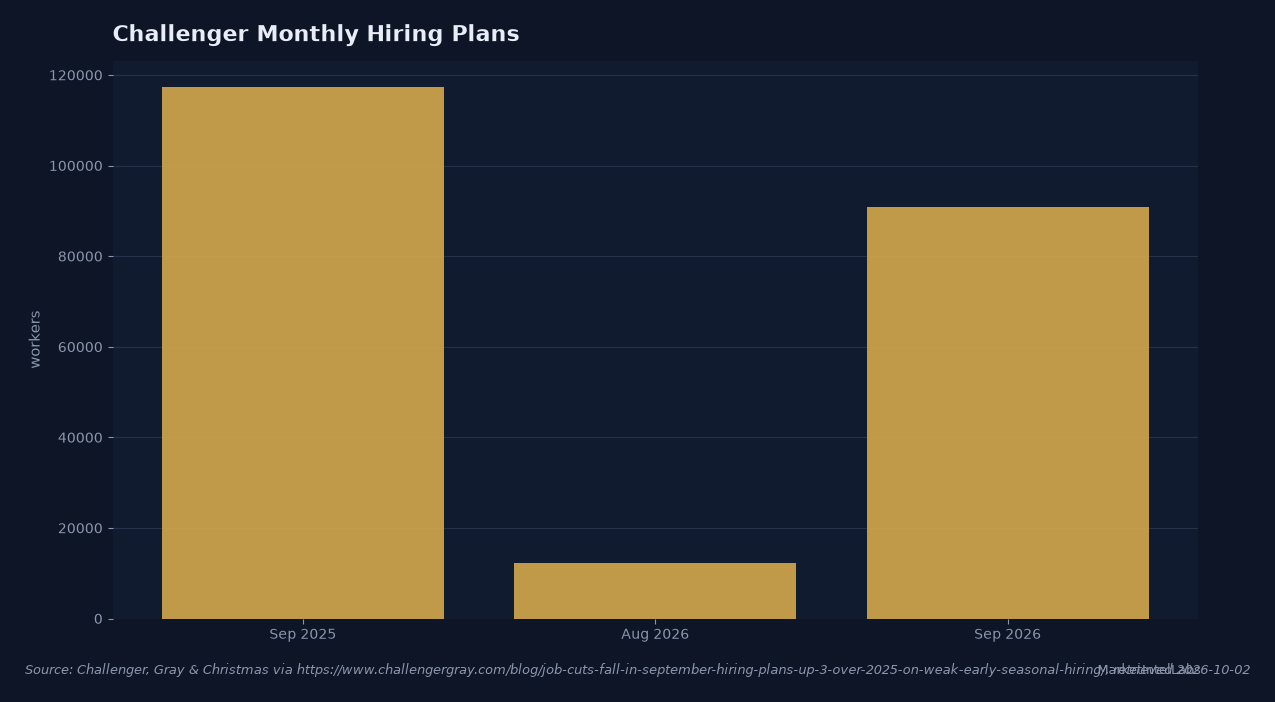
The report's retail detail makes the gap concrete. Retail employers announced 65,150 planned hires in September 2026, bringing their year-to-date hiring plans to 66,557. Challenger said Spirit Halloween and Michaels were the only retailers to have announced seasonal hiring plans so far in 2026, with a combined 62,000 positions. It compared that with 100,800 seasonal positions announced by seasonal employers in September 2025. These totals describe plans announced by a private tracker, not final holiday headcount, so the comparison is a warning about intent rather than a forecast of store staffing.
At the same time, the cuts were concentrated rather than evenly spread. Technology companies announced 10,799 cuts in September 2026, up 77% from August, and their year-to-date total reached 165,925, up 54% from the first nine months of 2025. Food producers announced 7,326 cuts in September, including 5,396 in Washington orchards and agricultural employers through WARN notices that cited weaker demand. Transportation companies had announced 44,430 cuts year to date through September, 190% above the comparable 2025 period. The overall decline conceals pockets of real adjustment.
Artificial intelligence was cited for 3,961 announced cuts in September and 120,136 through September 2026, about 21% of the year's total, according to Challenger. That is a count of cuts employers attributed to AI, not an independently measured estimate of jobs eliminated by automation. The attribution is useful as a record of company explanations, but it does not establish that AI caused every job loss in the category.
Claims offer a second, limited check
The Department of Labor's October 1, 2026, weekly report showed 197,000 seasonally adjusted initial claims for the week ending September 26, down 1,000 from the prior week's revised 198,000. The four-week average was 200,000, down 2,500 from the revised prior average. Initial claims count new applications for unemployment insurance, so they capture a different slice of the labor market than Challenger's plans. They have been steady at a low level, which is consistent with limited broad layoffs, but one weekly reading cannot confirm that hiring demand is healthy.
The next major test is the Bureau of Labor Statistics' September Employment Situation, scheduled for October 2, 2026, at 8:30 a.m. Eastern, according to the BLS release calendar. At the time of this writing, that report is still pending. Payroll, unemployment and wage measures will show whether fewer announced cuts are accompanied by actual hiring and stable household employment. The alternative is a labor market where low layoffs meet a slower pace of new jobs.
For now, the Challenger print argues against treating a lower layoff tally as an all-clear. Employers announced fewer cuts, but seasonal hiring plans missed last year's pace and job-cut announcements remained elevated in technology, food and transportation. The BLS report due October 2 will supply the harder test: whether payroll growth and household employment confirm the cautious picture or point to a broader slowdown.
This content is for informational purposes only and does not constitute financial advice. Past performance is not indicative of future results. Consult a qualified financial advisor before making investment decisions.
Sources: Challenger, Gray & Christmas, September 2026 job cuts and hiring plans, published October 1, 2026; U.S. Department of Labor, Unemployment Insurance Weekly Claims, October 1, 2026; Bureau of Labor Statistics, October 2026 release schedule.
Get daily intelligence delivered
Create a free account for the Daily Brief every weekday and The Week Ahead every Sunday. No card required.