M2 money supply accelerates to +5.66%: risk-asset read


The money supply is growing faster than at any point in this hiking cycle, and it is doing so while bonds refuse to back down. M2 climbed 5.66% year over year in August to $23,342.8 billion, up from 5.3% in July, per FRED's M2SL series, in the same stretch that put the 10-year Treasury at 5.28% and the 30-year at 5.63%. That pairing, accelerating money against record long yields, is the tension that will decide whether risk assets can keep grinding higher.
Money supply growth on its own does not tell you whether policy is loose or tight; the comparison to nominal rates does. When M2 expands 5.66% while a 10-year government bond pays 5.28%, the cost of money still outpaces the pace at which it is being created. That gap is the real stance, and it remains restrictive.
Related reading: Why the Fed's Tightening Cycle Isn't Over Despite Slowing Money Supply.
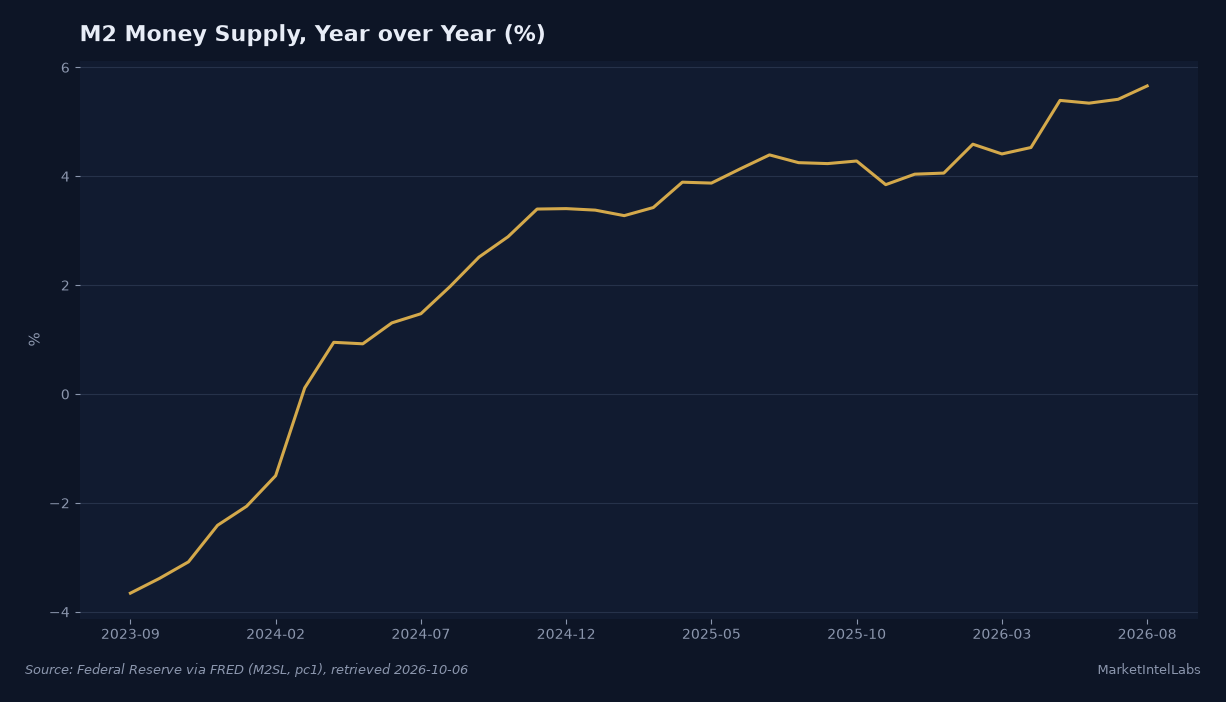
The turn is visible even in a longer rearview. M2 spent late 2023 in contraction, printed below 5% through most of 2025, and re-accelerated through 2026, from roughly 4% at the start of the year to 5.66% in August. It is the clearest liquidity turn since the Fed began tightening.
Why it matters is the collision it sets up. On one side sits a genuine tailwind for the economy: faster money growth is the raw fuel for nominal spending, and it supports the assets that lean most on liquidity, which is part of why SPY holds near its 52-week high at $774.83 and gold stays above $4,100. On the other side is the long end's dividend. A 10-year at 5.28% and a 30-year at 5.63% lock in an income stream without equity risk, and every basis point of that yield competes for the same investor dollar that might otherwise flow into equities or commodities. It also raises the discount rate applied to every future cash flow.
For the broader framework, see our Fed policy coverage.
Related reading: CPI Holds Near 332 as M2 Shrinks: What Fed Policy Means for Inflation.
That is the mechanism by which conditions stay tighter than the M2 headline suggests. The Fed's target range at 3.75% to 4.00% still leaves real short rates negative against roughly 3.4% inflation, which is stimulative to hard assets, and money creation at 5.66% reinforces the bid. But the long end is not cooperating. At 5.28% and 5.63%, the 10- and 30-year sit near multi-decade highs, and they tighten financial conditions through mortgages and corporate borrowing regardless of what the money supply does.
The bull read
Constructively, the M2 pickup is a leading signal for nominal activity. Negative real short rates plus accelerating money growth is a classic recipe for assets that hold value against inflation: gold, silver, and commodities generally. The economy is not cracking yet, with Q2 real GDP at 2.2% annualized and weekly claims at 197,000, and equities sit near highs with earnings intact. If the labor market stabilizes, faster money growth gives the equity bid a liquidity boost to extend further.
Related reading: M2 Contracts for Fourth Month: What Liquidity Drain Means for Risk Assets.
The bear read
The bear case is that money growth is chasing a tightening regime rather than loosening it. Inflation near 3.4% with a Cleveland Fed nowcast calling for September CPI at +0.53% month over month points to a Fed that delivers one more hike and then holds, the worst setting for duration, and TLT near its 52-week low is the price of that reality. Payrolls rose just 29,000 in September and unemployment ticked up to 4.2%, so the hiking lag is beginning to bite growth just as a 5.63% 30-year squeezes housing through mortgage pass-through. A firm dollar near 102 is a further headwind for gold and for crypto risk appetite. If the labor market rolls over before inflation normalizes, the Fed is boxed in, the most bearish configuration there is for risk assets.
The honest read of this data is bearish on duration and cautiously constructive on gold and hard assets, because the long end is not something to fight while the Fed itself projects rates holding near 4.1% through 2027. What changes the setup is the September CPI print on October 14, nowcast at +0.53% month over month, and the FOMC decision on October 27 to 28, where the market prices only about a 45% chance of the final hike. Watch whether M2's acceleration survives a hot CPI: if it does, the case for hard assets strengthens; if the labor market breaks first, liquidity will not be enough to rescue risk assets from a 5.6% long end.
Related reading: M2 Contraction and Dollar Strength Reshape Market Risk.
Get daily intelligence delivered
Create a free account for the Daily Brief every weekday and The Week Ahead every Sunday. No card required.