Housing Inventory Up 8.6% for 44th Week of List Price Cuts

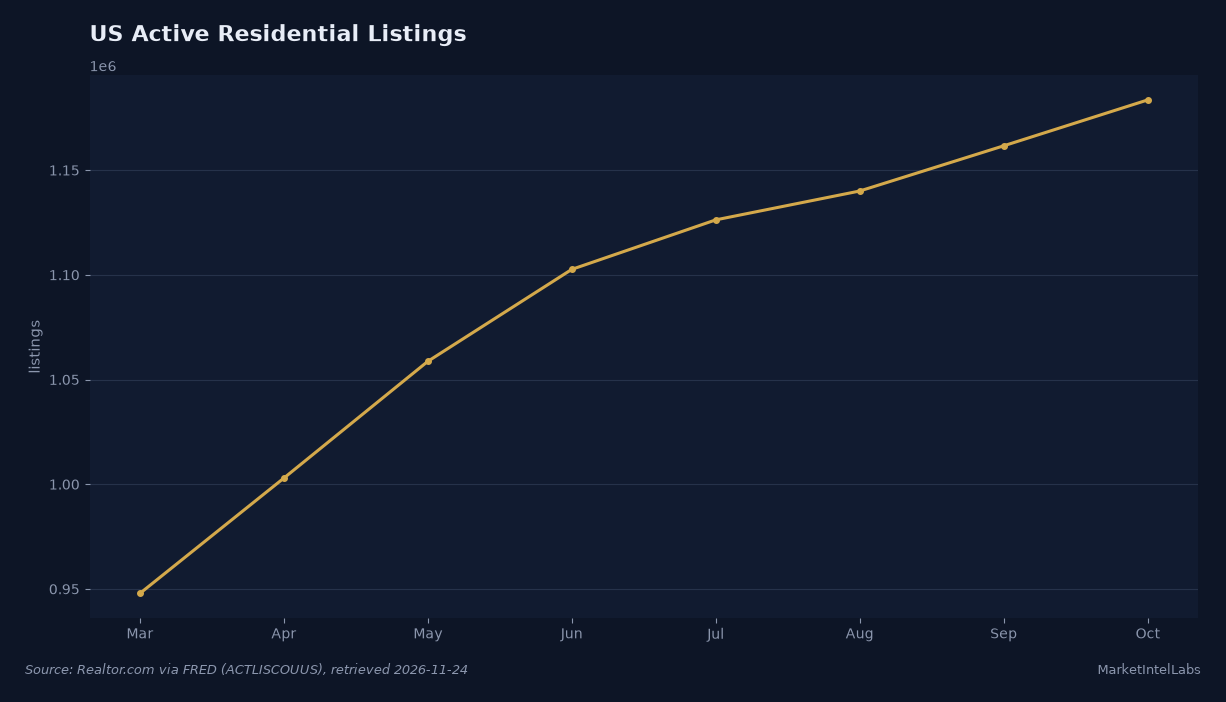
For sale inventory keeps building even as owners stay put. Active U.S. listings rose 8.6% from a year earlier in the week ending Nov. 14, and the median asking price fell to $405,000, down 2.4%, a 44th straight week of year-over-year declines, Realtor.com data show.
The inventory build is not owners rushing to sell. New listings fell 3.5% from a year earlier, a seventh straight weekly decline, Realtor.com said. According to U.S. Census Bureau American Community Survey data, roughly 59% of owner-occupied homes carry a mortgage, and owners holding low-rate loans are reluctant to trade that rate for a costlier one on a next home, which keeps relocation unattractive.
Related reading: Housing Inventory Climbs 6.7% as Sellers Cut Prices.
Why inventory grows while sellers hold off
Supply is rising because demand is not. Homes took a median 66 days to sell in the week, 2 days longer than a year earlier, the fourth straight week of slower selling and the widest gap since mid-April. Rising days on market lets unsold listings pile up, which is what pushed active inventory from roughly 2% year-over-year growth in mid-July to close to 9% now.
That supply favors buyers willing to wait out the rate environment. Listing prices are falling in existing homes more than in new ones: Realtor.com's third-quarter construction report found existing home prices about 1.5% below 2025 levels, while new home listing prices were flat and builders offered reduced mortgage rates to sweeten deals. The softness in asking prices is one of the few genuine concessions in this market, and it runs against what past years of low inventory made normal.
Related reading: Mortgage Rates Hit 6.95%: The Payment Math That Turns Inventory Into Price Cuts.
The affordability math still gates the deal
Price cuts have not moved the affordability needle much. Freddie Mac's 30-year fixed rate stood at 7.28% in the week of Nov. 19, up 17 basis points from the prior week as October inflation data pushed markets to price a December Fed hike. On the $405,000 median listing price with a 20% down payment, a 30-year loan at 7.28% carries a principal and interest payment near $2,217 a month. A year ago, with the rate near 6.26%, the same price cost about $1,997 a month. That $220 gap concentrates the whole standoff: sellers are cutting prices, but rates are eating the savings.
October pending home sales fell 4.7% from September to another record low and were down 16.7% from a year earlier, the National Association of Realtors said, as rates peaked near 7.4% before easing. Less competition and more negotiable sellers are the trade-off for buyers who can afford to act now. The data to watch is next Thursday's weekly listing update, and the Fed's response to October inflation, for whether the 7% rate floor firms or breaks.
Related reading: Freddie Mac's 7.28% Rate Reprices Fall Housing Demand.
Related reading: Housing Inventory Gains Ground in August as Price Cuts Match Last Year.
This content is for informational purposes only and does not constitute financial advice. Past performance is not indicative of future results. Consult a qualified financial advisor before making investment decisions.
Get daily intelligence delivered
Create a free account for the Daily Brief every weekday and The Week Ahead every Sunday. No card required.