Federal worker jobless claims keep climbing as the public sector sheds staff


Initial jobless claims rose to 200,000 in the week ending November 7, up 9,000 from a prior week revised up 2,000 to 191,000, while the 4-week moving average held flat at 195,250. That headline still reads as one of the calmest labor prints in the cycle. But the release carried a quieter signal that matters for a sector of the workforce now in active retreat: claims filed by former federal civilian employees are climbing again as the public sector sheds staff through the fall.
Federal civilian claims are unadjusted and small in absolute terms, but they are the cleanest weekly read available on the government restructuring, since WARN and Challenger track the private sector and payrolls arrive monthly. The 585 initial filings for the week ending October 31 compare with a prior-week 552 and with 7,483 a year earlier, and the 5,327 continued weeks compare with 30,651, so the surge that followed the 2025 drawdown has largely washed out. What remains is a slow, persistent drift in a small residual cohort, which is what steady public-sector headcount reduction tends to look like at the claims desk.
Related reading: Why Are Jobless Claims Still Near Multi-Decade Lows While Payroll Growth Cools?.
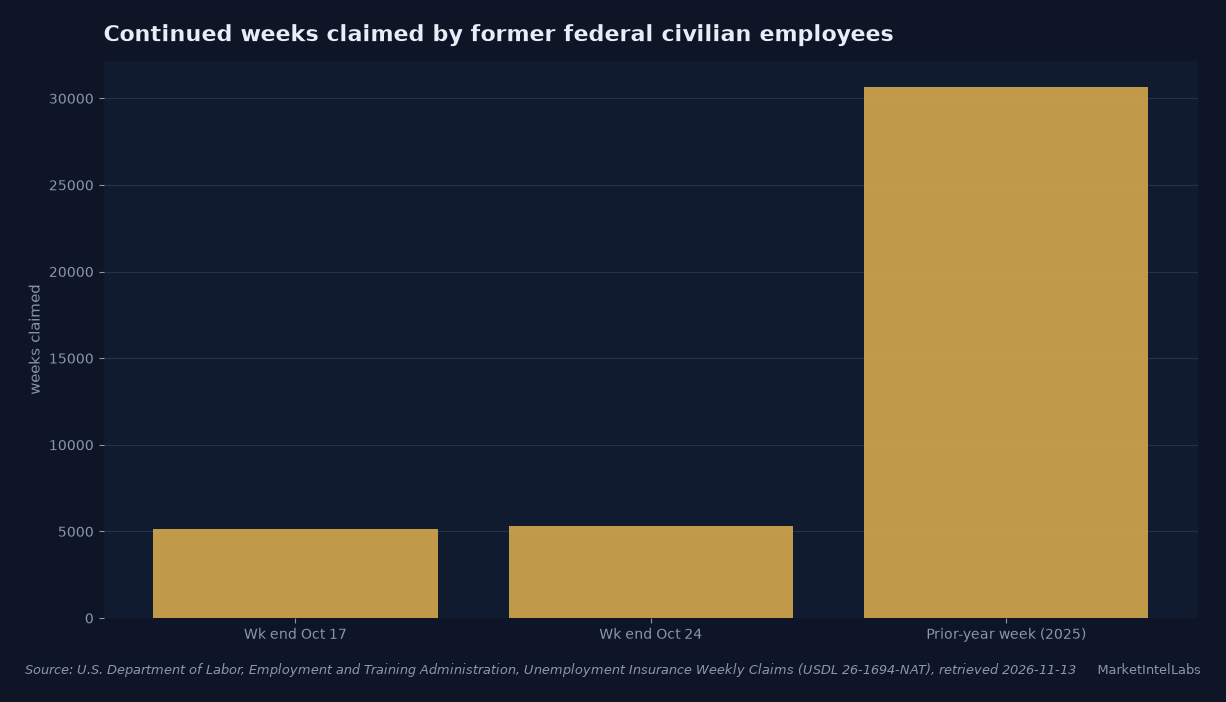
The federal move sits in the unadjusted program data rather than in the seasonally adjusted state claims that drive the headline, and that is partly a function of timing: the federal and newly discharged veteran categories track weeks a step behind the state figures and move in smaller, noisier numbers. Illinois led the week's state-level increases with 728 extra initial claims, followed by Indiana, Washington, Missouri and Oregon, while New York and Texas posted the largest declines, both over 1,400. None of that undoes the core message, that the private-sector claims backdrop is stable at very low levels.
It is worth being precise about what the federal column does and does not capture. The UCFE category counts claims filed by former federal civilian employees, which is a narrower base than the roughly 2.3 million federal civilian workers on payroll. A layoff round big enough to show up in the state series would be a markedly different event; the federal numbers moving by a few dozen at a time are best read as the tail of a large, earlier workforce reduction rather than as a fresh break. That is why the year-over-year levels matter: at 585 versus 7,483 for initial claims and 5,327 versus 30,651 for continued weeks, the cohort is now a fraction of what it was at the peak of the surge.
Related reading: Jobless Claims Rise to 199,000 as Continuing Claims Slide.
For the labor market as a whole, the insured-unemployment rate held at 1.1 percent and seasonally adjusted insured unemployment slipped 20,000 to 1,697,000, a continuing-claims level consistent with a tight labor market even as hiring has cooled. The divergence between that tightness and softer payroll gains is the running fixture of this cycle, and this week's claims do nothing to close it. The federal piece is the newest fold: layoffs in one large employer that barely register in the state series but show up as a slow bleed in the federal columns.
The near-term risk is measurement, not a wave. Single-week federal claims moves are noisy, and the category often revises. What would change the story is a sustained climb over consecutive weeks, or a step-up in the monthly payroll print from the public sector, which has been a steady source of job gains through most of the year. Until either shows up, the sane read is that the federal drawdown is now a slow trickle into the unemployment insurance system rather than the flood of a year ago.
Related reading: Jobless Claims Hit 196,000, a 1960s-Level Print Firms Are Not Firing.
A lower-inflation environment makes the federal drag easier for the Fed to tolerate, but it does not make it costless. Were public-sector claims to keep stepping up while private payrolls cooled, the composite would look less like a soft patch and more like a genuine contraction in the labor market's biggest single employer. That combination is not in the numbers yet. The two thresholds to watch are a third consecutive rise in the federal claims line and a government component that turns negative in the December employment report.
What is dated next: the initial claims series returns Thursday, November 19, for the week ending November 14. The bigger test for the public-sector read is the Employment Situation, scheduled for the first Friday of December, which reports November payrolls with the government component broken out by level of government. That is the print that will separate a genuine public-sector contraction from claims noise.
Related reading: Weekly Jobless Claims Today: 197,000 Before New Release.
For now the weekly claims grid still reads as a labor market that is soft at the margin but still tight where it counts. The federal civilian line is the one column that has started to move on its own, and it will be worth reading next week to see whether the rise becomes a pattern.
This content is for informational purposes only and does not constitute financial advice. Past performance is not indicative of future results. Consult a qualified financial advisor before making investment decisions.
Get daily intelligence delivered
Create a free account for the Daily Brief every weekday and The Week Ahead every Sunday. No card required.