September FOMC: Fed Hikes to 4% in Hawkish Surprise

The Federal Reserve raised its benchmark rate by a quarter point on September 16, moving the target range to 3-3/4 to 4 percent on a unanimous 12-0 vote. Consensus going into the meeting, recorded in our event calendar, was a hold at 3-1/2 to 3-3/4 percent, and markets priced no change. Our What to Watch: September FOMC Decision preview set out the setup going in. The Fed delivered the opposite: a hike that the three July dissenters who wanted one were no longer alone in requesting.
The statement removed any ambiguity about the direction of travel. "The Committee decided to raise the target range for the federal funds rate by 1/4 percentage point to 3-3/4 to 4 percent, in support of the Federal Reserve's dual mandate," it read, approved by a 12-0 vote. The follow-on is where the hawkish tilt lives: "Inflation remains elevated. Today's policy action will support a timelier return to the Committee's 2 percent goal. The Committee will deliver price stability."
That last sentence is the pivot. After a July meeting that split 9-3, with Hammack, Kashkari and Logan dissenting for a hike, the September meeting closed ranks. A hike that was a minority ask in July became policy now, unanimously. The Committee did not merely hold the door open to future tightening; it walked through it, then used the Summary of Economic Projections to signal it is not done. We mapped the pre-decision setup in The Fed's Hawkish Pivot: What the September FOMC Priced In.
The SEP shows the median fed funds path at 4.1 percent at the end of 2026, against 3.8 percent in the June projections, then 4.1 percent in 2027, 3.9 percent in 2028 and 3.6 percent in 2029. The current midpoint is 3.875 percent. A 4.1 percent median for end-2026 is the textbook definition of "at least one more hike," and the path stays meaningfully above June's dots at every horizon. On the inflation axis, median 2026 headline PCE was revised up to 3.7 percent from 3.6 percent, core PCE to 3.4 percent from 3.3 percent, and the return to a 2.0 percent reading on headline PCE is pushed out to 2029 from 2028.
On the labor and growth axes, the story is brighter and part of why the Committee felt it could tighten. Median unemployment was marked down to 4.1 percent for 2026 from 4.3 percent in June, holding there through 2029. Median real GDP growth was nudged up to 2.3 percent for this year from 2.2 percent. The statement's own summary matches on the labor side: economic activity is expanding at a solid pace, productivity growth is strong, capital investment is firming, and job gains have kept pace with the workforce. A resilient job market gives the Fed room to keep fighting inflation without fearing a collapse on the other mandate, the core of the Fed policy framework.
The balance sheet is the neutral corner. "The Committee is continuing its policy of maintaining ample reserves in the banking system," the statement said, and the SEP flagged no change to the runoff posture. Whatever hawkishness the Committee imported on rates and inflation, it did not carry into quantitative tightening, which the market is watching after years of runoff. The tightening signal is a rate signal, not a liquidity one.
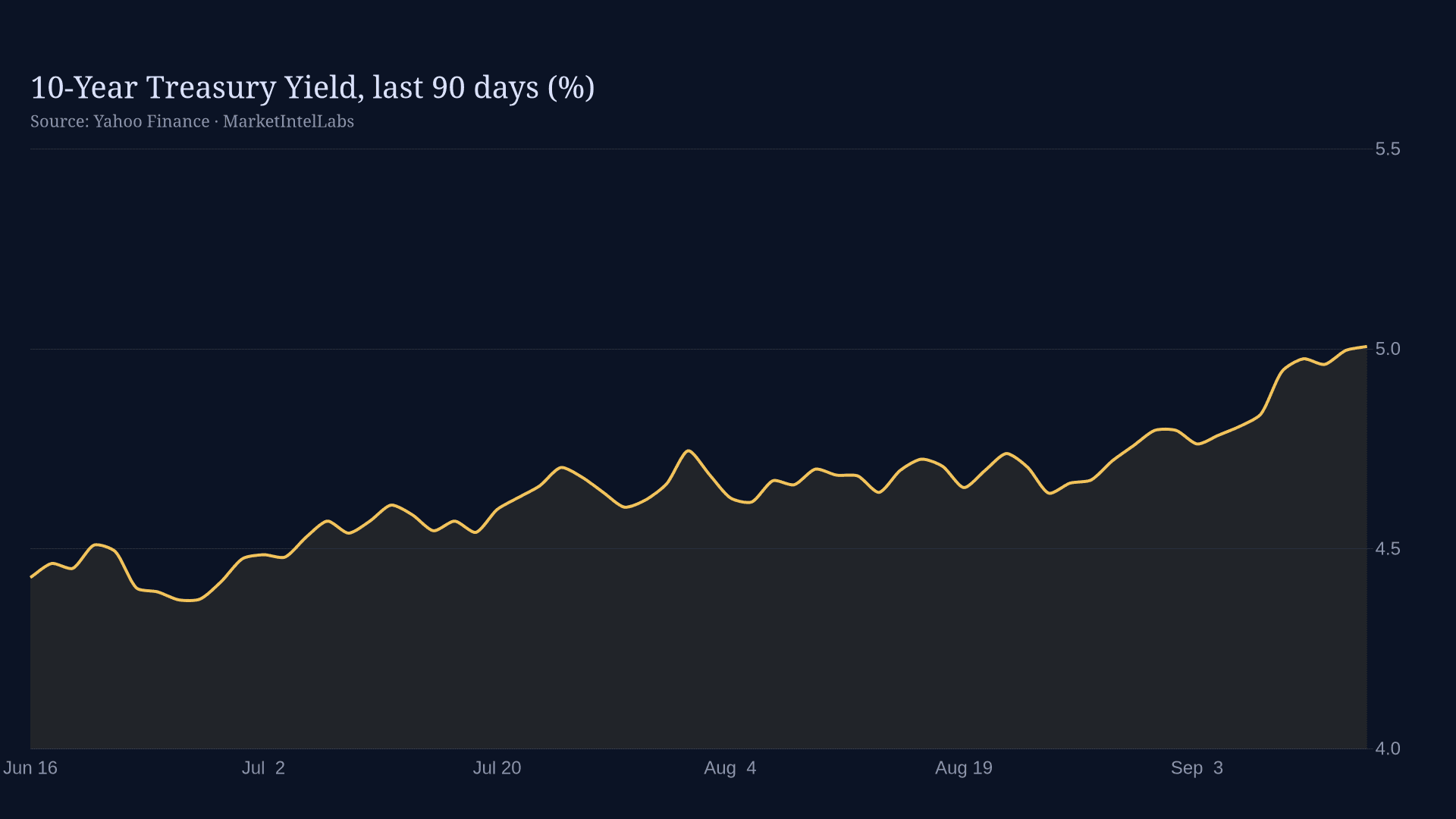
The market response was an orderly, hawkish repricing rather than a panic. The dollar index rose to 100.25, up 0.63 percent, on the stronger path. The 10-year Treasury yield held near 5.01 percent. Equities slipped but did not break: SPY, the S&P 500 ETF, was down about 0.50 percent at 753.58, QQQ down less than 0.1 percent at 703.90, and the small-cap IWM fell 0.61 percent to 283.41, the clearest sign that the higher-for-longer path hits high-beta borrowing costs hardest. The household fallout is detailed in Household Debt Service After the FOMC: What the New Fed Funds Level Means for Your Monthly Payments. Gold eased 0.68 percent to around 4,303.30 as the real-rate picture firmed, while Bitcoin was a touch higher near 75,964. The modest size of the equity drawdown suggests investors had largely braced for hawkish language even if not for a hike today.
The bear case is straightforward: this was a liquidity-driven tightening into slowing momentum, and the dot plot now invites the market to price a path the economy may not deliver. Against that, the bull case is that a Committee willing to hike into a resilient labor market and revised-up growth is front-running a policy mistake, not committing one. The statement gives the playbook if conditions deteriorate, and a Chair press conference is underway to frame the forward path.
What to watch next. The near-term question is whether the data supports the implied fourth-quarter hike: the next employment report and a core inflation print that stays at or above 0.3 percent month over month would validate the dots. Watch the 10-year auction cycle after the 5 percent breach, the dollar's persistence above 100, and whether small-cap relative weakness extends, which would signal the rate path is biting before the Fed's own forecast says it should.
This content is for informational purposes only and does not constitute financial advice. Past performance is not indicative of future results. Consult a qualified financial advisor before making investment decisions.
Get daily intelligence delivered
Create a free account for the Daily Brief every weekday and The Week Ahead every Sunday. No card required.