Five Things the Fed's 12-0 Hike Tells Us About the Rest of 2026

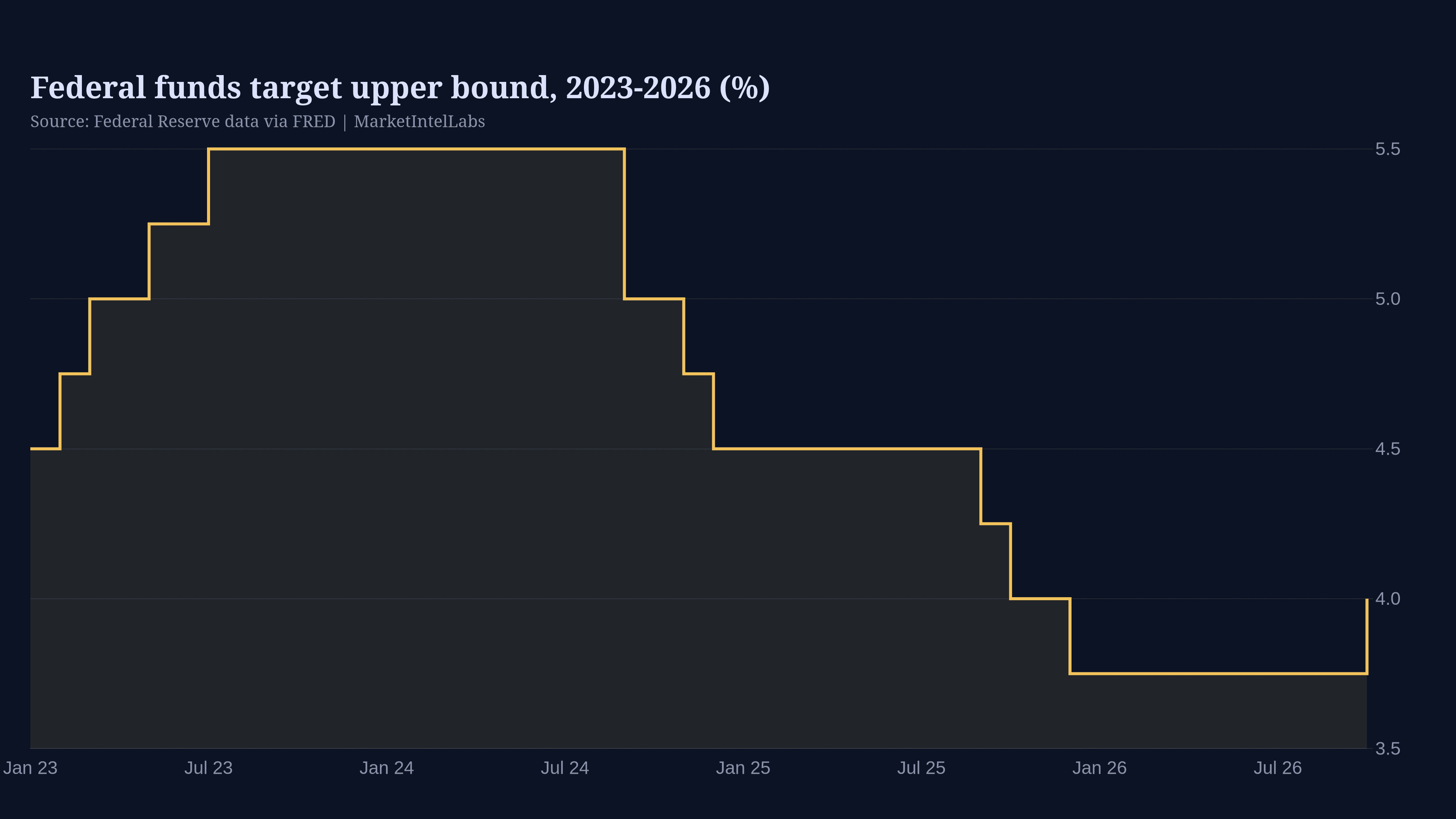
On September 16 the Federal Reserve did something it had not done in more than three years: raised interest rates. The 25 basis point move, to a 3.75 to 4.00 percent target range, passed 12 to 0 under Chair Kevin Warsh, and the message underneath the vote was unmistakable. This was not a one-off. It was the opening bid on a higher-for-longer regime.
The reason the vote matters is timing. In July, three Committee members dissented in favor of a hike, but in September the whole room came around. That rarely signals genuine unity. It usually means the Committee concluded it could no longer defend a hold with the 10-year Treasury already above 5 percent and crude above $100 a barrel. The August CPI print supplied the trigger: headline inflation held at 3.4 percent year over year while energy rose 2.1 percent month over month and gasoline climbed 27.4 percent on the year, according to BLS data cited by CNBC.
The policy path: a resuming cycle and a longer inflation fight
The hardest news in the decision was the path ahead. The September dot plot shows 16 of 18 participants expecting at least one more hike before year-end, with four seeing the possibility of two. That tells markets the September move is an opening bid, not a peak. When a Fed committee publishes a median that far in one direction, the base case is that the hiking cycle has resumed, not finished.
That said, dots are forecasts, not commitments. The brief's own scenario work puts the odds of a hike at the October meeting at 40 percent and a hold at 60 percent, because single-hike cycles often pause mid-sequence while the data confirms. The next milestone is the August PCE print in late September, then a September employment report due the first week of October, and the decision itself lands on October 27 and 28.
The SEP did the most uncomfortable work of the day. The Committee pushed its 2026 headline PCE forecast to 3.7 percent and core to 3.4 percent, and it now expects no return to its 2 percent target until 2029. That is a real shift from a Committee that spent the first half of the year on hold, expecting the energy shock tied to the Iran war to fade on its own. It is not fading. Diesel has touched $6 a gallon, fuel oil is up 52 percent year over year, and the Strait of Hormuz question keeps headline inflation mechanically high. The forecast, in plain terms, is that households absorb a multi-year stretch where inflation runs far above the Fed's stated goal.
The market path: borrowing costs rise as a 5% 10-year caps stocks
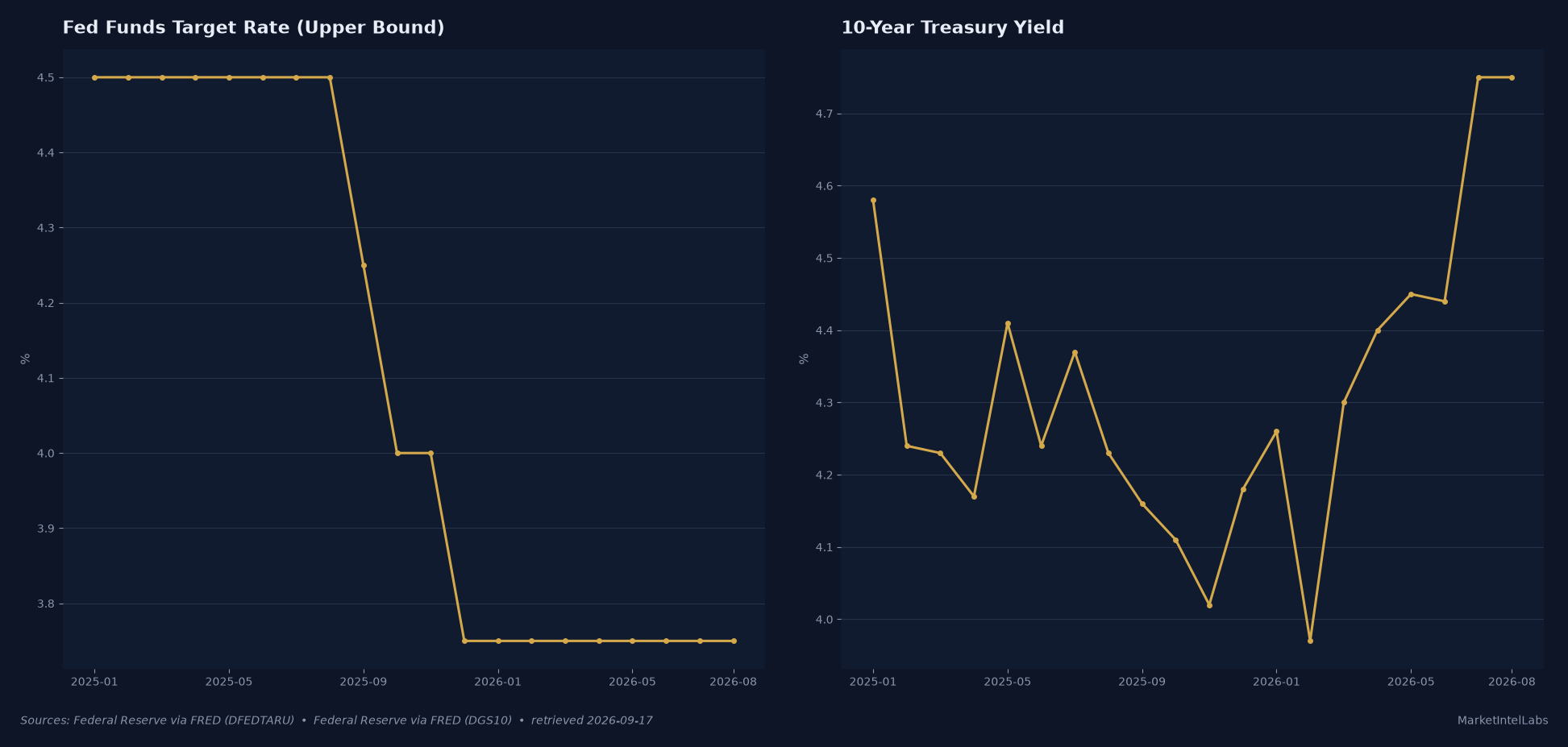
The 10-year Treasury yield is above 5 percent, roughly a quarter point higher since what the dot plot could change this week, and the 30-year fixed mortgage has risen to 7.19 percent. For a household that has not refinanced in two years, this is the difference between locking a mid-6 percent rate and a low-7 percent one. For businesses, the cost of capital just went up; for the federal government, a higher 10-year means a larger interest tab on every new issuance.
The cross-asset read runs through the real-rate channel. With the 10-year at 5.01 percent and the funds rate being lifted into a 3.75 to 4.00 percent range, the discount rate on long-duration assets has risen even as realized inflation stays sticky. That is a hostile combination for growth equities and long-duration bonds alike.
SPY tracks the S&P 500. The fund ended the day down 0.44 percent at $754.05, well below its 52-week high of 779. The reason is the round number above it: a 5 percent 10-year caps how far multiple expansion can run. When investors can earn 5 percent in a Treasury, they demand a bigger risk premium to hold stocks, and that compresses valuations at the top of every growth chart.
Gold is worth watching in this regime for the opposite reason. It fell 1.1 percent on the day to 4,339, pressured by rising real yields, yet it is holding at a high absolute level because the inflation hedge and the geopolitical bid are offsetting the yield drag. That split, rather than the day's direction, is the signal. A firmer dollar near 100.25 is doing the same work on commodities priced in dollars.
Because the Committee has resumed hiking, every data release now moves the policy path. The September PCE print is the highest-information item: an August headline that holds at or above 3.7 percent keeps the October hike on the table, while a step down reopens the door to a pause. Watch the August retail sales figure in the same window; a 1.2 percent monthly jump, the fourth straight acceleration, complicated the case for a gentle landing.
The contrarian case is real and worth tracking. Retail sales rose, but the July print was revised to a contraction and JOLTS data shows a cooling labor market. If core disinflation resumes and oil retreats on some de-escalation, the Committee retains room to deliver just this one hike and hold through year-end. Dots are a forecast, and they sit lower in the hierarchy than actual prints.
The practical message for the rest of 2026 is straightforward. under the Fed policy framework, a 5 percent 10-year is the new gravity on valuations, and the next two inflation reports will decide whether the Committee adds another hike or stops at one. None of that is a call to buy or sell anything. It is the map the data drew, and it rewards patience more than prediction.
This content is for informational purposes only and does not constitute financial advice. Past performance is not indicative of future results. Consult a qualified financial advisor before making investment decisions.
Get daily intelligence delivered
Create a free account for the Daily Brief every weekday and The Week Ahead every Sunday. No card required.