Container Freight Rates Up 130% Since February on the West Asia Reroute


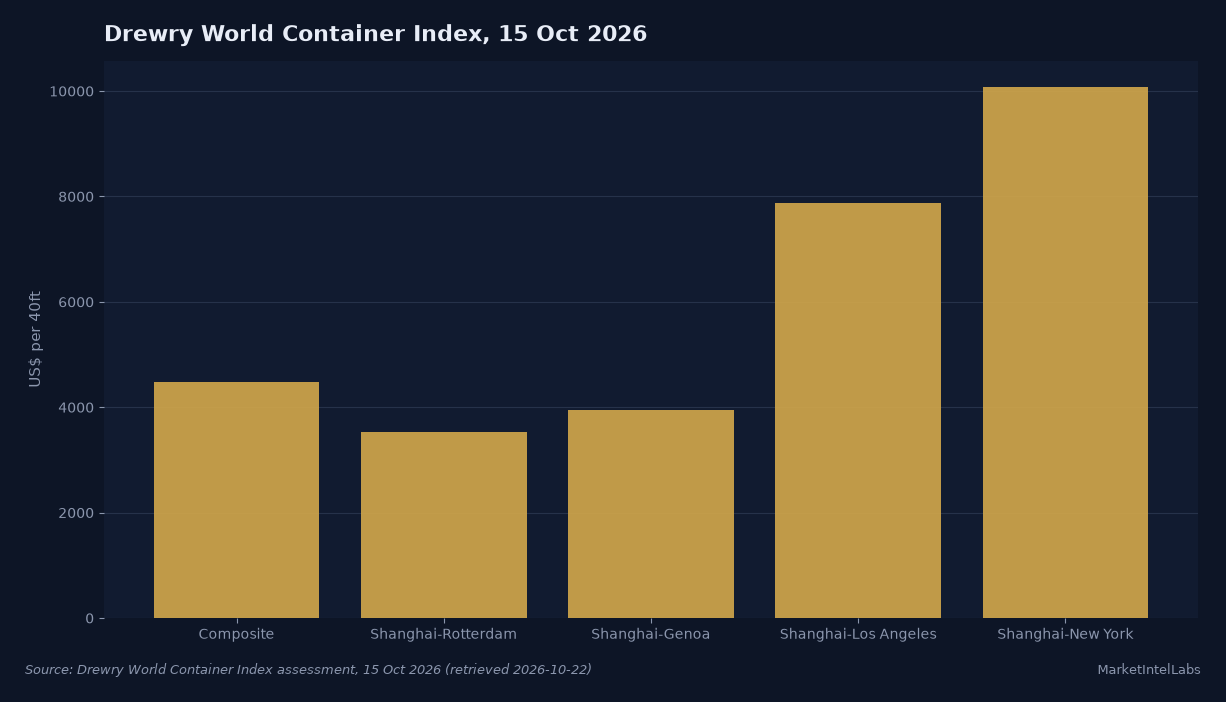
Global container freight rates have risen 130 percent since February 2026, according to a Jefferies research note, as renewed West Asia tensions push shipping lines onto longer routes and lift the cost of moving a box. The investment bank put the global container index at roughly $4,000 to $4,500 per 40-foot container in October, and Drewry's World Container Index corroborates the climb, sitting at $4,485 on October 15, up about 130 percent from a February base near $1,950; the 130 percent call circulated ahead of the 21-22 October coverage.
The move ends a long decline. Jefferies said freight rates had been falling steadily since early 2025 as an improving balance between supply and demand relieved the pressure that spot rates built up after the Red Sea disruptions of early 2024, and that the latest rise has put shipping costs back in focus for businesses in international trade. The dip through late 2025 and early 2026 left the global index near $1,950 in February before West Asia tensions began to tie up capacity and rates climbed through the autumn.
Related reading: Transpacific on-time rate 26.9% as ship delays deepen.
West Asia tensions are the cause the bank names plainly. Ships are taking longer routes around the affected region, and services from Asia to Europe and the Mediterranean have absorbed much of that rerouting. Longer voyages keep vessels away from their loading ports for more weeks, which pulls capacity out of the system even when demand is not rising. Higher fuel and insurance costs along the affected legs then feed into what carriers charge for a box.
That capacity drain is what makes this rate move different from a normal seasonal squeeze. Container lines had been adding effective capacity earlier in the year, in part by blanking sailings, the practice of cancelling scheduled departure slots to trim utilisation; a reroute around a conflict zone removes that slack outright, because every ship on the long leg is unavailable for a shorter rotation. The result is a rate rise that has little to do with consumer demand and everything to do with the physical geography of where the vessels are allowed, or willing, to sail.
Related reading: Container rates snap back: Drewry WCI composite jumps 3% to $4,485 as Asia-Europe legs reprice.
The weekly prints back the picture, and the real series is citable. Drewry's World Container Index, the benchmark procurement teams watch, rose 3 percent to $4,485 per 40-foot container on its October 15 assessment, per the Drewry World Container Index assessment. The Asia-Europe legs led the gain: Shanghai to Rotterdam rose 6 percent to $3,522 and Shanghai to Genoa rose 7 percent to $3,945, while Shanghai to Los Angeles climbed 3 percent to $7,884. The same assessment flags the counter-swing: fewer blank sailings and the resumption of Suez Canal transits are adding further capacity to the route, even as carriers attempt to push higher freight-all-kinds (FAK) rates of $4,500 to $4,800 per 40-foot container on Asia-Europe, effective October 19.
The factor to watch, Jefferies said, is whether shipping lines begin returning to the Suez Canal despite the security situation. The question matters twice over, because the same conflict zone that pushed rates up is the one punishing the tanker trade on other legs, and liner companies watch the war-risk assessment in real time. A return to Suez would shorten voyages and release capacity that longer routings now absorb, which could ease rates. Until that happens, the rerouting keeps a floor under prices, and the longer transit times stretch lead times for importers who have grown used to the Cape-route schedules.
Related reading: Transpacific Spot Rates Climb as Carriers Pull Capacity.
Demand has not cracked in the aggregate, but the Jefferies note also flags where it is cooling. India's containerisable export-import trade grew 23 percent year over year in September, with exports up 22 percent and imports up 23 percent, and shipments to the United States rose 48 percent. The same note shows India's boxed volumes to the United Arab Emirates and Saudi Arabia down 12 to 15 percent year over year, a sign the demand picture is regional rather than uniform even inside a growing lane. That tempers the demand-has-not-cracked read: the strength holding rates up is concentrated in the trades most exposed to the reroute, while Gulf-bound volumes are already giving ground, which points to capacity geometry rather than broad demand doing the work. The current figures do not show that higher freight has already slowed trade growth overall, the bank noted, though rising landed costs cut margins for exporters who cannot pass the increase on. A manufacturing PMI or inventory-to-sales print is the next independent test of that demand read; this piece leans on India's trade flows as the freshest proxy, because the rate move is a vessel-supply story first.
For importers and freight buyers the immediate question is how long the leg holds. A $2,000 rise on a 40-foot box adds up fast across a containerized import program, and it lands directly on landed cost before any tariff or duty is added.
Related reading: Container Freight Rates: Drewry WCI Falls 2% to $4,351.
The dated items on the calendar keep the picture honest: the next Drewry World Container Index assessment on Thursday, whether carriers hold the higher Asia-Europe and Mediterranean rate levels they set for cargo from October 19, the next manufacturing PMI read, and the next monthly port-volume prints. If lines return to Suez, the released capacity could take the edge off rates; until then, the reroute and the tight vessel supply keep a floor under what it costs to move a box, and freight buyers planning fourth-quarter cargo should price in that lower bound.
This content is for informational purposes only and does not constitute financial advice. Past performance is not indicative of future results. Consult a qualified financial advisor before making investment decisions.
Get daily intelligence delivered
Create a free account for the Daily Brief every weekday and The Week Ahead every Sunday. No card required.