Transpacific on-time rate 26.9% as ship delays deepen

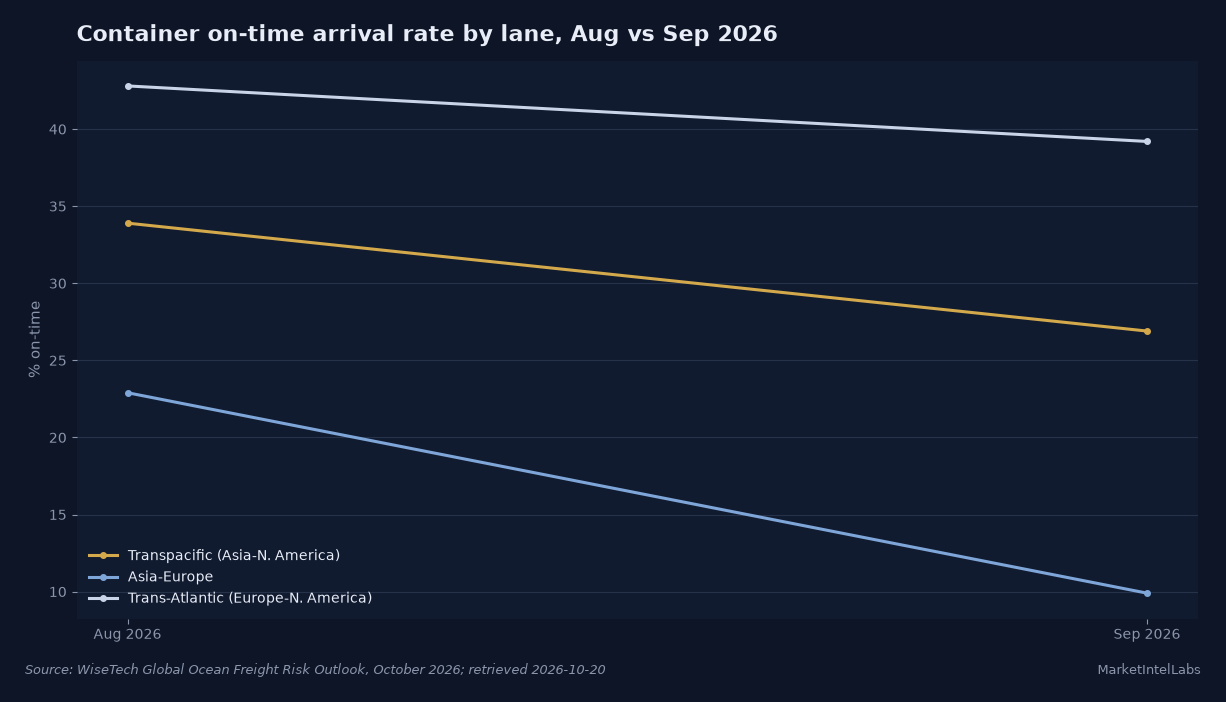
Only 26.9 percent of Asia to North America containers arrived on time in September, down from 33.9 percent in August and the clearest sign yet that the container market's problem has shifted from price to schedule. WiseTech Global's October Ocean Freight Risk Outlook, published this week, put the transpacific on-time rate at 26.9 percent for September, a 7 percentage point drop in one month, and the latest weekly reading was little better at 26.8 percent. Carriers keep rates near yearly highs, but ships are running late, and that combination is now the story shippers have to plan around.
The number underneath the headlines is that rates and reliability stopped moving together several weeks ago. Freightos FBX, Drewry and the Shanghai Containerized Freight Index all show spot prices holding near their strongest levels of the year into October: Freightos put the Asia to US West Coast at $8,322 per FEU and the East Coast at $9,606 the week of October 5, both near their 2026 peaks. Yet on-time performance sank. WiseTech attributes the September drop to continuing disruption at Asian ports, where vessel delays have cut effective transpacific capacity even as the calendar moves past China's Golden Week holiday. The divergence has independent corroboration. ISM's Manufacturing PMI Supplier Deliveries Index read 59.0 in September, a tenth straight month above 50 signaling slower deliveries, even as the Inventories Index slipped back into contraction at 48.6, a mix that points to goods stuck in transit rather than to weak demand.
Related reading: Transpacific Spot Rates Climb as Carriers Pull Capacity.
WiseTech's reliability measure tracks the share of shipments arriving at the discharge port on or before the carrier's promised schedule. Across the transpacific, delays of eight days or more were the single largest arrival-outcome category in the latest weekly reading. That means the distribution of outcome is worse than the average suggests: a shipment is less likely to be on time, and when it is late it tends to be very late. For importers holding retail and manufacturing inventory into the holiday sell-through, an eight-day miss is not a rounding error on a 28-day baseline transit, it is a stockout risk on the shelf.
The deterioration is even steeper on Asia to Europe. WiseTech's September reading put that lane's on-time rate at 9.9 percent, down from 22.9 percent in August, a collapse of 13 points. Shipments delayed eight days or more accounted for 45.5 percent of Asia to Europe volume in the latest week. The report points to Asian port congestion and the shifting mix between Suez Canal-Red Sea routings and the longer Africa diversions as contributors, and it cautions that even the stronger-performing carriers have weak recent on-time records, so carrier selection alone will not fix the schedule.
Related reading: Transpacific Container Rates Near Annual High at $7,884.
The trans-Atlantic lane is comparatively calmer but still weakening. On-time performance there slipped to 39.2 percent in September from 42.8 percent in August, with the spread among carriers wide: September on-time results ranged from roughly 14 percent to 61 percent depending on the line, per WiseTech. Capacity is more plentiful on that route, with planned supply running ahead of forecast demand, so the constraint is execution rather than available space.
What matters next is capacity. WiseTech forecasts transpacific capacity to tighten toward the end of its four-week outlook, driven by reduced planned carrier supply rather than any rebound in demand. Its booking security risk indicator is expected to rise and sit well above its historical average, a signal that securing space on preferred sailings gets harder in the weeks ahead. The numbers line up with what carriers themselves are signalling: Xeneta's senior analyst Emily Stausboll counted 58,200 TEU blanked on the Far East to US West Coast trade in the latest week and 35,500 TEU on the Far East to US East Coast, removals that say carriers doubt the current high rates will hold into November even as they defend them into the last peak of the year.
Related reading: Golden Week Blank Sailings Hit 11% as Transpacific Spot Rates Top $10,000.
The demand side is starting to bend. The National Retail Federation projects November arrivals at US container ports down 11 percent month over month, which would mark the end of an unusually extended peak season that carried records through September. The Port of Los Angeles booked 1,042,652 TEU in September, the busiest month in its 118-year history and up 18 percent from the 883,053 TEU it handled a year earlier, per its October 9 release. The Port of Long Beach moved 997,177 TEU, the busiest month in its 115-year history and 25 percent above September 2025, with loaded imports up 31.3 percent year over year to 509,390 TEU, as FreightWaves reported October 16. Each print topped a prior monthly record. Those September releases captured the last of the front-loaded import wave. November's projected decline is the market telling carriers that the container math changes once peak volume steps down, and blank-sailing programs are the read-through.
Shorter published transit times do not change the slide. WiseTech notes planned Asia to North America transits of 26.2 to 27.6 days are actually below the recent 28 day baseline, yet actual arrivals keep missing schedule, which widens the gap between what carriers quote and what importers receive. For a shipper, the practical rule is to book earlier against contracted allocations and build extra time into delivery commitments, particularly as the pre-Lunar New Year rush in late December and January pulls demand forward again.
Related reading: Diesel Prices Near $6.18, Up 69% Year Over Year: What Freight Costs Next.
The next datapoints to watch are the weekly blank-sailing counts, which reveal how much capacity carriers are willing to park to defend spot rates, and the November port arrival data, which will confirm whether the peak has broken. If blankings keep climbing while NRF's 11 percent arrival drop materializes, the reliability crunch gives way to the opposite problem: excess capacity and sliding spot rates. For now the market sits in the uncomfortable middle, where freight costs stay high but schedules do not, and late is the likeliest outcome.
This content is for informational purposes only and does not constitute financial advice. Past performance is not indicative of future results. Consult a qualified financial advisor before making investment decisions.
Get daily intelligence delivered
Create a free account for the Daily Brief every weekday and The Week Ahead every Sunday. No card required.