Transpacific Spot Rates Climb as Carriers Pull Capacity


The China to North America West Coast trade printed $8,040.50 per 40-foot container on the Freightos Baltic Index dated September 18. That is up 3.5 percent from $7,765 on the September 11 index and up 40 percent from $5,741.60 on June 19. The global composite sat at $3,499, down 0.61 percent on the week. One lane is climbing while the world market drifts, and the gap is the story.
The divergence shows up route by route. China to the North America East Coast (FBX03) quoted $9,724, up 2.31 percent on the week. China to the Mediterranean (FBX13) fell 12.23 percent to $4,158. North Europe to the US East Coast was flat at $2,666. The transpacific lanes are the only major eastbound trades moving against the soft global tape, and both moved together, which points to a common cause on the Asia origin side rather than anything specific to one destination port.
The cause is capacity. According to Drewry's September 17 assessment, carriers have announced four blank sailings for next week across the east-west trades, up from one this week. Waiting time at Shanghai anchorage rose from 65 hours in Week 36 to 78 hours in Week 37, a sign that vessels are queueing even as sailings get pulled. When carriers withdraw tonnage ahead of China's Golden Week factory closures, which begin October 1, the ships that do sail carry more boxes at higher rates. This is the classic pre-holiday squeeze, running on schedule.
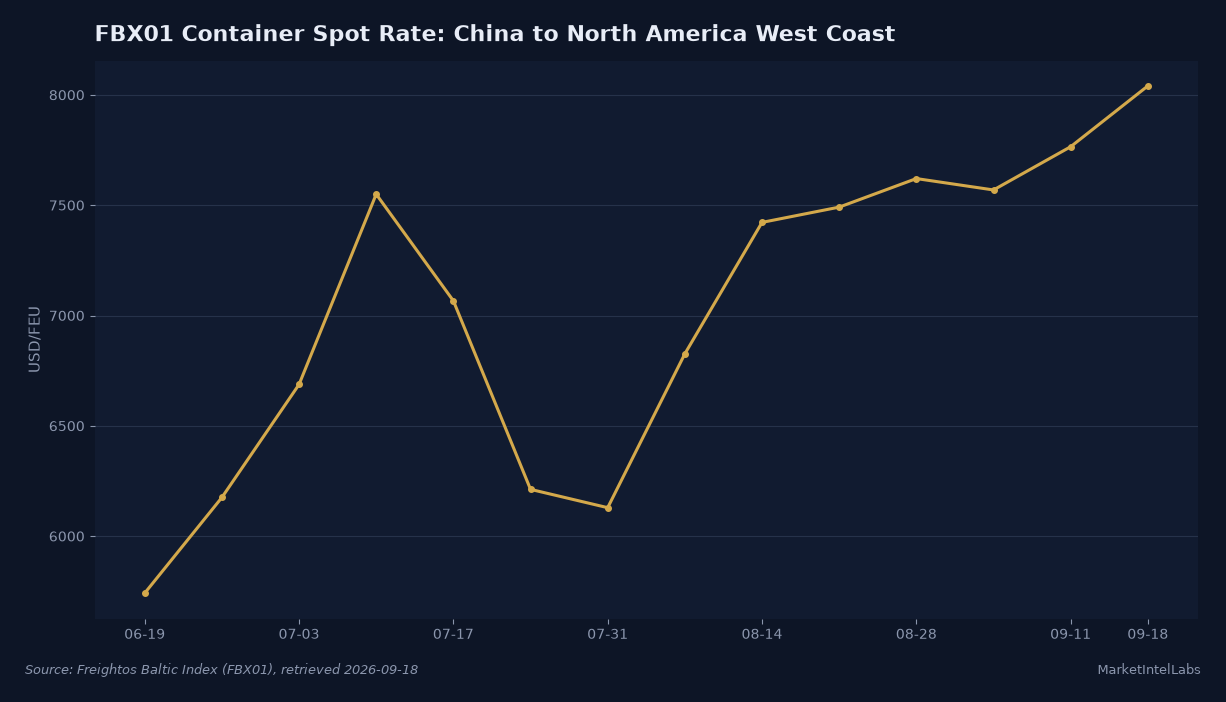
The shape of the climb matters for how long it lasts. The series I pulled shows a first spike into July 10 at $7,549.80, a retreat to $6,129 by July 31 as post-peak demand thinned, and then a second, steadier climb through August and September that has now cleared the July high. Two pushes in one season usually means the second one is underwritten by something firmer than a one-off event. Here the firmer thing is schedule discipline: carriers have kept capacity tight rather than chasing volume, and the blank-sailing count says they intend to keep doing it through the holiday.
Does the demand side agree? The survey evidence says volumes are not booming. ISM's supplier deliveries index has been slowing for months even as inventory growth moderates, which we covered earlier this week. Restocking is happening, but at a measured pace, not a rush. That matters because a rate move carried by genuine cargo demand survives the event that started it, while a rate move carried by withdrawn capacity tends to give the gain back when the ships return. Golden Week ends in early October, and the vessels blanked for next week come back on the water shortly after.
For landed cost, the arithmetic is straightforward. A 40-foot container of consumer goods moving Shanghai to Los Angeles at $8,040.50 carries roughly $400 per FEU of ocean freight per week of climb at the current pace, and the June-to-September move adds about $2,300 per container against what a mid-June booking cost. For a load value of $50,000, freight has gone from about 11 percent of goods value to under 17 percent. Importers on annual contracts are insulated for now; spot-heavy shippers, especially mid-size retailers booking inside 30 days, are the ones paying the difference.
The watch items are dated. Drewry posts its next World Container Index assessment on Thursday, September 24, and the blank-sailing count for that week will show whether the pull-back extends past Golden Week or stops at it. The major West Coast ports release September volumes in mid-October, which will settle whether cargo actually moved or whether carriers simply priced a thinner market higher. If FBX01 prints above $8,500 before the holiday, the squeeze has real cargo behind it. If it rolls over in the first week of October, this was capacity management, and the composite at $3,499 was telling the truth all along.
My read: the climb is real but rented. Carriers bought it with blank sailings and slow steaming through anchorage queues, and the bill comes due when October schedules restore capacity. Shippers with flexibility should book transpacific before September 25 rather than gamble on a post-holiday collapse; the downside case saves less than the upside case costs if the second push continues.
This content is for informational purposes only and does not constitute financial advice. Past performance is not indicative of future results. Consult a qualified financial advisor before making investment decisions.
Get daily intelligence delivered
Create a free account for the Daily Brief every weekday and The Week Ahead every Sunday. No card required.