Diesel Hits $6.29 a Gallon and the Truck Leg Now Sets Landed Cost

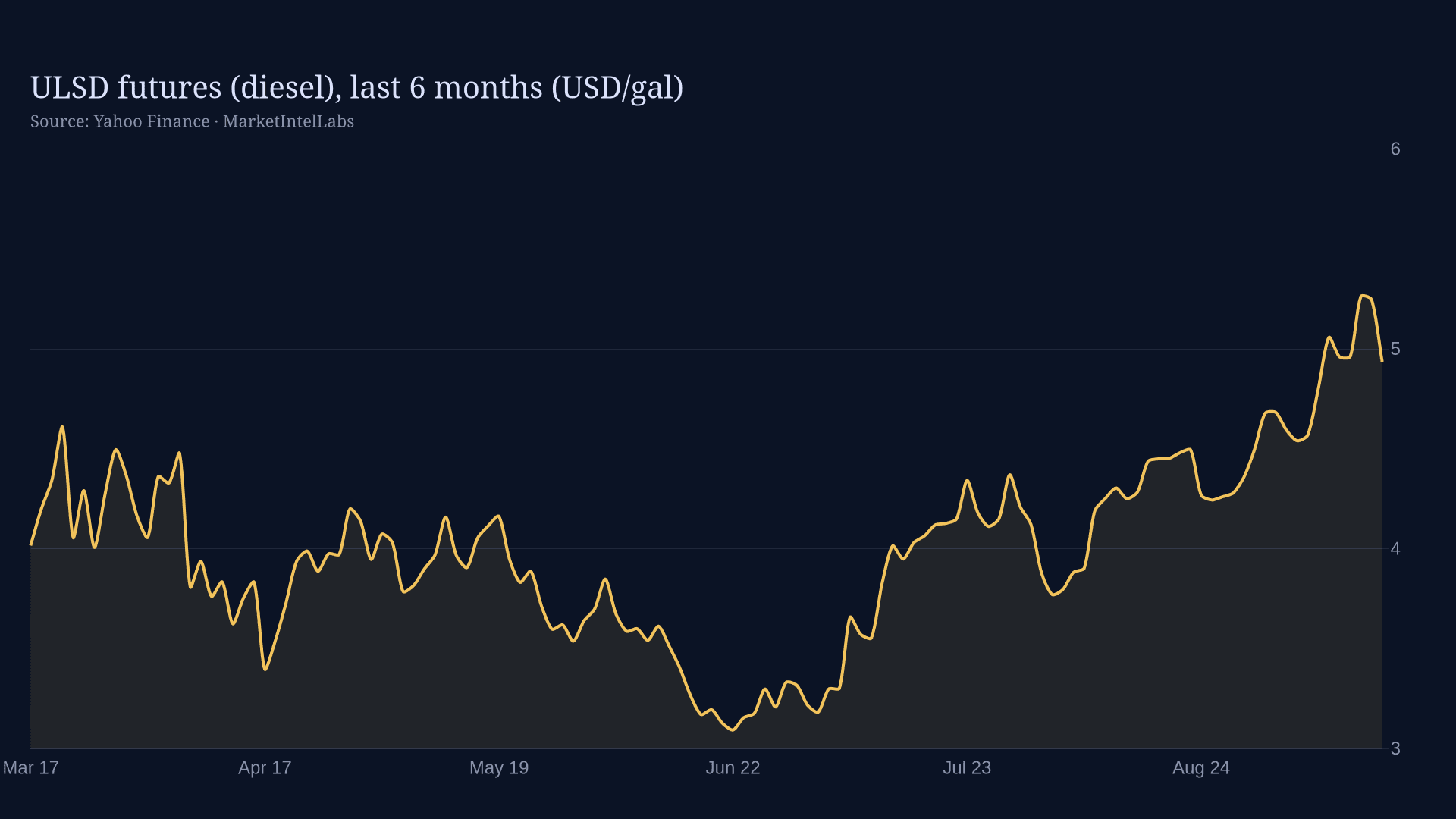
America's trucks are burning the most expensive fuel since early 2024, and that number now matters more to landed cost than anything happening on the water. The EIA weekly on-highway diesel price hit $6.285 per gallon for the week of September 14, per EIA data published via the Federal Reserve's FRED series GASDESW. That is up 31.8 cents from the prior week's $5.967, a 5.3% jump, and up 68% from the $3.739 print for the week of September 15, 2025.
The move is not a one-week blip. EIA's weekly series shows diesel at $5.348 in the week of August 3, then $5.652 by August 24 and $5.967 in the week of September 7 before the latest jump. Six weeks, roughly 94 cents a gallon, close to an 18% rise in the fuel bill for every mile a truck runs. The backdrop is pricey crude, which we track in our crude-oil coverage. For a mode that consumes about 3 billion gallons of diesel a month on highways, per EIA supply data, that is roughly $280 million a week of new cost working through the freight system.
Why fuel, not freight, is the squeeze
Ocean freight is doing the opposite. As our freight-week piece, Freight This Week: Container Rates Slide as Tanker Costs Surge Through Hormuz, flagged, the Freightos Baltic Index composite, the global container rate benchmark, sat at $3,499 per FEU in the latest reading, down 0.61% on the week. Individual lanes are mixed: North Europe to North America (FBX11) fell 2.96% to $4,366 per FEU, and the Mediterranean to North America lane (FBX13) dropped 12.23% to $4,158. So the container leg is cheap and getting cheaper, which is exactly why the truck leg stands out.
Fuel is the largest controllable cost in trucking after driver pay, and it is the fastest to reprice. At the pump the pressure is showing up too, see Gasoline Prices Jump as WTI Near $97 and Hormuz Premium Hits the Pump. Diesel surcharges are typically reset weekly off the EIA index, which means the September 14 print is already flowing into shipper invoices this week. A long-haul truck at roughly 6.5 miles per gallon burns about 1,000 gallons on a Los Angeles to Chicago round trip. At the six-week move of 94 cents, that is an extra $940 per truck per round trip, or close to $310 on the latest weekly jump alone.
The question is pass-through. Freight capacity is loose by most measures of the truckload market, and loose capacity usually means carriers eat fuel costs to hold volume. But surcharges are contractual and mechanical, not negotiated, so fuel inflation lands in shipper cost of goods even when the base linehaul rate stays flat. That is the quiet version of the squeeze: the rate you quote does not move, and the invoice still goes up.
What the surveys say
The ISM Manufacturing Report on Business for August, released September 1, showed supplier deliveries still slowing, the sub-index running below the 50 line that separates slower from faster deliveries, the same cost pressure we flagged in ISM Data Shows Costs Rising Even as Inventory Growth Slows. Slower deliveries plus rising fuel is a familiar combination from 2022, when diesel crossed $5.80 a gallon and supplier delivery times stretched for months. The difference this time is demand: inventory-to-sales ratios, per Census data, have not shown the panic restocking that amplified the 2022 cost shock, so the fuel move should pass through prices without a freight-rate blowoff on top.
Watch the trucking rate proxies over the next two weeks rather than the headline indexes. Cass Freight Index shipments and expenditures both react with a lag, and the expenditures component folds fuel surcharges in directly. If expenditures rise while shipments stay flat, the fuel bill is being passed through, and shippers see it in Q3 cost of goods sold. If expenditures flatten too, carriers are absorbing it, and margins in the sector take the hit instead.
The calendar
The next EIA weekly diesel print arrives Monday, September 21. The August Cass Freight Index and the ATA truck tonnage series for August are the rate-side checks this month, and ISM's next Manufacturing Report on Business is due October 1, where supplier deliveries will either confirm or refute the fuel story in delivery times. Port of Los Angeles September container volumes arrive in mid-October and will show whether import demand gives carriers any pricing room to offset the fuel bill.
One implication ties it together. Ocean rates are doing nothing for the cost outlook, so every cent of the diesel move lands on the truck leg, and trucks carry the last mile of nearly everything a container ships. A 68% year-over-year fuel increase with flat ocean rates means landed-cost inflation is now decided on the highway, not the pier. Shippers with October renewals should assume the surcharge column of their contracts, not the linehaul rate, is where the year's cost story gets written.
This content is for informational purposes only and does not constitute financial advice. Past performance is not indicative of future results. Consult a qualified financial advisor before making investment decisions.
Get daily intelligence delivered
Create a free account for the Daily Brief every weekday and The Week Ahead every Sunday. No card required.