Bitcoin ETF Flows This Week Explained: $700M Out Through Oct 8


Bitcoin ETF flows this week turned negative before Friday's US session: the listed US spot bitcoin products recorded about $700.0 million of net redemptions from October 5 through October 8 in the Farside Investors issuer-by-issuer flow table. That subtotal excludes Friday, whose trading session is still ahead. Fidelity's FBTC accounted for $376.7 million of the withdrawals and ARKB for $207.2 million. The same Coinbase Exchange BTC-USD daily candles put bitcoin's October 8 UTC close at $81,692.79, down from $84,504.88 on October 2. The flow reversal and the price decline occurred together; this dataset cannot establish which caused the other.
The headline figure needs a boundary. Farside's October 7 row lists a $484.9 million outflow, while our earlier account of the October 7 selling and whale accumulation reported a roughly $487 million withdrawal using its then-available feed. This feature uses one consistent Farside snapshot for every daily and issuer comparison. The two figures are not interchangeable without matching their provider, capture time and revisions. Friday's flow is not included; neither is an intraday estimate.
Related reading: Bitcoin Range-Bound Near $63,300 as ETF Flows Turn Negative.
How we got here
The recent change is easier to see by separating completed weeks from this unfinished one. Summing Farside's daily total column gives a $2,385.8 million inflow for September 21-25, followed by $241.1 million for September 28-October 2. Then October 5 brought an $89.8 million outflow, October 6 a $118.8 million inflow, October 7 a $484.9 million outflow and October 8 a $244.1 million outflow. The last four numbers sum to a $700.0 million withdrawal. The preceding five-session weeks and this four-session span are deliberately not labeled as equivalent weekly rates.
For the broader framework, see our bitcoin coverage.
The concentration changed with the direction. IBIT took in $1,157.6 million during September 21-25 and another $450.2 million during September 28-October 2, by adding its daily Farside entries. Across October 5-8 it lost just $21.3 million net: a $69.9 million intake on Monday and $122.0 million on Tuesday were overwhelmed by Wednesday's $207.7 million withdrawal and Thursday's $5.5 million withdrawal. A single issuer's daily swing can make the aggregate look like a change in the entire investor base when the other products are doing something else.
FBTC tells a different story. Its September 21-25 intake was $701.6 million; the following week it lost $167.9 million; by October 5-8 the withdrawal reached $376.7 million. ARKB's comparable totals were $294.7 million in, $25.5 million in and $207.2 million out. These are sums of Farside's displayed, rounded daily observations, so small differences from another provider's published totals should be expected. Our earlier look at September's strong ETF intake is useful background, but this week's mix is not a continuation of that intake.
Issuer detail matters on the two heaviest redemption days. On October 7 IBIT lost $207.7 million, FBTC $105.1 million and ARKB $101.7 million, alongside BITB's $27.6 million outflow and GBTC's $39.3 million outflow. On October 8 the biggest withdrawal moved to FBTC at $197.1 million. IBIT's $5.5 million withdrawal that day was modest by comparison. Franklin's EZBC gained $4.7 million on October 8, an example of why a negative category total does not imply that every fund lost assets.
The price sequence offers another check. Coinbase's UTC daily closes were $80,875.04 on September 18, $84,093.13 on September 25 and $84,504.88 on October 2. October 5 finished at $85,748.96, October 6 at $85,539.77, October 7 at $83,275.06 and October 8 at $81,692.79. Those are exchange spot closes at midnight UTC, not the US ETF closing auction and not an intraday bitcoin high. As a result, the October 8 spot close cannot be mechanically paired with a fund NAV dated October 8 as if their measurement instants were identical.
The reference set has a gap: the retrieved Farside snapshot starts its visible rows on September 21. We can directly calculate two complete prior trading weeks and the current four-day subtotal from that snapshot, not four complete prior weeks. This feature will not fill the earlier two weeks with unverified totals to make the comparison look longer. The historical approval date and product mechanics are independently available in regulator and issuer documents; historical daily flows still need an archived issuer table or a complete dated aggregator extract before additional week totals are publishable.
What an ETF flow counts
A spot bitcoin exchange-traded product holds bitcoin in a trust while its shares trade on a securities exchange. That distinction begins with the SEC investor bulletin on spot crypto ETPs: these spot products are commodity trusts, not investment companies registered under the Investment Company Act of 1940, even when people casually call them ETFs. Shareholders own shares whose value seeks to reflect bitcoin after costs. They do not receive direct custody of the trust's bitcoin.
Most secondary-market trades transfer existing shares between buyers and sellers. A trade in IBIT on an exchange does not, by itself, create new IBIT shares or require the trust to buy fresh bitcoin. Net creations and redemptions are the relevant primary-market events. Authorized participants can assemble or redeem blocks of shares under the fund's operative terms; the trust's holdings and outstanding shares then change. Depending on the product and its approved procedure, settlement may involve cash or bitcoin. That is why a daily flow estimate is not the same thing as the exchange's share-trading volume.
The SEC July 2025 order announcement approved in-kind creation and redemption for crypto ETP shares after the earlier cash-only framework. This is a permission for product structures, not a statement that every daily creation is completed in kind. It also complicates simplistic claims that every dollar of reported ETP inflow becomes an immediate bitcoin purchase on one spot venue. Inventory, financing, hedges, execution timing and product-specific documents matter. The observable claim here is the net reported fund flow, not a tape of exactly when a custodian acquired coins.
An issuer's assets under management are another different measure. If the bitcoin price rises while a trust holds the same amount of bitcoin and has unchanged shares outstanding, the US dollar value of its assets rises without a new share creation. Conversely, a falling market can shrink AUM without a redemption. A genuine net outflow should be interpreted against the creation and redemption data, not inferred from the one-day AUM change. An exchange-traded share can also move at a premium or discount to its net asset value during stressed sessions.
The magnitude of the reported flow is expressed in dollars. To convert a $244.1 million daily withdrawal into a coin amount, one would need the applicable execution prices and product-level timing. Dividing it by a convenient end-of-day bitcoin quote produces only a rough notional, not a verified count of coins sold. Farside's columns are rounded to tenths of a million dollars and are an aggregator's estimates, not a single consolidated SEC tape. Treat its daily table as a consistent lens and consult the issuer's own holdings, outstanding shares and filings when precision changes the conclusion.
This is where the price relationship becomes analytically interesting rather than predictive. An ETF redemption can transmit selling pressure if the basket process results in bitcoin disposal, but the causal chain is not visible in two daily columns. Investors can sell existing ETP shares without a net redemption. Bitcoin also trades globally when US securities exchanges are closed. A price decline could precede redemptions, follow them, reflect other venues, or combine all three. Our previous comparison of bitcoin and ether fund flows showed why even neighboring crypto products can tell different stories on the same date.
The contrasting October 6 and October 7 observations make a useful test case. Tuesday's $118.8 million net fund intake accompanied an $85,539.77 Coinbase UTC close, slightly below Monday's $85,748.96. Wednesday's $484.9 million reported withdrawal accompanied an $83,275.06 close. That combination is consistent with weakening demand, but Tuesday already demonstrates that a positive daily ETP flow does not guarantee a positive daily spot return. A broader liquidity move or a changing discount can dominate the effect an observer hopes to isolate.
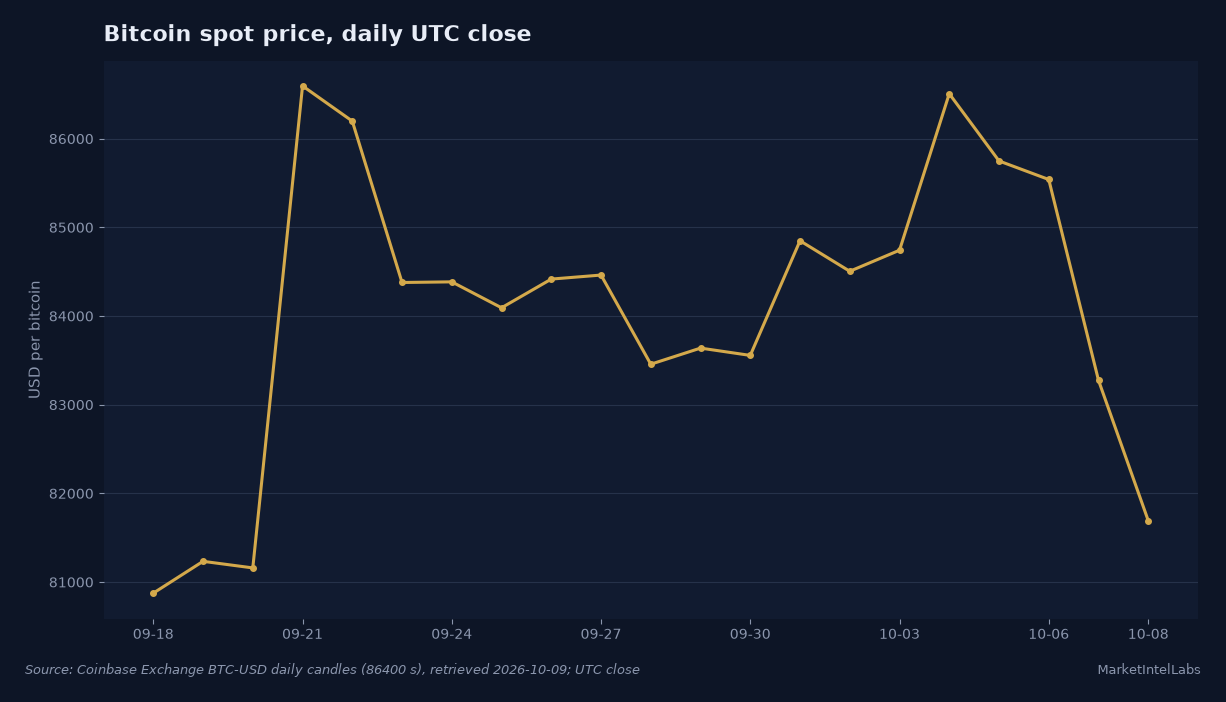
The original chart uses all 21 daily UTC closing observations from September 18 through October 8 returned by Coinbase Exchange. Its first plotted value is $80,875.04 and its last is $81,692.79; within that interval the highest plotted close was $86,594.94. It charts the spot price, not fund flows, because the exchange gives one consistent daily series across that interval while the available Farside snapshot gives only the later portion of the issuer table. Read the chart alongside the dated issuer sums above, not as proof that fund creations set the spot closing price.
What the primary documents say
BlackRock's iShares Bitcoin Trust ETF product page states that IBIT seeks to reflect bitcoin's price and shows a 0.25% sponsor fee. It also says the trust is not registered under the 1940 Act. The fee is a cost charged to the vehicle, not a share of this week's inflows. IBIT's near-flat net figure over October 5-8 should therefore not be confused with a statement that its shares or bitcoin exposure did not change in market value.
The Fidelity Wise Origin Bitcoin Fund page describes FBTC as an exchange-traded way to obtain bitcoin exposure without directly buying bitcoin and warns that its asset may become illiquid and investors can lose their entire investment. Fidelity's fund description establishes the product's purpose, not the Farside flow total. For the $376.7 million October 5-8 FBTC estimate, the source remains Farside's dated table. Separating those attributions prevents an aggregator observation from being passed off as an issuer disclosure.
The ARK 21Shares Bitcoin ETF product page says ARKB tracks a bitcoin pricing benchmark after trust expenses. Its disclosures note that ETF shares trade at a market price that can differ from NAV and that only authorized participants directly redeem large blocks at NAV. That distinction is the missing link in a common misreading of the outflow chart: a retail shareholder selling ARKB to another shareholder may create a market-price move without a primary-market redemption.
Grayscale's Bitcoin Mini Trust ETF product page similarly says shares are acquired and redeemed from the fund only in creation units and may trade above or below NAV. Its BTC ticker also needs care in a fund table: the ticker BTC refers to the Mini Trust, while bitcoin the asset is a different quantity. In the October 5-8 Farside rows, the BTC fund column sums to an $11.0 million outflow. That number is not the overall bitcoin category total and is not a quoted bitcoin price.
The SEC January 2024 approval statement says the Commission approved listing and trading of spot bitcoin ETP shares but did not endorse bitcoin or the products' custody arrangements. Its investor bulletin says bitcoin is highly speculative and stresses the difference between a spot trust and a registered ETF. That official caution fits the evidence in this week's table better than either extreme claim: reported net redemptions are a meaningful measure of primary-market demand, but they are neither a real-time BTC order book nor a forecast.
There is also an asymmetry across products. The Farside snapshot has a $7.8 million October 6 inflow for MSBT, no recorded flows for that fund on October 7 or 8, and a $47.5 million outflow from GBTC over all four sessions. Those smaller entries do not erase the dominant FBTC and ARKB withdrawals. They do show why the category sum is not a referendum on a single sponsor. Product fees, authorized-participant arrangements and existing-holder behavior can differ even though each vehicle points to the same underlying asset.
What comes next
The next dated observation is Friday, October 9. Farside's US issuer rows should be compared only after the trading day and its data update are complete. A Friday inflow larger than $700.0 million would reverse the October 5-8 four-session subtotal; a smaller inflow would reduce but not erase it. This is arithmetic, not a forecast. Watch FBTC and ARKB separately: a rebound concentrated solely in IBIT would not mean the two funds responsible for $583.9 million of withdrawals have reversed course.
The next completed five-session comparison will be the October 5-9 week against September 28-October 2's $241.1 million intake and September 21-25's $2,385.8 million intake, using the same Farside series and its eventual revisions. A clean comparison should specify the table capture time. It should then put the Friday US fund data beside a consistently timed spot series, such as Coinbase's daily UTC closes, without asserting an exact fund-close to spot-close causal match.
The bullish interpretation would strengthen if primary-market creations return across several large issuers while spot prices stabilize, rather than one fund absorbing the category's change. The bearish interpretation would strengthen if FBTC and ARKB continue to redeem and IBIT begins to post sustained withdrawals too. Either scenario can be overturned by broader bitcoin trading or macro liquidity that the fund table does not measure. The October 9 issuer-level close, not an intraday screenshot, is the specific next test.
Frequently Asked Questions
What are bitcoin ETF flows this week?
Farside's US spot bitcoin product table shows about $700.0 million of net outflows from October 5 through October 8, 2026. This four-session subtotal excludes Friday, October 9. FBTC lost $376.7 million and ARKB lost $207.2 million over those four sessions in that same table; figures may be revised by the provider.
Which bitcoin ETFs had the biggest outflows on October 8?
FBTC had the largest withdrawal in Farside's October 8 row at $197.1 million. ARKB followed at $20.3 million and BITB at $17.7 million. The overall category outflow was $244.1 million, which incorporates the positive $4.7 million entry for EZBC as well as the negative issuer entries.
Do bitcoin ETF outflows mean the funds sold bitcoin immediately?
Not necessarily. Net flow is a measure of creations less redemptions, usually reported as a dollar estimate. The SEC in-kind approval allows approved product procedures to settle in bitcoin rather than cash, while fund terms and authorized-participant execution determine the actual path. Ordinary exchange trades of existing shares do not automatically cause a primary-market redemption.
Why can bitcoin fall when ETF inflows are positive?
ETF creation is one source of demand, not the entire bitcoin market. On October 6 Farside recorded a $118.8 million product intake, yet Coinbase's BTC-USD UTC close edged down from $85,748.96 on October 5 to $85,539.77 on October 6. Spot trades, other venues and differences in observation times can outweigh or obscure the effect of the reported fund flow.
Are spot bitcoin ETFs the same as registered mutual funds?
No. The SEC investor bulletin says spot bitcoin ETPs are exchange-traded commodity trusts, not funds registered under the Investment Company Act of 1940. They provide share-based exposure to bitcoin but do not have all the same 1940 Act requirements that apply to registered ETFs and mutual funds.
This content is for informational purposes only and does not constitute financial advice. Past performance is not indicative of future results. Consult a qualified financial advisor before making investment decisions.
Get daily intelligence delivered
Create a free account for the Daily Brief every weekday and The Week Ahead every Sunday. No card required.