Anthropic IPO Explained: What the Debut Means for AI Stocks

Anthropic shares began trading on Nasdaq as ANT on November 19, 2026, after an $83 offering that the company's SEC pricing sheet values at $81.34 billion including shares sold by existing holders. At 1:31 p.m. ET, Nasdaq displayed $96.90 and an open market, with an intraday range of $92.72 to $114.99. That is a traded price, not a closing price. Nasdaq's displayed market capitalization at that reading was about $1.27 trillion. A $2 trillion closing valuation cannot be verified from an intraday screen. The important question for AI stocks is not whether a headline valuation briefly flashed across a screen, but whether Anthropic can turn fast-growing usage into cash after the suppliers of compute, distribution and power take their share.
Our report on the offering and trading start covers the immediate news. Our closer look at the revenue run rate explains the operating claim. This feature asks a separate question: what does a public price for an AI model developer reveal about the payments moving from enterprises to model makers, cloud hosts, chipmakers and the utilities that connect their data centers? First, an essential correction. The $81 billion figure attached to this deal appears twice in circulation, once as an offering value and once as a revenue run rate. Those numbers describe different things and are not interchangeable.
Related reading: AI chip stocks diverge after TSMC record October revenue.
What Anthropic sold, and what the first trade tells us
Anthropic's November 18 issuer announcement set the initial public offering at $83 a share, with 980 million Class A shares offered. The company said 956,351,354 were its own shares and 23,648,646 came from selling shareholders; it will not collect the sellers' proceeds. The same announcement scheduled the stock to begin trading on November 19 and the transaction to close on November 20, subject to normal conditions. A trade on the exchange does not itself mean settlement of the entire offering has occurred.
The SEC-filed issuer free writing prospectus is more precise about the dollar total: $81.34 billion is the base offering's gross size, excluding a possible 147 million share underwriters' option. The company's base shares account for roughly $79.38 billion at the offering price, while about $1.96 billion represents existing holders' sales. These are gross figures, not Anthropic's net cash after fees, and not a forecast of future cash flow. The SEC document separately describes a $26 billion concurrent private placement of Class N shares, contingent on the offering's completion. Folding that private placement into the public IPO total would misstate what the public offering raised.
Related reading: Anthropic S-1 IPO filing: compute costs fall to 55% of revenue as operating loss narrows.
Nasdaq's ANT page identifies the security as Anthropic Class A common stock on its Global Select Market and at 1:31 p.m. ET listed a $96.90 last price against an $83 previous close used as the IPO reference. The exchange displayed a high of $114.99 and a low of $92.72. Such a range establishes that the security traded, but the page's market-cap number is a provider calculation at a particular instant. It must not be described as a settled first-day valuation. An intraday high is not a first close; a price on one listed share class also should not be multiplied casually by an unverified fully diluted share count.
Anthropic's final SEC prospectus describes multiple classes and a concurrent Class N placement. Economic share count, voting rights, option exercise and restricted stock can change which denominator an analyst uses for equity value. Anyone offering a single precise $2 trillion valuation without identifying the price timestamp and share basis has left out half the calculation. At the Nasdaq reading above, its own displayed market cap was about $1.27 trillion. We cannot verify a $2 trillion first close without the closing auction; if a later price reaches such a level, it still needs a dated exchange quote and a stated capitalization basis. Nor does an issuer pricing sheet by itself establish a historical record across every IPO jurisdiction and method. The $81.34 billion base deal is enormous, but the label 'largest ever' needs a defined comparison.
The operating history behind the price
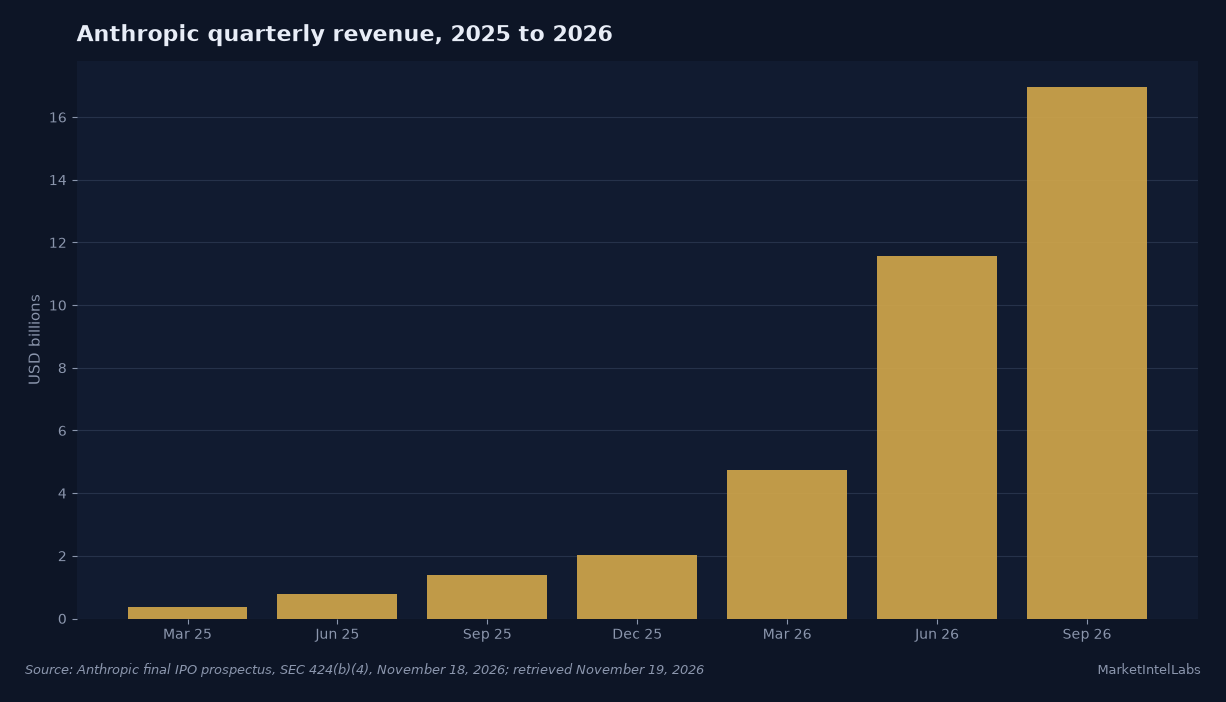
Anthropic's final prospectus gives an unusually clear quarterly revenue sequence. In millions of dollars, its revenue rose from $376 million in the March 2025 quarter to $787 million in June, $1.382 billion in September and $2.040 billion in December. It then reported $4.731 billion for March 2026, $11.555 billion for June and $16.956 billion for September. The chart below plots exactly those seven company-reported quarters. It makes both the scale of the advance and the risk of extrapolating a short series visible: a business that multiplies revenue rapidly still has to finance the capacity required for the next step.
Anthropic's SEC prospectus reports $33.242 billion of revenue for the nine months ended September 30, 2026, compared with $2.545 billion a year earlier. That historical nine-month total is not $81 billion. The filing defines October 31 run-rate revenue as an annualization of the most recent 28 days of consumption-based fees, plus current subscription fees multiplied by twelve; the company reported approximately $81 billion under that definition, up $10 billion from September 30. The measure is useful for tracking current activity but is not booked revenue for a year, not audited annual guidance, and not proof that today's spending repeats indefinitely. Anthropic expressly warns in the prospectus that this metric may not predict future revenue and can include use by customers later restricted under its commercial policies.
The same SEC quarterly table records $9.863 billion of compute and infrastructure expense for September 2026, up from $5.558 billion in June. Operating results swung from a $974 million profit in the June quarter to a $567 million loss in September, despite the higher revenue. This is the core tension in the valuation: a rapid increase in sales can coexist with rising compute, product and distribution costs. Net loss in the prospectus also reflects large changes in the fair value of financing instruments, so it should not be used as a simple proxy for operating cash burn. The operational question is whether each additional dollar of usage leaves more contribution after serving the workload.
Anthropic's prospectus says customers buying through cloud-service-provider marketplaces produced 44% of total revenue in the nine months to September 2026, compared with 47% for 2025. That route brings enterprise customers into the product but makes the developer dependent on cloud partners' distribution terms, payment collection and capacity. The filing says more than 11,900 customers produced at least $100,000 of trailing-twelve-month revenue by September 30, up from more than 950 a year before. That breadth supports the case for real enterprise demand. It does not disclose the marginal profit on each customer's workload, and a customer count is not a renewal rate.
From the enterprise invoice to silicon and grid connection
The economic chain starts when a customer pays for model use or a subscription. Anthropic's prospectus describes a consumption-based business in which use is metered and a separate subscription business. The developer needs inference hardware to serve each request and training capacity to improve its product. Cloud marketplaces can bring customers and bill them, while the underlying facilities buy accelerators, networking, storage and electricity. A rising invoice at the top of that chain is not the same as rising profit at each link.
Microsoft's October 28 fiscal first-quarter earnings call puts a number on the infrastructure response. Chief financial officer Amy Hood said capital expenditures were $45.2 billion, and roughly three quarters went toward shorter-lived assets, principally CPUs and GPUs along with memory and storage. She said some third-party capacity deliveries had slipped; she expected more than $50 billion of spending in the next quarter. These are Microsoft's investments, not Anthropic's expenses, and they cannot simply be added to Anthropic's prospectus compute line. They show what a large cloud operator must commit to before the eventual utilization and price per unit of computing are known.
Nvidia's November 17 fiscal third-quarter release reported $107.6 billion of Data Center revenue, up 110% from a year earlier, and $115.8 billion of total quarterly revenue. Those are Nvidia's reported sales, not a measure of how much hardware Anthropic bought. The release identified cloud providers among deployment partners and projected $130 billion of total fourth-quarter revenue, plus or minus 3%, with an extra week in that quarter. The public-market implication is a test of timing: equipment suppliers book revenue when they deliver under their contracts, while model developers may require several quarters to convert available capacity into durable, profitable customer use.
TSMC's monthly revenue table provides a different link in the same supply chain. It shows consolidated October 2026 revenue of NT$586.890 billion, up 59.7% year over year, after NT$511.857 billion in September and NT$514.806 billion in August. TSMC labels the 2026 monthly figures unaudited. Its table does not attribute those sales to Anthropic or to any one AI customer. Its value here is as an independently dated indicator of fabrication demand and supply-chain scale; treating an entire foundry's monthly revenue as an Anthropic read-through would be a category error.
Between a chip shipment and a customer inference call lies a physical bottleneck: installing machines, bringing cooling and network capacity online, and obtaining reliable electricity. Microsoft's earnings-call discussion of delayed third-party capacity is evidence that scheduled availability can slip even when buyers have budgets. Anthropic's prospectus compute costs are evidence that the model developer pays for capacity as demand grows. Neither source provides a project-by-project power commissioning schedule, so this article does not claim a specific megawatt constraint or grid date. Utility and interconnection filings, rather than AI-market enthusiasm, would be the appropriate documents for a claim about when a particular site gets power.
The result is a useful division of labor for listed AI stocks. Nvidia's release measures one supplier's shipment revenue; TSMC's table measures a manufacturer's consolidated sales; Microsoft's call measures a cloud customer's outlays; Anthropic's prospectus measures the developer's customers and operating costs. A single AI spending cycle can lift all four top lines at different times, yet margins and cash conversion can diverge. This is why a newly quoted ANT price is a benchmark for capital markets, not an automatic re-rating instruction for every semiconductor, cloud or software share.
The bull case, the bear case and the difficult denominator
The stronger case for Anthropic rests on documented growth and customer breadth. Its SEC prospectus shows quarterly revenue rising every quarter in the plotted sequence, more than 11,900 sizable customers at September 30, and approximately $81 billion in its October run-rate measure. If annualized use converts into recognized revenue while the cost of serving each request falls, today's network of distribution partners could widen rather than compress the developer's margin. If costs fall slowly or cloud partners retain more economics, a high sales multiple could contract even while reported sales keep rising. Both paths are plausible; neither follows mechanically from the first-day share price.
The harder case begins in Anthropic's own quarterly results. The September operating loss of $567 million followed a June profit of $974 million while compute and infrastructure expense grew to $9.863 billion. The prospectus warns that results can fluctuate with investment decisions and compute commitments. When capacity is scarce, negotiating leverage may reside with chip and cloud suppliers. When supply catches up, competing model providers may lower prices. Either scenario challenges a valuation that assumes both extraordinary volume growth and durable pricing power.
One shorthand comparison is instructive only with warnings attached. Dividing $2 trillion by Anthropic's approximately $81 billion October annualized run rate yields roughly 24.7 times that operating metric, not a conventional trailing-sales multiple. The $2 trillion numerator is not a verified first close at the time of this writing. Using Nasdaq's then-displayed roughly $1.27 trillion market cap instead produces about 15.7 times the same run rate. Both are point-in-time illustrations, sensitive to price, share count and an annualization methodology; neither is a forecast or a clean comparison with Nvidia's booked sales or Microsoft's consolidated revenue. For a historical-sales lens, Anthropic's prospectus records $33.242 billion over nine months through September, but a nine-month number cannot be placed beside a twelve-month enterprise multiple without identifying the mismatch.
The prospectus's proposed $26 billion Class N placement adds another reason to inspect the cap table rather than the headline. The SEC filing names Advanced Micro Devices, Broadcom, Google, Micron, Microsoft, Nvidia and a TSMC entity among the placement purchasers. A supplier can simultaneously be an investor and a commercial counterparty. The filing does not establish how much future Anthropic procurement each investor will receive, and a funding commitment is not booked customer demand. A dollar can circulate through the ecosystem as investment, capacity payment and later supplier revenue; counting it three times would overstate independent end-market spending.
The search for a 'pure AI' comparison has the same problem. Listed chipmakers sell to many customers beyond one model provider, cloud companies have older businesses and other workloads, and a model developer has its own capital structure and revenue-recognition cycle. A direct multiple comparison requires matching period, accounting definition, margins, net cash and share basis. The public ANT quote is valuable because it gives investors a daily market price for a developer. It does not create a universal price-to-sales rule for the whole supply chain.
What is dated next, and what could change the reading
November 20 is the first contractual date to watch: Anthropic's November 18 pricing release expects the offering to close then, subject to conditions, while its SEC pricing sheet labels November 20 as settlement date. Confirmation of completion would establish the final funding event; it would not prove that the run-rate revenue becomes annual sales. The exchange's official November 19 closing price, when published, will allow a disciplined first-close calculation with an explicit share-count basis. Until then, a timestamped intraday quote is the honest reference.
For operating performance, Anthropic's next public financial filing after the offering will matter more than the debut's high print. Investors should compare booked revenue with the $81 billion October annualization, compute and infrastructure costs with the $9.863 billion September quarter, and operating results with the recent swing from profit to loss. The company has not supplied a verified date for that next results release in the materials reviewed here. Across the supplier chain, Microsoft's next quarter of planned capital spending and Nvidia's fourth-quarter results can test whether reported capacity purchases keep matching the demand implied by the developer's usage. TSMC's next monthly revenue update offers another dated manufacturing observation, but not an Anthropic order book.
What would change the interpretation? A verified first close and a fully specified diluted share count could substantiate or disprove the $2 trillion close claim. Sustained recognized revenue and improving unit economics would strengthen the bull case. Slower paid usage, cloud-marketplace dependence or compute expense growing as fast as revenue would strengthen the bear case. The record offering is a financing fact. The traded ANT quote is a market fact. Whether the customers at the start of this chain ultimately generate enough cash for every company at its end remains the question.
Frequently Asked Questions
Did Anthropic stock start trading on November 19, 2026?
Yes. Nasdaq displayed Anthropic Class A common stock under ANT with an open market and a $96.90 last price at 1:31 p.m. ET on November 19. Anthropic's pricing announcement and SEC pricing sheet both identified November 19 as the scheduled trading date. An intraday trade does not establish the first closing price.
How much did the Anthropic IPO raise?
The SEC-filed pricing sheet states that 980 million Class A shares at $83 made the base public offering $81.34 billion gross, excluding the underwriters' option. Of those shares, 956,351,354 were sold by Anthropic and 23,648,646 by existing holders, according to its November 18 announcement. The company does not receive the holders' proceeds. A contingent $26 billion private placement is separate from the public offering.
Did Anthropic close its first day at a $2 trillion valuation?
Not established at the time of this article. Nasdaq showed trading still open at 1:31 p.m. ET and displayed market capitalization around $1.27 trillion at that reading. A first-day close requires the closing price and an explicitly chosen share-count basis. An intraday high or an unsourced valuation headline cannot replace either.
What does Anthropic's $81 billion revenue run rate mean?
Anthropic's SEC prospectus says the approximately $81 billion October 31 figure annualizes recent consumption fees and current subscriptions under its defined methodology. It is not $81 billion of recognized annual revenue. The prospectus separately reports $33.242 billion of booked revenue in the first nine months of 2026 and warns the annualized measure may not indicate future results.
Does an Anthropic IPO change the outlook for Nvidia and cloud stocks?
It supplies a public market price for a model developer, not a direct forecast for its suppliers. Nvidia's November 17 release reported $107.6 billion of quarterly Data Center revenue, while Microsoft's October 28 earnings call reported $45.2 billion in quarterly capital expenditures. Those numbers describe different companies and stages of the spending chain. The test is whether the developer's paying customers support the hardware, cloud and electricity commitments after costs.
This content is for informational purposes only and does not constitute financial advice. Past performance is not indicative of future results. Consult a qualified financial advisor before making investment decisions.
Get daily intelligence delivered
Create a free account for the Daily Brief every weekday and The Week Ahead every Sunday. No card required.