AI Markets Week: Meta Lifts 2026 Capex Floor to $135 Billion as GPU Debt Tightens

The number that defined the week in AI finance was Meta raising its 2026 capital expenditure floor to $135 billion on October 21, from $130 billion, while its free cash flow ran negative for the quarter. One of the biggest AI spenders lifted its spending commitments into a market that had just started doubting whether all of that capital can be financed. Four days later, SpaceX announced it had closed $40 billion of callable debt to buy graphics processing units, the largest single disclosed GPU raise, and its chief executive warned that lenders have effectively shut off companies whose revenue depends on AI data centers.
Meta's print matters because it lays bare the split inside AI spending. Revenue rose 26% year over year to $64.60 billion, roughly $1.8 billion above the average analyst estimate, and ad volume and pricing both strengthened, according to the company's October 21 release and Reuters. Yet capital expenditures in Q3 pushed free cash flow to negative $2.12 billion, and management guided 2026 capex to $135-145 billion, narrowing the range from $130-145 billion. The company also introduced a new class of non-voting stock, a structure that lets it fund AI spending without diluting the chief executive's voting control.
Related reading: Meta Stock Drops 6% After Lifting 2026 AI Capex Floor to $135 Billion.
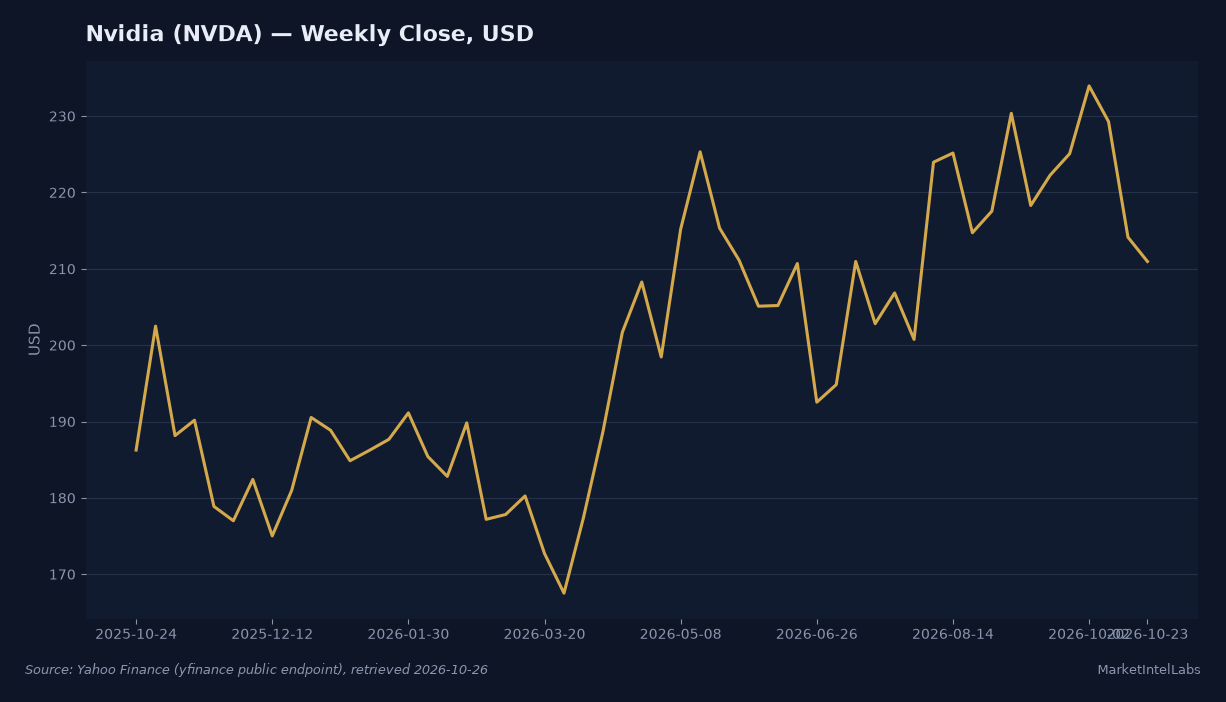
Read the Nvidia chart and the tension shows up in the price. Nvidia closed near $210.96 on October 23, about 6% below the $224.58 it traded a month earlier on September 24, but still 13% above the $186.26 of a year ago. The pullback is not a demand story. It is a financing story. Analysts and investors spent the week asking whether the buildout can keep paying for itself as debt markets get pickier, a question Meta's capex guidance and SpaceX's raise both put in sharper relief.
SpaceX was the clearest signal that the answer has two tracks. On October 25, Musk said in a post on X that SpaceX had closed $40 billion in callable debt for GPU purchases expected to arrive in the first and second quarters of 2027, citing the company's investment-grade rating and revenue from Starlink and launches. He added that debt markets have largely shut off access for any company without substantial revenue independent of AI data centers, and predicted that more than 200 neoclouds would consolidate, with only a small number surviving. The deal was first reported by Bloomberg as a $40 billion raise for Nvidia chips, structured through a special purpose vehicle to keep the debt off SpaceX's balance sheet.
Related reading: SpaceX GPU debt: $40 billion closed for AI chips as Musk warns of a neocloud shakeout.
Weigh the two prints together and the market story is about who can still raise, not whether demand holds. Meta, with its advertised business, and SpaceX, with Starlink and launches, can still command big debt packages. Pure-play neoclouds, companies that lease AI compute and depend on data-center revenue to cover GPU leases, are the ones Musk says are being cut off. The equity half of the ledger moved too: OpenAI raised $30 billion at a $1.4 trillion valuation on October 21, and DeepSeek pulled in a reported $15 billion round on October 22 days after a U.S. federal procurement ban, both covered on our site.
That concentration has an implication for the chip names. If only the biggest, cash-generative buyers can keep financing GPU purchases, demand lands on a narrower list of customers whose orders keep flowing to Nvidia and the equipment suppliers, while the risk moves down the stack to the neoclouds with thin revenue. The near-term pullback in Nvidia and the broader AI complex suggests investors are pricing exactly that split rather than a retreat in aggregate demand.
Related reading: Meta Q3 2026 Earnings: Capex Floor Raised to $135 Billion as New Share Class Funds AI Spend.
What is dated next makes the question concrete. Alphabet and Microsoft report on October 28 and Amazon on October 29, and each will be read primarily for its capex line and how much of it is funded by cash flow versus debt. Nvidia then reports fiscal third-quarter results on November 17, the single biggest test of whether the demand side still justifies the financing. Between the earnings days and the next Federal Reserve decision, the tape is likely to keep trading on who can pay for AI, not whether AI has a buyer.
Related reading: Amazon's Nvidia Financing Talks Meet a $7.6 Billion Cash Flow Gap.
This content is for informational purposes only and does not constitute financial advice. Past performance is not indicative of future results. Consult a qualified financial advisor before making investment decisions.
Get daily intelligence delivered
Create a free account for the Daily Brief every weekday and The Week Ahead every Sunday. No card required.