AI chip stocks log worst week of 2026 as credit costs climb

Nvidia, AMD, Broadcom, TSMC, Micron and Oracle each fell sharply in the week that ended Friday, and the Philadelphia semiconductor index closed lower for an eighth consecutive session, its longest losing streak since 2021. The index ended the week at 11,137.29, down 11.4% on the week and 15.7% from its October 6 close, according to market data cross-checked by this desk's own daily-close pull.
This was a credit story before it was a chip story, and separating the two matters. The trigger ran through CoreWeave, the cloud provider that rents out Nvidia GPUs and carries roughly $50 billion of debt and lease obligations. Its heavily traded bonds fell and the cost of insuring its debt against default climbed past 1,000 basis points this week, from about 547 in late June. Yields on its 2032 notes traded near 15%, levels normally associated with distressed borrowers. The company said its backlog more than supports all of its debt obligations, and Nvidia's chief executive said in Stockholm that CoreWeave's cost of capital is actually decreasing. The market, for the week, did not agree.
Related reading: AI Debt Fears Send Global Chip Stocks Lower as Credit Costs Climb.
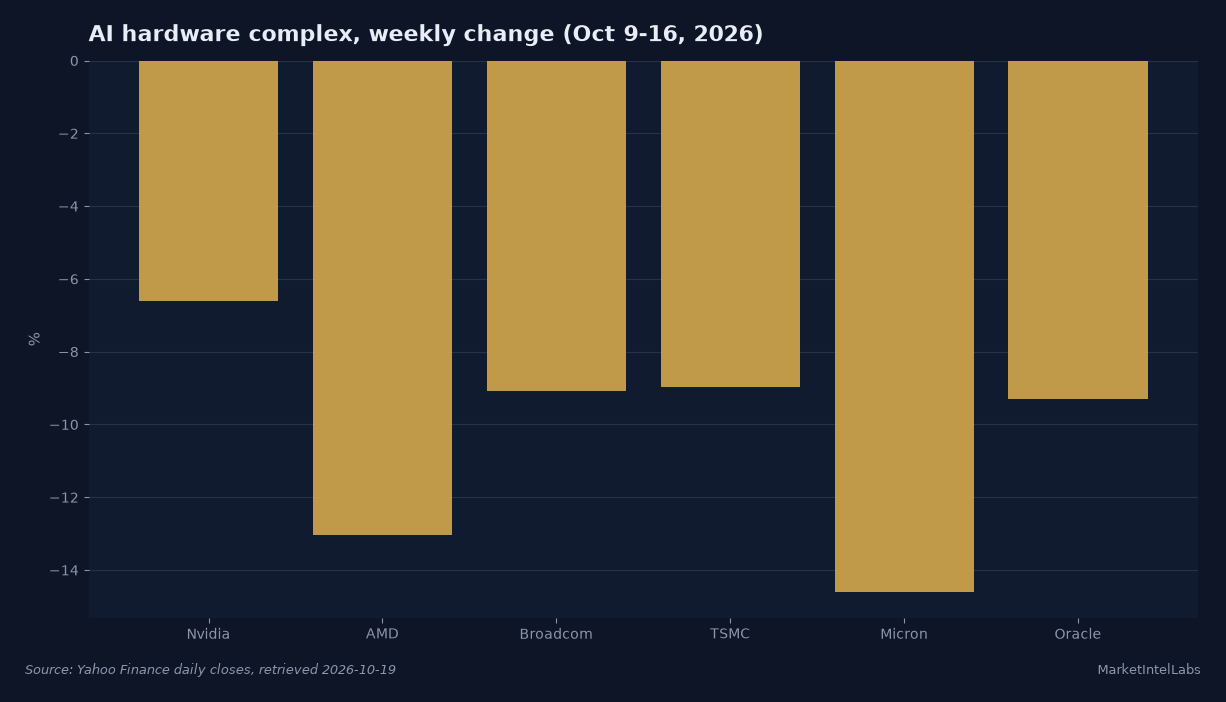
The move was broad. Micron fell 14.6% on the week and has now dropped 15.9% from its October 6 high. AMD lost 13.1%, Oracle 9.3%, Broadcom 9.1% and TSMC 9.0% in its U.S. listing. Even Nvidia, the group's most diversified name, fell 6.6%. Every company in this desk's tracked basket declined more than the S&P 500, which slipped 1.95% on the week. The sell-off extended overseas: South Korea's Kospi fell 7.6% on Thursday and Samsung Electronics tumbled 9.5%, while SK hynix dropped 11.1%.
The comparison points frame how much of this is repricing versus a broken thesis. A year ago, in late October 2025, these names traded materially lower: AMD near $256 versus $528.75 now, Micron near $224 versus $878.84, TSMC near $303 versus $412.61. The PHLX index is still up 57% for the year and sits 23.9% below its June 22 record. Even after this week's damage, the complex is barely off its highs for older investors, which is precisely why credit, not demand, has become the swing variable.
Related reading: AI chip demand: Samsung and Micron results set the bar for TSMC.
The earnings that did land only sharpened the tension. TSMC reported on October 15 a third-quarter revenue of $46.72 billion, up 41.2% from a year earlier in U.S. dollars, raised its 2026 growth outlook to about 44%, and guided fourth-quarter revenue to $52.3 to $54.3 billion. That is an extraordinarily strong demand print. Yet on the call, chairman C.C. Wei said consumer and price-sensitive segments are being challenged by rising component prices and macroeconomic uncertainty, and that the company is being prudent in business planning for 2027. It gave no 2027 growth figure. The gap between a record 2026 guide and a cautious 2027 is the whole debate in one sentence.
Add the macro layer and the repricing has a reason. September CPI, released October 14, came in at 3.7% year over year, above the 3.6% consensus, and the 10-year Treasury yield briefly pushed above 5.3% that morning before easing. Traders raised the odds of a Fed rate hike at the October 27-28 meeting to roughly 44%, up from about 20% before the report, per CME data. Longer-term yields actually fell a touch by Friday's close, so the pressure this week came from the risk premium lenders charge on top of rates, not from the base rate itself. That premium is what a debt-heavy buildout reprices first.
Related reading: AI Infrastructure Debt Repricing: What a 5% 10-Year Does to the Capital Stack.
Related reading: TSMC Gross Margin Guide Faces AI Capacity Cost Test.
Two dated events anchor the week ahead. Lam Research reports its September quarter on Wednesday, October 21, and its commentary on customers' 2027 spending plans will be the first read on whether equipment demand holds. The Federal Reserve meets on October 27-28. Reported prices on CoreWeave's bonds and default insurance, meanwhile, are the cleanest daily gauge of what lenders now demand from debt-funded AI builders. If the gap between record demand prints and a cautious capital stack persists, this week's move is a valuation reset, not an end to the buildout. The data this desk tracks supports that read for now.
Get daily intelligence delivered
Create a free account for the Daily Brief every weekday and The Week Ahead every Sunday. No card required.