SCFI container spot index rebounds to 3,569.54


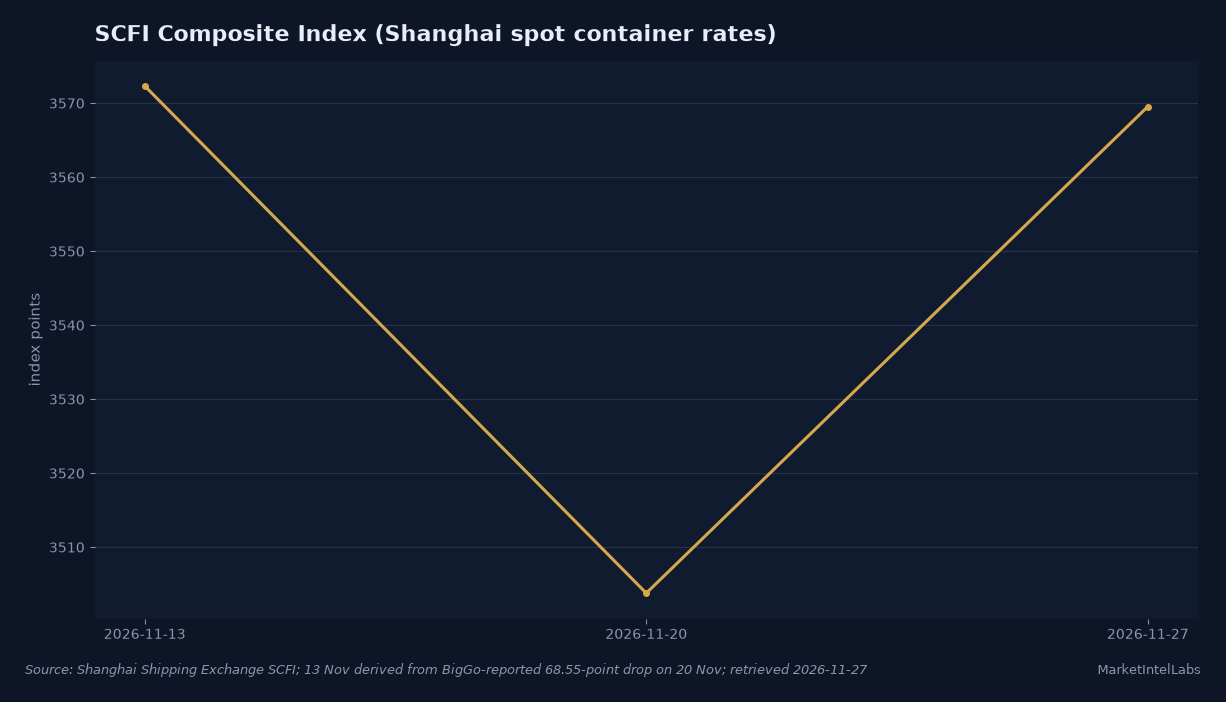
Container spot rates turned higher in Shanghai on Friday. The Shanghai Containerized Freight Index, the exchange's composite measure of export freight costs, rose 65.75 points to 3,569.54, its first weekly gain after three straight weekly declines had taken the index to 3,503.78, the Shanghai Shipping Exchange said.
The reversal is a reshuffle in where strength sits more than a broad recovery. Through the middle of November the transpacific did all the falling in the four major long-haul routes. In the exchange's reading for November 20, the Far East to U.S. East Coast leg dropped 6.5% to $8,776 per 40-foot container, the steepest fall of the group and the move that broke the index below 3,500. The Far East to U.S. West Coast leg fell 5.62% to $6,711 per 40-foot container and lost its $7,000 footing. Europe eased 1.65% to $2,253 per 20-foot container, while the Mediterranean bucked the decline with a 1.63% gain to $3,678.
Related reading: Why did the Drewry World Container Index slide to $4,032?.
The carry came from the Europe and Mediterranean legs, where carriers are filing general rate increases and peak-season surcharges on the Asia-Europe trade ahead of the Lunar New Year factory shutdown. Drewry's World Container Index for the week ended November 26 put Shanghai to Genoa 8% higher at $4,802 per 40-foot container, contract-season pressure now showing up in spot markets. The same assessment still showed the transpacific sliding, with the 19 November reading for Shanghai to Los Angeles at $7,026 and Shanghai to New York at $8,194, their lowest levels in 12 and 15 weeks respectively.
Read the composite with its construction in mind. The Shanghai index blends a fixed basket of export routes, so a move like this week's 65.75 point gain is a weighted picture, not a single lane. Note too that the quoted container size differs by trade: the U.S. corridor legs are quoted per 40-foot container while the Europe and Mediterranean legs are quoted per 20-foot container, a distinction that matters when comparing single-route moves across the same release.
Related reading: SCFI container spot rates slide to 3,503.78, third week down.
For anyone pricing imported goods, the divergence between the corridors is the useful detail, not the composite alone. A rate that firms in Genoa while the Los Angeles leg keeps sliding means shipping-cost pressure is not uniform, and retailers and manufacturers lean differently on each lane. The month ahead will show whether the December general rate increases on the Asia-Europe trade hold in spot markets or, like the planned November 1 increase on the transpacific that did not stick, fade into the new year.
Do not overstate the turn. The composite is one weighted number across a range of trades, and the demand picture underneath it remains soft. The National Retail Federation estimated U.S. imports at about 2.05 million 20-foot equivalent units in November, roughly 14% below the 2.37 million it sized for September, an acknowledgment that the peak holiday restocking has already moved. Spot cargo is easier to book than it was a month ago.
Related reading: Drewry World Container Index: what it is and how to read it.
Carriers are trimming capacity to defend what they can. Drewry's cancelled-sailings tracker counted 42 blanked departures out of 724 scheduled across the major east-west trades for the November 23 to December 27 window, about 6% of sailings, with the transpacific eastbound services accounting for nearly half of the cancellations. Blanking tightens space but has not, so far, reversed the rate trend on the U.S. corridors.
Two risks worth watching sit on the U.S. coast. A labor dispute involving ILWU Local 26 watchmen and security personnel at the ports of Los Angeles and Long Beach threatened disruption in November, but the Pacific Maritime Association and the local reached a tentative agreement on November 21, avoiding the work stoppage for now; the deal still needs union ratification. On the routing side, the Panama Canal Authority advisory A-42-2026, dated November 9, raised total daily booking slots to 34 and the maximum authorized Neopanamax draft to 15.24 metres, easing a transit constraint that has been a quiet overhang for East Coast all-water services.
Related reading: Container spot rates ease as SCFI slips to 3,572, down 1.7% for the week to Nov 13.
Logistics operators quoted by the shipping press expect the correction to run near mid-December, when pre-Lunar New Year restocking could generate a short-term surge that supports rates. The other market to watch is the Europe contract season: how shipping lines and cargo owners settle new-year contract prices and capacity allocations will set the floor for the off-season. The fresh SCFI print lands again next Friday, and the December rate increases on the Asia-Europe trade will show up first in the weekly spot assessments, including this one.
This content is for informational purposes only and does not constitute financial advice.
Get daily intelligence delivered
Create a free account for the Daily Brief every weekday and The Week Ahead every Sunday. No card required.