Polymarket Puts Flavio Bolsonaro at 61 Cents in Brazil While the Polls Say Tie

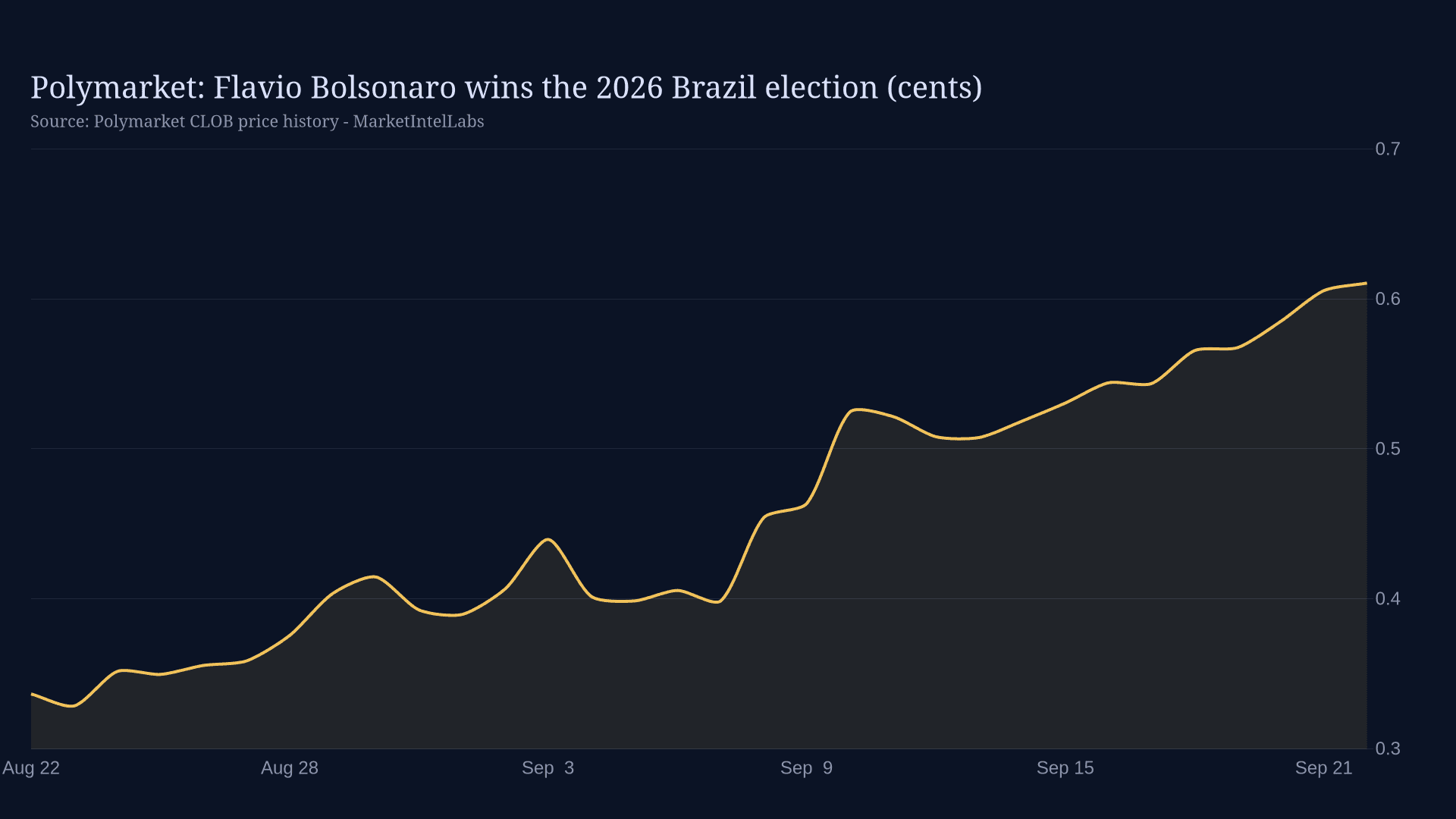
Two numbers sit side by side this week and they do not agree. On Monday, September 21, Polymarket's contract on Flavio Bolsonaro winning Brazil's October 4 presidential election traded at 61 cents, and by Tuesday morning (07:46 UTC, September 22) it held at 60.9 cents, a 21-point climb from the 39.3 cents it closed at on September 1. The same window produced three new polls, from Datafolha, Quaest and BTG Pactual/Nexus, and all three put the first round in a statistical tie: Datafolha had President Luiz Inacio Lula da Silva at 39 percent and Bolsonaro at 36 percent (September 17), Quaest 37 to 33 (September 21), BTG/Nexus 40 to 37 (September 21). The prediction market has been moving in one direction for three weeks while the surveys have barely moved at all.
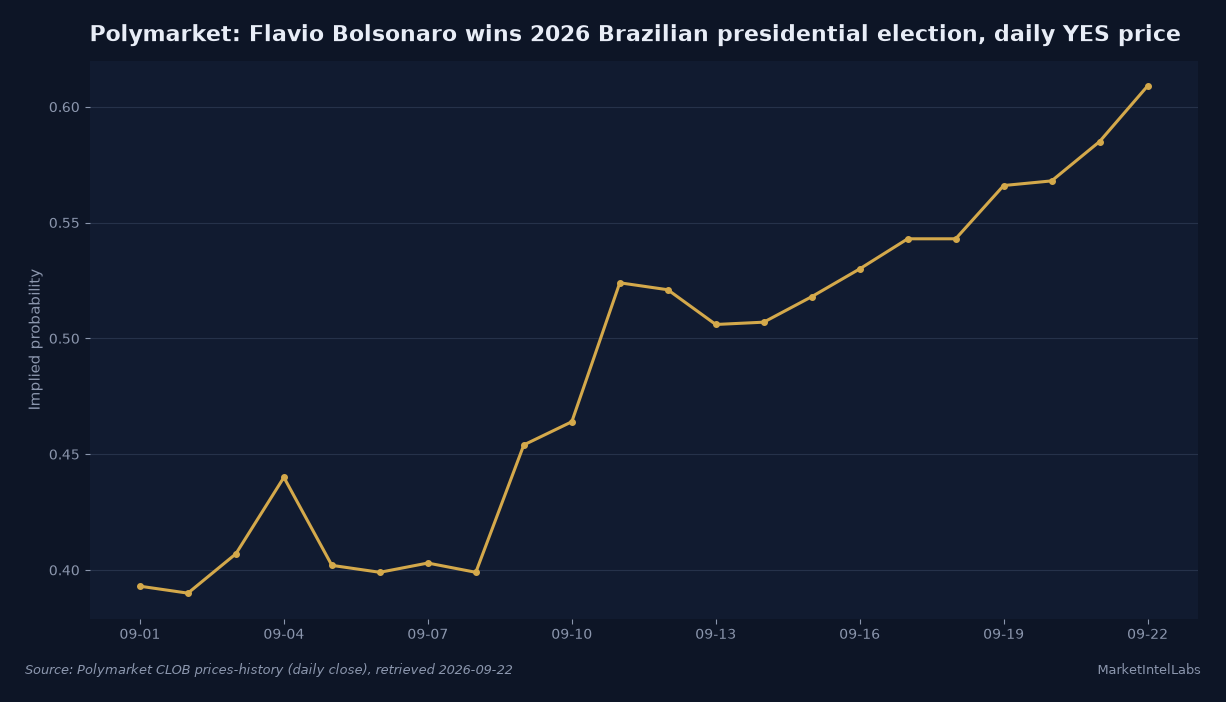
The move has been steady rather than jumpy. Bolsonaro's contract closed at 39.3 cents on September 1, crossed 52 cents on September 11, and printed 58.5 cents on September 21 before touching 60.9 cents early Tuesday. That is 21 probability points in three weeks, on a market carrying more than 11.4 million dollars in cumulative volume and roughly 396,000 dollars in liquidity. Daily volume on the four leading candidate contracts (Bolsonaro, Lula, Geraldo Alckmin and Renan Santos) summed to about 837,000 dollars over the last 24 hours as of the Tuesday pull, which is heavy for a non-US political market and suggests real money is repricing, not a thin book drifting.
The polls, for their part, describe a dead heat. Datafolha's September 17 survey (2,002 voters, September 15 to 16, margin of error 2 points) put Lula at 39 and Bolsonaro at 36 in the first round, and 46 to 44 in a simulated runoff. Quaest's Monday survey for Globo and O Globo (margin of error 2 points) had the first round at 37 to 33 and the runoff at 42 percent Bolsonaro to 41 percent Lula. BTG Pactual/Nexus, fielded September 18 to 20 among 2,006 voters, showed the runoff at 46 to 45 for Lula. Strip out the house effects and the picture is identical across all three: a tie inside the margin of error, with Lula holding a small numerical lead.
So which is off, the market or the surveys? The honest answer is that a divergence this wide, this persistent, is information even when you cannot say which side carries the error. Markets and polls measure different things: a contract price is money committed against a known settlement rule, a poll is a snapshot of stated intent with a sampling error band. Prediction markets have historically absorbed polling averages and added something on top, typically turnout expectations and late-deciding behavior. Here the market's edge over the polls has widened from roughly 5 points on September 1 (Bolsonaro at 39 cents against polls showing him 3 to 5 points behind) to somewhere north of 20 points today. That is no longer a disagreement about the polls' error bars; it is a disagreement about the election's structure.
Two mechanics are worth naming because they do the work the headline number hides. The first is the runoff rule. If no candidate wins a majority of valid votes on October 4, the top two advance to October 25, and Polymarket's question, like the constitution's, is who ultimately wins the presidency, not who leads round one. A market can legitimately price Bolsonaro above 60 cents for the outright win while expecting Lula to lead the first round, because runoff electorates in Brazil have historically tightened toward the right-of-center candidate as second-tier votes reallocate. The polls' runoff numbers (46-44, 41-42, 46-45) are simulated snapshots, and they too sit inside their error bands.
The second mechanic is that the contracts on the individual candidates are complements, not independent prices. Bolsonaro at 60.9 cents implies Lula at roughly 39 cents plus whatever the market assigns to a long-shot (Alckmin trades at 0.15 cents, Santos at 0.95 cents, so effectively nothing). The two prices sum to just under 100 cents with no arbitrage gap, which tells you the divergence is a belief about the two frontrunners' relative chances, not sloppy bookkeeping on one side of the ladder.
The conventional-instrument cross-check is thin here, which is part of the story. Brazil election risk trades in the BRL rates and FX complex rather than anything a retail reader can pull in one line, so the prediction market has no futures strip to argue with; the polls are the only conventional instrument, and they say tie. When the only cross-check agrees with the market's own momentum rather than against it, the market's move deserves the benefit of the doubt on information grounds, even though nobody can yet verify it.
Resolutions
The desk's track-record ledger had no markets due for resolution this week; the covered Fed, CPI and Russia Duma contracts all remain open ahead of their scheduled settlement dates. The most recent resolutions on the books, recorded in last week's coverage of the September FOMC, stand as filed: the Kalshi September rate-above-3.75 percent ladder resolved YES at the September 16 decision, with the above-4.00 and above-4.25 strikes resolving NO, matching the Fed's 25 basis point move to a 3.75 to 4.00 percent target range per the Federal Reserve's September 16 statement.
What resolves next
The calendar is close. Polymarket's Brazil presidential election contracts carry an end date of October 4, 2026, with a runoff extension to October 25 if the first round does not produce a majority. Before that, the October FOMC decision lands October 28 and the September CPI print (the settlement source for the Kalshi CPI strip, which priced the above-0.5 percent monthly strike at 60.5 cents and the above-0.6 strike at 25.5 cents as of Tuesday) arrives October 14. Whichever way Brazil's first round cuts on October 4, the desk will mark these contracts against the certified result and file the resolutions.
This content is for informational purposes only and does not constitute financial advice. Past performance is not indicative of future results. Consult a qualified financial advisor before making investment decisions.
Related Reading
See Polymarket's Duma Seat Ladder Priced 340-354 at 81 Cents. The Count Says 324..
See Prediction markets show Democratic advantage in 2026 House race while Senate remains a tossup.
See Cross-Venue Mispricings in Fed, CPI and Election Markets.
Get daily intelligence delivered
Create a free account for the Daily Brief every weekday and The Week Ahead every Sunday. No card required.